

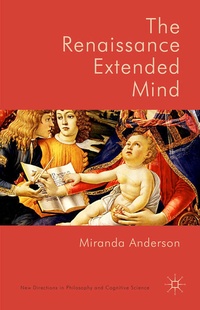
The Renaissance Extended Mind
Published on 8. July 2015
Book
Hardback
XIX, 285 pages
978-1-137-41284-3 (ISBN)
Description
The Renaissance Extended Mind explores the parallels and contrasts between current philosophical notions of the mind as extended across brain, body and world, and analogous notions in literary, philosophical, and scientific texts circulating between the fifteenth century and early-seventeenth century.
Reviews / Votes
More details
Series
Edition
1st ed. 2015
Language
English
Place of publication
London
United Kingdom
Target group
Professional and scholarly
Product notice
sewn/stitched
Cloth over boards
With dust jacket
Illustrations
XIX, 285 p.
Dimensions
Height: 216 mm
Width: 140 mm
Thickness: 18 mm
Weight
494 gr
ISBN-13
978-1-137-41284-3 (9781137412843)
DOI
10.1057/9781137412850
Schweitzer Classification
Other editions
Additional editions
Miranda Anderson
The Renaissance Extended Mind
E-Book
07/2015
1st Edition
Palgrave Macmillan
€96.29
Available for download

Miranda Anderson
The Renaissance Extended Mind
Book
01/2014
Palgrave Macmillan
€85.59
The article will not be published
Person
Miranda Anderson is a literary scholar at the University of Edinburgh. She is the initiator of, and a Research Fellow on, the AHRC-funded project, A History of Distributed Cognition. She received a Leverhulme Early Career Fellowship for work on this book and was a Research Associate on the Balzan Project, based at St John's College, Oxford University. Dr Anderson combines specialization in Renaissance literary, philosophical and scientific texts, with a broader interest in investigating paradigms of the mind and self across historical and disciplinary boundaries.
Content
1. The Extended Mind
2. Extending Literary Theory and the Psychoanalytic Tradition
3. Renaissance Subjects: Ensouled and Embodied
4. Renaissance Language and Memory Forms
5. Renaissance Intrasubjectivity and Intersubjectivity
6. Shakespeare: Natural-Born Mirrors
7. Shakespeare: Perspectives and Words of Glass
Epilogue
2. Extending Literary Theory and the Psychoanalytic Tradition
3. Renaissance Subjects: Ensouled and Embodied
4. Renaissance Language and Memory Forms
5. Renaissance Intrasubjectivity and Intersubjectivity
6. Shakespeare: Natural-Born Mirrors
7. Shakespeare: Perspectives and Words of Glass
Epilogue