

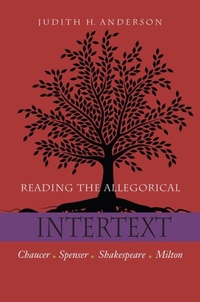
Reading the Allegorical Intertext
Chaucer, Spenser, Shakespeare, Milton
Published on 15. May 2008
Book
Hardback
452 pages
978-0-8232-2847-8 (ISBN)
Description
Judith H. Anderson conceives the intertext as a relation between or among texts that encompasses both Kristevan intertextuality and traditional relationships of influence, imitation, allusion, and citation. Like the Internet, the intertext is a state, or place, of potential expressed in ways ranging from deliberate emulation to linguistic free play. Relatedly, the intertext is also a convenient fiction that enables examination of individual agency and sociocultural determinism. Anderson's intertext is allegorical because Spenser's Faerie Queene is pivotal to her study and because allegory, understood as continued or moving metaphor, encapsulates, even as it magnifies, the process of signification. Her title signals the variousness of an intertext extending from Chaucer through Shakespeare to Milton and the breadth of allegory itself. Literary allegory, in Anderson's view, is at once a mimetic form and a psychic one-a process thinking that combines mind with matter, emblem with narrative, abstraction with history.
Anderson's first section focuses on relations between Chaucer's Canterbury Tales and Spenser's The Faerie Queene, including the role of the narrator, the nature of the textual source, the dynamics of influence, and the bearing of allegorical narrative on lyric vision. The second centers on agency and cultural influence in a variety of Spenserian and medieval texts. Allegorical form, a recurrent concern throughout, becomes the pressing issue of section three. This section treats plays and poems of Shakespeare and Milton and includes two intertextually relevant essays on Spenser.
How Paradise Lost or Shakespeare's plays participate in allegorical form is controversial. Spenser's experiments with allegory revise its form, and this intervention is largely what Shakespeare and Milton find in his poetry and develop. Anderson's book, the result of decades of teaching and writing about allegory, especially Spenserian allegory, will reorient thinking about fundamental critical issues and the landmark texts in which they play themselves out.
Anderson's first section focuses on relations between Chaucer's Canterbury Tales and Spenser's The Faerie Queene, including the role of the narrator, the nature of the textual source, the dynamics of influence, and the bearing of allegorical narrative on lyric vision. The second centers on agency and cultural influence in a variety of Spenserian and medieval texts. Allegorical form, a recurrent concern throughout, becomes the pressing issue of section three. This section treats plays and poems of Shakespeare and Milton and includes two intertextually relevant essays on Spenser.
How Paradise Lost or Shakespeare's plays participate in allegorical form is controversial. Spenser's experiments with allegory revise its form, and this intervention is largely what Shakespeare and Milton find in his poetry and develop. Anderson's book, the result of decades of teaching and writing about allegory, especially Spenserian allegory, will reorient thinking about fundamental critical issues and the landmark texts in which they play themselves out.
Reviews / Votes
"A first-rate scholar-critic at the peak of her form." -- -William J. Kennedy Cornell University "A collection of essays written over a distinguished critic's career..." -Studies in English Literature "Reading the Allegorical Intertext gives rich attention to its four authors-Chaucer, Spenser, Shakespeare, and Milton-although Spenser, who plays a major part in seventeen of the nineteen chapters, remains at the heart of the book." -Shakespeare Quarterly "...an impressive collection of seventeen of Judith Anderson's previously published articles..." -Renaissance Quarterly "A landmark contribution to work on the epochal transformations of medieval into Renaissance and early modern writing cultures." -- -Theresa Krier Macalester College "Exemplary. Anderson is patient but never dull as she sifts the textural and historical evidence out of which her readings are constructed." -- -David Lee Miller University of South CarolinaMore details
Language
English
Place of publication
New York
United States
Target group
Professional and scholarly
Product notice
Cloth over boards
Dimensions
Height: 235 mm
Width: 157 mm
Thickness: 31 mm
Weight
877 gr
ISBN-13
978-0-8232-2847-8 (9780823228478)
Copyright in bibliographic data and cover images is held by Nielsen Book Services Limited or by the publishers or by their respective licensors: all rights reserved.
Schweitzer Classification
Other editions
Additional editions
E-Book
12/2010
1st Edition
Fordham University Press
€39.49
Available for download
E-Book
12/2010
1st Edition
Fordham University Press
€36.99
Available for download
Person
Judith H. Anderson is Chancellor's Professor of English Emeritus at Indiana University. Her books include Words That Matter: Linguistic Perception in Renaissance English; Translating Investments: Metaphor and the Dynamic of Cultural Change in Tudor-Stuart England (Fordham); and Reading the Allegorical Intertext: Chaucer, Spenser, Shakespeare, Milton (Fordham).