

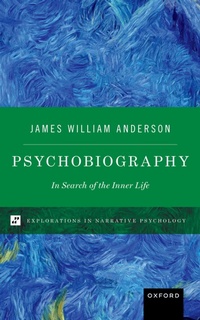
Psychobiography
In Search of the Inner Life
Published on 18. December 2024
Book
Hardback
280 pages
978-0-19-760209-6 (ISBN)
Description
Biographies are at their best when they convey that the subject is a three-dimensional human being who possesses an inner life. Psychobiography: In Search of the Inner Life offers tools for using psychological approaches when writing biography.. A leader in the field, James William Anderson, analyzes the effective use of psychology and what can go wrong, such as treating the biographical subject reductively, and failing to account for both historical and cultural context. Anderson recommends using psychology to open up, not close down; to provide new questions, not easy answers; to complicate, not simplify.
His lively inquiry into the art of biography--with its vignettes about people such as Oprah Winfrey, Abraham Lincoln, Woodrow Wilson, Henry James, Simone de Beauvoir, Edith Wharton, and Anais Nin--will appeal to all readers who are curious about the lives of fascinating personages.
His lively inquiry into the art of biography--with its vignettes about people such as Oprah Winfrey, Abraham Lincoln, Woodrow Wilson, Henry James, Simone de Beauvoir, Edith Wharton, and Anais Nin--will appeal to all readers who are curious about the lives of fascinating personages.
Reviews / Votes
A terrific exposition of a complex field. I'm frankly stunned by the range of examples James Anderson uses-and the detail and richness of the various points made along the way. It's clear he's spent an intellectual lifetime mastering this domain. The prose is crisp and bright; the readings of people astute. Buy this book! * William Todd Schultz, Professor of Psychology, Pacific University * Anyone interested in the synergy between individual psychology, culture, and the historical moment should read this engaging meditation on psychohistory. With examples as diverse as Abraham Lincoln, Edith Wharton, and Donald Trump, Anderson explores how personal psychologies interact with context and era. Because his writing is open-hearted, lively, and utterly unpretentious, he has produced a real page-turner for readers who are fascinated by the reciprocal intersections among personality, creativity, literature, and politics. * Nancy McWilliams, Visiting Professor, Rutgers University * Biographies and their first cousin, memoirs, cascade around us. Most fail the smell test of intellectual or psychological authenticity. James Anderson, in this excellent and welcome book, provides valuable criteria for evaluating studies that probe the self. That is no mean feat. It was once the case that the world scorned psychobiography. Now everyone does it on the sly. We need the wise counsel of James Anderson to guide the perplexed. * Charles B. Strozier, Professor of History, Graduate Center of the City University of New York * As James Anderson suggests, it is time for an up-to-date book on the use of psychology in biography. He has provided a great one. It is both engaging and informative. It will prove an invaluable resource to both writers and readers of biography. * Alan C. Elms, Professor of Psychology, University of California, Davis * James Anderson's book makes a compelling case for the revitalization of psychobiography, a genre that has sometimes been accused of formulaic applications of dogmatic psychoanalytic concepts. By contrast, Anderson's wide-ranging study counsels the use of contemporary, post-Freudian theory, sensitivity to culture, and understanding of authors' relationships with the people they write about. The result is an approach that gets at the complexities of inner life. Among many contributions to the understanding of culture, Psychobiography: In Seach of the Inner Life offers valuable insights into literary artists and the psychodynamics of creativity. * Maud Ellmann, Professor of English Literature, University of Chicago *More details
Series
Language
English
Place of publication
New York
United States
Target group
Professional and scholarly
Product notice
sewn/stitched
Cloth over boards
Dimensions
Height: 244 mm
Width: 167 mm
Thickness: 24 mm
Weight
562 gr
ISBN-13
978-0-19-760209-6 (9780197602096)
Copyright in bibliographic data and cover images is held by Nielsen Book Services Limited or by the publishers or by their respective licensors: all rights reserved.
Schweitzer Classification
Other editions
Additional editions
E-Book
10/2024
OUP eBook
€45.99
Available for download
E-Book
10/2024
OUP eBook
€45.99
Available for download
Person
James William Anderson is Professor of Clinical Psychiatry and Behavioral Sciences at Northwestern University. There he teaches courses on Personality Psychology and the Psychology of Film. He also serves on the faculty of the Chicago Psychoanalytic Institute. He received degrees from Princeton University, Harvard University, and the University of Chicago. For several decades, as a licensed clinical psychologist, he has conducted psychotherapy. In his research, he focuses on psychobiography and has published pieces on William and Henry James, Abraham Lincoln, Edith Wharton, Sigmund Freud, Anna Freud, D. W. Winnicott, Woodrow Wilson, and Frank Lloyd Wright.
Content
Chapter 1 Introduction: In Search of the Inner Life
Chapter 2 Research, the Foundation of Psychobiography
Chapter 3 Research Materials of Special Value to the Psychobiographer
Chapter 4 The Relationship of Psychobiographers with Their Subjects
Chapter 5 The Relevance of Culture to Psychobiography
Chapter 6 Use Psychological Theory, Don't Let It Use You
Chapter 7 Narrative Identity for Psychobiographers (written with Dan P. McAdams)
Chapter 8 Analysis and Interpretation in Psychobiography
Chapter 9 Psychobiography of Literary Artists
Chapter 10 Executing Psychobiography: The Case of William and Henry James
Chapter 11 Why Might a Psychobiography Go Wrong?
References
Index
Chapter 2 Research, the Foundation of Psychobiography
Chapter 3 Research Materials of Special Value to the Psychobiographer
Chapter 4 The Relationship of Psychobiographers with Their Subjects
Chapter 5 The Relevance of Culture to Psychobiography
Chapter 6 Use Psychological Theory, Don't Let It Use You
Chapter 7 Narrative Identity for Psychobiographers (written with Dan P. McAdams)
Chapter 8 Analysis and Interpretation in Psychobiography
Chapter 9 Psychobiography of Literary Artists
Chapter 10 Executing Psychobiography: The Case of William and Henry James
Chapter 11 Why Might a Psychobiography Go Wrong?
References
Index