


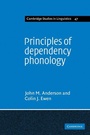
Principles of Dependency Phonology
Published on 13. August 1987
Book
Hardback
324 pages
978-0-521-32313-0 (ISBN)
Description
John Anderson and Colin Ewen, two of the most notable exponents of 'dependency phonology', present in this book a detailed account of this integrated model for the representational of segmental and suprasegmental structure in phonology. Dependency phonology departs from traditional 'linear' models of phonology, and the more recent non-linear models of autosegmental and metrical phonology, in several respects. Unlike in these models, suprasegmental structure is derived directly from the segmental representations, and these representations are based on single-valued features, or components (rather than Chomsky and Halle-type binary features), linked by the dependency relation to form suprasegmental structures, with the exact nature of the dependency relations being directly determined by the properties of the segmental structure. Phonology is currently noteworthy for the diversity of views within the discipline, but no linguist or phonetician with a serious interest in phonology can afford to ignore this book or fail to be interested by it.
More details
Series
Language
English
Place of publication
Cambridge
United Kingdom
Target group
College/higher education
Dimensions
Height: 228 mm
Width: 152 mm
Thickness: 25 mm
Weight
622 gr
ISBN-13
978-0-521-32313-0 (9780521323130)
Copyright in bibliographic data is held by Nielsen Book Services Limited or its licensors: all rights reserved.
Schweitzer Classification
Other editions
New editions
John Mathieson Anderson | Colin J. Ewen
Principles of Dependency Phonology
Book
06/2009
Cambridge University Press
€52.10
Shipment within 15-20 days
Additional editions
John Mathieson Anderson | Colin J. Ewen
Principles of Dependency Phonology
Book
06/2009
Cambridge University Press
€52.10
Shipment within 15-20 days
Content
Part I. Phonological Structure: 1. The structure of phonological segments; 2. The structure of phonological sequences; 3. Dependency structures in phonology; Part II. Phonological Gestures and their Structure: 4. The categorical gesture: phonation; 5. The categorical gesture: initiation; 6. The articulatory gesture; Part III. Overview: 7. Conclusions and consequences.