

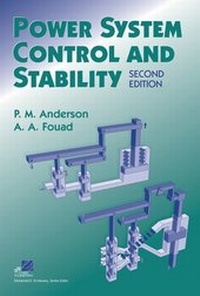
Power System Control and Stability
2nd Edition
Published on 29. October 2002
Book
Hardback
672 pages
978-0-471-23862-1 (ISBN)
Description
Analyzes the dynamic performance of interconnected power systems.
* Examines the characteristics of the various components of a power system during normal operating conditions and during disturbances.
* Explores the detailed mathematical models of system components and analyzes the system behavior using the necessary computational tools.
* Examines the characteristics of the various components of a power system during normal operating conditions and during disturbances.
* Explores the detailed mathematical models of system components and analyzes the system behavior using the necessary computational tools.
Reviews / Votes
"...updating a work first published more than 25 years ago, this book was written for both electric utility engineers and 'advanced students'...each chapter includes a set of problems..." (Electrical Apparatus, January 2003)More details
Edition
2. Auflage
Language
English
Place of publication
United States
Publishing group
John Wiley & Sons Inc
Target group
College/higher education
Professional and scholarly
Edition type
New edition
Dimensions
Height: 25.9 cm
Width: 18.4 cm
Thickness: 3.6 cm
Weight
1332 gr
ISBN-13
978-0-471-23862-1 (9780471238621)
Schweitzer Classification
Other editions
New editions
Vijay Vittal | James D. McCalley | Paul M. Anderson
Power System Control and Stability
Book
11/2019
3rd Edition
Wiley-IEEE Press
€164.59
Shipment within 15-20 days
Previous edition

Paul Anderson | A.A. Fouad
Power System Control and Stability
Book
08/1993
Wiley
€111.00
Article exhausted; check for reprint
Persons
PAUL M. ANDERSON has over forty years of experience in power system engineering and research, power education, technical writing, and research management. His areas of interest are power system analysis, computer applications, and system dynamic performance. Currently a consultant, Dr. Anderson served as a professor of engineering at Iowa State University, Arizona State University, and Washington State University, where he was the Schweitzer Visiting Professor.
A. A. Fouad is Distinguished Professor Emeritus of Engineering at Iowa State University. He has had more than 40 years experience in power system dynamics in teaching, research, and in industry. He is a fellow of IEEE, and is the recipient of the 1993 IEEE Power Engineering Educator Award, and the 1994 IEEE Herman Halperin Transmission and Distribution Award. In 1996 he was elected to membership of the US National Academy of Engineering.
A. A. Fouad is Distinguished Professor Emeritus of Engineering at Iowa State University. He has had more than 40 years experience in power system dynamics in teaching, research, and in industry. He is a fellow of IEEE, and is the recipient of the 1993 IEEE Power Engineering Educator Award, and the 1994 IEEE Herman Halperin Transmission and Distribution Award. In 1996 he was elected to membership of the US National Academy of Engineering.
Content
Preface. Part I: Introduction.
Chapter 1: Power System Stability.
Chapter 2: The Elementary Mathematical Model.
Chapter 3: System Response to Small Disturbances.
Part II: The Electromagnetic Torque.
Chapter 4: The Synchronous Machine.
Chapter 5: The Simulation of Synchronous Machines.
Chapter 6: Linear Models of the Synchronous Machine.
Chapter 7: Excitation Systems.
Chapter 8: Effect of Excitation on Stability.
Chapter 9: Multimachine Systems with Constant Impedance Loads.
Part III: The Mechanical Torque Power System Control and Stability.
Chapter 10: Speed Governing.
Chapter 11: Steam Turbine Prime Movers.
Chapter 12: Hydraulic Turbine Prime Movers.
Chapter 13: Combustion Turbine and Combined-Cycle Power Plants.
Appendix A: Trigonometric Identities for Three-Phase Systems.
Appendix B: Some Computer Methods for Solving Differential Equations.
Appendix C: Normalization.
Appendix D: Typical System Data.
Appendix E: Excitation Control System Definitions.
Appendix F: Control System Components.
Appendix G: Pressure Control Systems.
Appendix H: The Governor Equations.
Appendix I: Wave Equations for a Hydraulic Conduit.
Appendix J: Hydraulic Servomotors.
Index.
Chapter 1: Power System Stability.
Chapter 2: The Elementary Mathematical Model.
Chapter 3: System Response to Small Disturbances.
Part II: The Electromagnetic Torque.
Chapter 4: The Synchronous Machine.
Chapter 5: The Simulation of Synchronous Machines.
Chapter 6: Linear Models of the Synchronous Machine.
Chapter 7: Excitation Systems.
Chapter 8: Effect of Excitation on Stability.
Chapter 9: Multimachine Systems with Constant Impedance Loads.
Part III: The Mechanical Torque Power System Control and Stability.
Chapter 10: Speed Governing.
Chapter 11: Steam Turbine Prime Movers.
Chapter 12: Hydraulic Turbine Prime Movers.
Chapter 13: Combustion Turbine and Combined-Cycle Power Plants.
Appendix A: Trigonometric Identities for Three-Phase Systems.
Appendix B: Some Computer Methods for Solving Differential Equations.
Appendix C: Normalization.
Appendix D: Typical System Data.
Appendix E: Excitation Control System Definitions.
Appendix F: Control System Components.
Appendix G: Pressure Control Systems.
Appendix H: The Governor Equations.
Appendix I: Wave Equations for a Hydraulic Conduit.
Appendix J: Hydraulic Servomotors.
Index.