

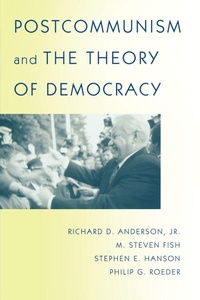
Postcommunism and the Theory of Democracy
Will be published approx. on 2. December 2001
Book
Paperback/Softback
216 pages
978-0-691-08917-1 (ISBN)
Description
Why did the wave of democracy that swept the former Soviet Union and Eastern Europe starting more than a decade ago develop in ways unexpected by observers who relied on existing theories of democracy? In Postcommunism and the Theory of Democracy, four distinguished scholars conduct the first major assessment of democratization theory in light of the experience of postcommunist states. Richard Anderson, Steven Fish, Stephen Hanson, and Philip Roeder not only apply theory to practice, but using a wealth of empirical evidence, draw together the elements of existing theory into new syntheses. The authors each highlight a development in postcommunist societies that reveals an anomaly or lacuna in existing theory. They explain why authoritarian leaders abandon authoritarianism, why democratization sometimes reverses course, how subjects become citizens by beginning to take sides in politics, how rulers become politicians by beginning to seek popular support, and not least, how democracy becomes consolidated. Rather than converging on a single approach, each author shows how either a rationalist, institutionalist, discursive, or Weberian approach sheds light on this transformation.
They conclude that the experience of postcommunist democracy demands a rethinking of existing theory. To that end, they offer rich new insights to scholars, advanced students, policymakers, and anyone interested in postcommunist states or in comparative democratization.
They conclude that the experience of postcommunist democracy demands a rethinking of existing theory. To that end, they offer rich new insights to scholars, advanced students, policymakers, and anyone interested in postcommunist states or in comparative democratization.
Reviews / Votes
"This work will be central to anyone studying the region and democratization in general."--ChoiceMore details
Language
English
Place of publication
New Jersey
United States
Target group
Professional and scholarly
College/higher education
Product notice
Paperback (trade)
Illustrations
13 tables, 2 line illus.
Dimensions
Height: 234 mm
Width: 156 mm
Thickness: 12 mm
Weight
336 gr
ISBN-13
978-0-691-08917-1 (9780691089171)
Copyright in bibliographic data and cover images is held by Nielsen Book Services Limited or by the publishers or by their respective licensors: all rights reserved.
Schweitzer Classification
Other editions
Additional editions
Richard D. Anderson | M. Steven Fish | Stephen E. Hanson
Postcommunism and the Theory of Democracy
E-Book
07/2021
1st Edition
Princeton University Press
€53.99
Available for download
Persons
Richard D. Anderson, Jr., is Associate Professor of Political Science at the University of California, Los Angeles, where he is also active in Communication Studies. He is the author of Public Politics in an Authoritarian State: Making Foreign Policy in the Brezhnev Years. M. Steven Fish is Associate Professor of Political Science at the University of California, Berkeley. He is the author of Democracy from Scratch: Opposition and Regime in the New Russian Revolution (Princeton). Stephen E. Hanson is Associate Professor of Political Science at the University of Washington and Director of the Russian, East European, and Central Asian Studies Program of the Jackson School of International Studies. He is the author of Time and Revolution: Marxism and the Design of Soviet Institutions and coeditor of Can Europe Work? Germany and the Reconstruction of Postcommunist Societies. Philip G. Roeder is Associate Professor of Political Science at the University of California, San Diego. He is the author of Red Sunset: The Failure of Soviet Politics (Princeton).
Content
CONTRIBUTORS vii LIST OF TABLES AND FIGURES ix ACKNOWLEDGMENTS xi ONE: Introduction by George W. Breslauer 1 TWO: The Rejection of Authoritarianism by Philip G. Roeder 11 THREE: The Dynamics of Democratic Erosion by M. Steven Fish 54 FOUR: The Discursive Origins of Russian Democratic Politics by Richard D. Anderson, Jr. 96 FIVE: Defining Democratic Consolidation by Stephen E. Hanson 126 SIX: Conclusion: Postcommunism and the Theory of Democracy by Richard D. Anderson, Jr., M. Steven Fish, Stephen E. Hanson, and Philip G. Roeder, 152 NOTES 169 REFERENCES 175 INDEX 197