

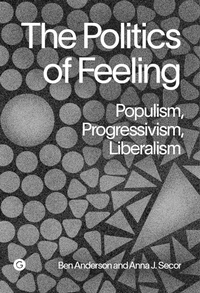
The Politics of Feeling
Populism, Progressivism, Liberalism
Published on 1. July 2025
Book
Hardback
256 pages
978-1-915983-29-9 (ISBN)
Description
How today's dominant political forms-right-wing populism, progressivism, and liberalism-offer differentiated responses to shared conditions of uncertainty.
The Politics of Feeling argues that politics has become a matter of political feelings in an age of uncertainty. The uncertainties of the post-2008 period have transformed the political arena and made the question of how people feel central to the formation of political affiliations and divisions. The book identifies three competing political forms in the US and the UK today: right-wing populism, progressivism, and contemporary liberalism. It argues that rather than naming coherent programs of political thought, these popular political forms are operating as arrangements or modes of attachment and political intensity. Each one suggests a different way of remembering the past, imagining the future, and making the present politically meaningful. Each one elevates some affective orientations over others and thereby etches differences of race, class, and gender within its structure. The Politics of Feeling is a critique of the living edge of politics, where feelings emerge, gather intensity, or dissolve in the continual making and remaking of the politics of the present.
The Politics of Feeling argues that politics has become a matter of political feelings in an age of uncertainty. The uncertainties of the post-2008 period have transformed the political arena and made the question of how people feel central to the formation of political affiliations and divisions. The book identifies three competing political forms in the US and the UK today: right-wing populism, progressivism, and contemporary liberalism. It argues that rather than naming coherent programs of political thought, these popular political forms are operating as arrangements or modes of attachment and political intensity. Each one suggests a different way of remembering the past, imagining the future, and making the present politically meaningful. Each one elevates some affective orientations over others and thereby etches differences of race, class, and gender within its structure. The Politics of Feeling is a critique of the living edge of politics, where feelings emerge, gather intensity, or dissolve in the continual making and remaking of the politics of the present.
More details
Language
English
Place of publication
United Kingdom
Dimensions
Height: 199 mm
Width: 132 mm
Thickness: 13 mm
Weight
254 gr
ISBN-13
978-1-915983-29-9 (9781915983299)
Copyright in bibliographic data and cover images is held by Nielsen Book Services Limited or by the publishers or by their respective licensors: all rights reserved.
Schweitzer Classification
Other editions
Additional editions
E-Book
09/2025
Goldsmiths Press
€27.49
Available for download
Persons
Ben Anderson is Professor of Human Geography at Durham University, UK.
Anna J. Secor is Professor of Human Geography at Durham University, UK.
Anna J. Secor is Professor of Human Geography at Durham University, UK.