

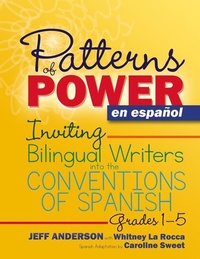
Patterns of Power en espanol, Grades 1-5
Inviting Bilingual Writers into the Conventions of Spanish
1st Edition
Published on 6. August 2019
Book
Paperback/Softback
288 pages
978-1-62531-332-4 (ISBN)
Description
Author Jeff Anderson and bilingual teacher and coach Caroline Sweet lead a vibrant approach to grammar instruction in Patterns of Power en espanol, Grades 1-5: Inviting Bilingual Writers into the Conventions of Spanish. Here, young, emergent writers are invited to notice the conventions of the Spanish language and build off them in this inquiry-based approach to instructional grammar.
The book comes with standards-aligned lessons that can be incorporated in just 10 minutes a day. Patterns of Power's responsive, invitational approach puts students in an involved role and has them explore and discuss the purpose and meaning of what they read. Students study short, authentic texts and are asked to share their findings out loud, engaging in rich conversations to make meaning.
Inside you'll find:
Ready-to-use lesson plan sets that include excerpts from authentic and diverse Spanish mentor texts curated for grades 1-5 and can be adapted over 5 grade levels
Real-life classroom examples, tips, and Power Notes gleaned from the authors' experiences that can be applied to any level of writer
Resources, including a Patterns of Power Planning Guide adapted for Spanish, to use in classroom instruction or as handouts for student literacy notebooks
How to correlate to Spanish TEKS, Common Core, and other state standards
Patterns of Power en espanol, Grades 1-5 provides a simple classroom routine that is structured in length and approach, but provides teachers flexibility in choosing the texts, allowing for numerous, diverse voices in the classroom. The practice helps students build cognitive recognition and provides a formative assessment for teachers on student progress. With these short lessons, students will gain confidence and move beyond limitation to produce effortless writing in your class and beyond.
The Patterns of Power series also includes Patterns of Power, Grades 6-8: Inviting Adolescent Writers into the Conventions of Language; Patterns of Power, Grades 1-5: Inviting Young Writers into the Conventions of Language; Patterns of Power, Grades 9-12: Teaching Grammar Through Reading and Writing; and Patterns of Wonder, Grades PreK-1: Inviting Emergent Writers to Play with the Conventions of Language.
The book comes with standards-aligned lessons that can be incorporated in just 10 minutes a day. Patterns of Power's responsive, invitational approach puts students in an involved role and has them explore and discuss the purpose and meaning of what they read. Students study short, authentic texts and are asked to share their findings out loud, engaging in rich conversations to make meaning.
Inside you'll find:
Ready-to-use lesson plan sets that include excerpts from authentic and diverse Spanish mentor texts curated for grades 1-5 and can be adapted over 5 grade levels
Real-life classroom examples, tips, and Power Notes gleaned from the authors' experiences that can be applied to any level of writer
Resources, including a Patterns of Power Planning Guide adapted for Spanish, to use in classroom instruction or as handouts for student literacy notebooks
How to correlate to Spanish TEKS, Common Core, and other state standards
Patterns of Power en espanol, Grades 1-5 provides a simple classroom routine that is structured in length and approach, but provides teachers flexibility in choosing the texts, allowing for numerous, diverse voices in the classroom. The practice helps students build cognitive recognition and provides a formative assessment for teachers on student progress. With these short lessons, students will gain confidence and move beyond limitation to produce effortless writing in your class and beyond.
The Patterns of Power series also includes Patterns of Power, Grades 6-8: Inviting Adolescent Writers into the Conventions of Language; Patterns of Power, Grades 1-5: Inviting Young Writers into the Conventions of Language; Patterns of Power, Grades 9-12: Teaching Grammar Through Reading and Writing; and Patterns of Wonder, Grades PreK-1: Inviting Emergent Writers to Play with the Conventions of Language.
More details
Series
Language
Spanish
Place of publication
Oxford
United States
Publishing group
Taylor & Francis Inc
Target group
Professional and scholarly
Professional Practice & Development
Product notice
Paperback (trade)
Unsewn / adhesive bound
Dimensions
Height: 277 mm
Width: 211 mm
Thickness: 20 mm
Weight
794 gr
ISBN-13
978-1-62531-332-4 (9781625313324)
Copyright in bibliographic data and cover images is held by Nielsen Book Services Limited or by the publishers or by their respective licensors: all rights reserved.
Schweitzer Classification
Other editions
Additional editions
Jeff Anderson | Whitney La Rocca | Caroline Sweet
Patterns of Power en espanol, Grades 1-5
Inviting Bilingual Writers into the Conventions of Spanish
E-Book
10/2023
1st Edition
Taylor & Francis
€51.49
Available for download
Jeff Anderson | Whitney La Rocca | Caroline Sweet
Patterns of Power en espanol, Grades 1-5
Inviting Bilingual Writers into the Conventions of Spanish
E-Book
10/2023
1st Edition
Taylor & Francis
€51.49
Available for download
Persons
Jeff Anderson -- For nearly thirty years, Jeff has inspired writers and teachers of grades 1-10 with the power and joy of the writing process. He has written five books for Stenhouse Publishers. He also writes middle-grade novels.
Whitney La Rocca is an elementary literacy coach and has spent over 20 years working with young readers and writers. She enjoys delivering professional development and coaching teachers in best practices to empower children to create their identities in the world of literacy.
Caroline Sweet is a Bilingual Literacy Coach at LCpl Nicholas S. Perez Elementary School in Austin, Texas. She has been a bilingual educator for 14 years and was named 2011 Teacher of the Year in Austin Independent School District. Caroline first met Jeff when she was a student in his fourth-grade classroom in 1991.
Whitney La Rocca is an elementary literacy coach and has spent over 20 years working with young readers and writers. She enjoys delivering professional development and coaching teachers in best practices to empower children to create their identities in the world of literacy.
Caroline Sweet is a Bilingual Literacy Coach at LCpl Nicholas S. Perez Elementary School in Austin, Texas. She has been a bilingual educator for 14 years and was named 2011 Teacher of the Year in Austin Independent School District. Caroline first met Jeff when she was a student in his fourth-grade classroom in 1991.
Content
Introduction; 1: Getting Started with the Patterns-of-Power Process; Into the Lessons; 2: What Do Capital Letters Do?; 3: What Do Nouns Do?; 4: What Do Verbs Do?; 5: What Do End Marks Do?; 6: What Do Pronouns Do?; 7: How Do Verbs and Nouns Agree?; 8: How Do Writers Use Dialogue and Parentheses?; 9: What Do Adjectives Do?; 10: What Do Adverbs Do?; 11: What Do Prepositions Do?; 12: What Do Conjunctions Do?; 13: Why Do Writers Use Compound Sentences?; 14: Why Do Writers Use the Serial Comma?; 15: Why Do Writers Use Complex Sentences?