

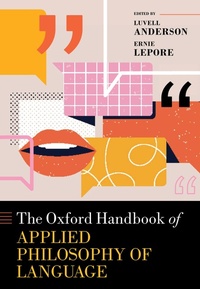
The Oxford Handbook of Applied Philosophy of Language
Published on 20. May 2024
Book
Hardback
720 pages
978-0-19-284411-8 (ISBN)
Description
This Handbook represents a collective exploration of the emerging field of applied philosophy of language. The volume covers a broad range of areas where philosophy engages with linguistic aspects of our social world, including such hot topics as dehumanizing speech, dogwhistles, taboo language, pornography, appropriation, implicit bias, speech acts, and the ethics of communication. An international line-up of contributors adopt a variety of approaches and methods in their investigation of these linguistic phenomena, drawing on linguistics and the human and social sciences as well as on different philosophical subdisciplines. The aim is to map out fruitful areas of research and to stimulate discussion with thought-provoking essays by leading and emerging philosophers.
More details
Series
Edition
1
Language
English
Place of publication
Oxford
United Kingdom
Target group
Professional and scholarly
Product notice
sewn/stitched
Cloth over boards
Dimensions
Height: 251 mm
Width: 188 mm
Thickness: 66 mm
Weight
1429 gr
ISBN-13
978-0-19-284411-8 (9780192844118)
Copyright in bibliographic data and cover images is held by Nielsen Book Services Limited or by the publishers or by their respective licensors: all rights reserved.
Schweitzer Classification
Other editions
Additional editions
Luvell Anderson | Ernie Lepore
The Oxford Handbook of Applied Philosophy of Language
E-Book
05/2024
1st Edition
OUP eBook
€132.99
Available for download
Luvell Anderson | Ernie Lepore
The Oxford Handbook of Applied Philosophy of Language
E-Book
04/2024
1st Edition
OUP eBook
€132.99
Available for download
Persons
Luvell Anderson is Associate Professor of Philosophy and Affiliate Faculty in African American Studies and Women's and Gender Studies at Syracuse University. Before coming to Syracuse, he was an assistant professor of philosophy at the University of Memphis and Alain Locke Postdoctoral Fellow at Pennsylvania State University. His research lies principally in Philosophy of Language, Philosophy of Humor, and Philosophy of Race. He has published articles on the semantics of racial slurs and racist humor, and is co-editor of the Routledge Companion to the Philosophy of Race (Routledge Press). Professor Anderson is currently working on a book, The Ethics of Racial Humor, which explores themes of race, humor, and the connection between ethics and aesthetics.
Ernie Lepore is Board of Governors Professor of Philosophy at Rutgers University. He has authored numerous books and papers in the philosophy of language, philosophical logic, metaphysics and philosophy of mind, including recently Imagination and Convention (with Matthew Stone, OUP, 2015), and Liberating Content (2016) with Herman Cappelen. He is the co-editor of The Oxford Handbook of Contemporary Philosophy of Language (with Una Stojnic, 2024) and of the series Oxford Studies in Philosophy of Language, with David Sosa.
Ernie Lepore is Board of Governors Professor of Philosophy at Rutgers University. He has authored numerous books and papers in the philosophy of language, philosophical logic, metaphysics and philosophy of mind, including recently Imagination and Convention (with Matthew Stone, OUP, 2015), and Liberating Content (2016) with Herman Cappelen. He is the co-editor of The Oxford Handbook of Contemporary Philosophy of Language (with Una Stojnic, 2024) and of the series Oxford Studies in Philosophy of Language, with David Sosa.
Content
1: Luvell Anderson and Ernie Lepore: Introduction
2: Sally Haslanger and Stephen Yablo: Amelioration as Course Correction
3: Angeles Erana and Axel Barcelo: A world where many worlds fit
4: J. L. Dowell: Silencing and Assertion: An Account of their Conversational Dynamic
5: Quill R. Kukla: The Pragmatics of Technologically Mediated Online Speech: Don>'t @ Me!
6: Robin Jeshion: The Truth About Slurs
7: Una Stojni'c and Ernie Lepore: Slurring Words
8: Rebecca Roache: On Passive Aggression
9: Timothy Jay: Taboo Word Research: Problems from the Past, Plans for the Future
10: Louise Antony: Speech-Act Theory in Feminist Thought
11: Mari Mikkola: Pornography as Oppressive Speech
12: Cameron Domenico Kirk-Giannini and Michael Glanzberg: Pronouns and Gender
13: E. M. Hernandez and Archie Crowley: How to Do Things with Gendered Words
14: Iz Gonzalez Vazquez, Martina Rosola, and Anna Klieber: Beyond Pronouns: Gender Visibility and Neutrality across Languages
15: Anita L. Allen: Privacy, Critical Definition and Racial Justice
16: Jules Holroyd and Matthew J. Cull: Gender-neutrality and family leave policies
17: Esa Saarinen: In Praise of Spoken Philosophy
18: Teresa Blankmeyer Burke: Boxed Ears and Swiveling Fists: American Sign Language, Audism, and Power
19: Luvell Anderson: Resistance and Reclamation: Notorious Thugs
20: Jose Medina: Public Protest and Silencing
21: Jeffrey King: The Contents of Maps
22: Gabriel Greenberg: Map Semantics and the Geography of Meaning
23: John Kulvicki: The Semantics of Iconography and Code Words
24: Ray Drainville and Jennifer Saul: Visual and Linguistic Dogwhistles
25: erman Cappelen and Josh Dever: AI with Alien Content and Alien Metasemantics H
26: Daian Florez: Semantic Change in the Language of Technology
27: Eliot Michaelson, Jessica Pepp, and Rachel Sterken: On Retweeting
28: Matthew McKeever: Ideology and Intersectionality
29: Tina Chanter and Andrew Cutrofello: Shakespeare's Proper Names
30: Noel Carroll: Art and Language
2: Sally Haslanger and Stephen Yablo: Amelioration as Course Correction
3: Angeles Erana and Axel Barcelo: A world where many worlds fit
4: J. L. Dowell: Silencing and Assertion: An Account of their Conversational Dynamic
5: Quill R. Kukla: The Pragmatics of Technologically Mediated Online Speech: Don>'t @ Me!
6: Robin Jeshion: The Truth About Slurs
7: Una Stojni'c and Ernie Lepore: Slurring Words
8: Rebecca Roache: On Passive Aggression
9: Timothy Jay: Taboo Word Research: Problems from the Past, Plans for the Future
10: Louise Antony: Speech-Act Theory in Feminist Thought
11: Mari Mikkola: Pornography as Oppressive Speech
12: Cameron Domenico Kirk-Giannini and Michael Glanzberg: Pronouns and Gender
13: E. M. Hernandez and Archie Crowley: How to Do Things with Gendered Words
14: Iz Gonzalez Vazquez, Martina Rosola, and Anna Klieber: Beyond Pronouns: Gender Visibility and Neutrality across Languages
15: Anita L. Allen: Privacy, Critical Definition and Racial Justice
16: Jules Holroyd and Matthew J. Cull: Gender-neutrality and family leave policies
17: Esa Saarinen: In Praise of Spoken Philosophy
18: Teresa Blankmeyer Burke: Boxed Ears and Swiveling Fists: American Sign Language, Audism, and Power
19: Luvell Anderson: Resistance and Reclamation: Notorious Thugs
20: Jose Medina: Public Protest and Silencing
21: Jeffrey King: The Contents of Maps
22: Gabriel Greenberg: Map Semantics and the Geography of Meaning
23: John Kulvicki: The Semantics of Iconography and Code Words
24: Ray Drainville and Jennifer Saul: Visual and Linguistic Dogwhistles
25: erman Cappelen and Josh Dever: AI with Alien Content and Alien Metasemantics H
26: Daian Florez: Semantic Change in the Language of Technology
27: Eliot Michaelson, Jessica Pepp, and Rachel Sterken: On Retweeting
28: Matthew McKeever: Ideology and Intersectionality
29: Tina Chanter and Andrew Cutrofello: Shakespeare's Proper Names
30: Noel Carroll: Art and Language