

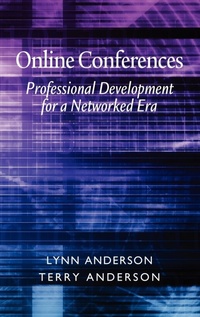
Online Conferences
Professional Development for a Networked Era
Will be published approx. on 7. October 2010
Book
Hardback
156 pages
978-1-61735-139-6 (ISBN)
Description
The professional conference has been, for many years, the primary tool for continuing education and networking in many professions. Now, however, the economic and environmental costs associated with travel, and the opportunity costs associated with absence from the workplace, compel organizers, trainers and executives to weigh the costs versus the benefits of this form of professional development. Online conferences offer an effective alternative that is economical, environmentally friendly and convenient. These factors position online professional conferences as poised to emerge as a mainstream form of lifelong learning in all professions.
This book looks at the elements of effective continuing professional education, the affordances of interactive technologies, and the lessons learned by experienced online conference organizers. It is designed to provide guidance and advice to those wishing to coordinate, sponsor or participate effectively in an online professional development conference. The text describes various ways in which a variety of networking technologies are being used to support successful online professional development events. Resources for conference organizers are given in the form of links to commercial and open source software, and companies providing platforms and comprehensive support for the organization of online conferences. The text contains the results of interviews with 12 organizers of the most successful online conferences to date. Finally, a list of best practices, based on the research literature, experiences of the authors and experienced online conference organizers, is presented in the final chapter.
This book looks at the elements of effective continuing professional education, the affordances of interactive technologies, and the lessons learned by experienced online conference organizers. It is designed to provide guidance and advice to those wishing to coordinate, sponsor or participate effectively in an online professional development conference. The text describes various ways in which a variety of networking technologies are being used to support successful online professional development events. Resources for conference organizers are given in the form of links to commercial and open source software, and companies providing platforms and comprehensive support for the organization of online conferences. The text contains the results of interviews with 12 organizers of the most successful online conferences to date. Finally, a list of best practices, based on the research literature, experiences of the authors and experienced online conference organizers, is presented in the final chapter.
More details
Language
English
Place of publication
Charlotte
United States
Publishing group
Emerald Publishing Inc
Target group
Professional and scholarly
Dimensions
Height: 240 mm
Width: 161 mm
Thickness: 13 mm
Weight
405 gr
ISBN-13
978-1-61735-139-6 (9781617351396)
Copyright in bibliographic data and cover images is held by Nielsen Book Services Limited or by the publishers or by their respective licensors: all rights reserved.
Schweitzer Classification
Other editions
Additional editions
E-Book
11/2010
1st Edition
Information Age Publishing
from
€62.33
Available for download
Persons
Terry Anderson is a professor and Canada Research Chair in Distance Education at Athabasca University. He has published widely in the area of distance education and educational technology
Content
Introduction.
Chapter 1. Continuing Professional Education: An Historical Overview.
Chapter 2. What is an Online CPE Conference?
Chapter 3. Technologies: From Text to Immersion.
Chapter 4. Synchronous Versus Asynchronous Conferencing Technologies.
Chapter 5. Conference Components, Formats, and Design.
Chapter 6. Online Conference Evaluation.
Chapter 7. Emergence of Infrastructure and Commercial Support for Online Conferences.
Chapter 8. Organizer Perspectives.
Chapter 9. Summary of Best Practices and Making Change Happen.
References.
Chapter 1. Continuing Professional Education: An Historical Overview.
Chapter 2. What is an Online CPE Conference?
Chapter 3. Technologies: From Text to Immersion.
Chapter 4. Synchronous Versus Asynchronous Conferencing Technologies.
Chapter 5. Conference Components, Formats, and Design.
Chapter 6. Online Conference Evaluation.
Chapter 7. Emergence of Infrastructure and Commercial Support for Online Conferences.
Chapter 8. Organizer Perspectives.
Chapter 9. Summary of Best Practices and Making Change Happen.
References.