

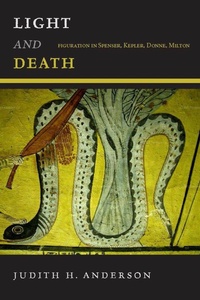
Light and Death
Figuration in Spenser, Kepler, Donne, Milton
Published on 2. January 2017
Book
Hardback
328 pages
978-0-8232-7277-8 (ISBN)
Description
Light figures being; darkness, death. Bridging mathematical science, semantics, rhetoric, grammar, and major poems, Judith H. Anderson seeks to negotiate writings from multiple disciplines in the shared terms of poiesis and figuration rather than as cultural opposites.
Analogy, a type of metaphor, has always been the connector of the known to the unknown, the sensible to the infinite. Anderson's study moves from the figuration of light and death to the history of analogy and its pertinence to light in physics and metaphysics, from Kepler to Donne, Spenser, and Milton. Topics proliferate: creativity, optics, the relation of literature to science, the methodology of thought and argument, and the processes of narrative, discovery, and interpretation.
Analogy, a type of metaphor, has always been the connector of the known to the unknown, the sensible to the infinite. Anderson's study moves from the figuration of light and death to the history of analogy and its pertinence to light in physics and metaphysics, from Kepler to Donne, Spenser, and Milton. Topics proliferate: creativity, optics, the relation of literature to science, the methodology of thought and argument, and the processes of narrative, discovery, and interpretation.
Reviews / Votes
"Analogy, 'the connector of the known to the unknown,' is given in-depth exploration in this fascinating study of life and death, darkness and light, language and meaning; a learned, richly textured study that contributes immeasurably to early modern studies." -- -Regina M. Schwartz Professor of English, Northwestern University "This fascinating book is above all a contribution to the history of early modern science that helps an ongoing critical process of revisionism by showing how both scientific and poetic thought use analogy in similar ways. It is also fascinating in its unusual structure: it allows us access to Anderson's subtle critical mind in the process of building interpretations." -- -Leah Marcus Vanderbilt UniversityMore details
Language
English
Place of publication
New York
United States
Target group
Professional and scholarly
Product notice
Cloth over boards
Dimensions
Height: 231 mm
Width: 157 mm
Thickness: 25 mm
Weight
612 gr
ISBN-13
978-0-8232-7277-8 (9780823272778)
Copyright in bibliographic data and cover images is held by Nielsen Book Services Limited or by the publishers or by their respective licensors: all rights reserved.
Schweitzer Classification
Other editions
Additional editions
E-Book
01/2017
1st Edition
Fordham University Press
€63.99
Available for download
E-Book
01/2017
1st Edition
Fordham University Press
€71.49
Available for download
Person
Judith H. Anderson is Chancellor's Professor of English Emeritus at Indiana University. Her books include Words That Matter: Linguistic Perception in Renaissance English; Translating Investments: Metaphor and the Dynamic of Cultural Change in Tudor-Stuart England (Fordham); and Reading the Allegorical Intertext: Chaucer, Spenser, Shakespeare, Milton (Fordham).
Content
Introduction: Issues of Death, Light, and Analogy
1. "The Body of This Death": Donne's Sermons,
Spenser's Maleger, Milton's Sin and Death
2. Mutability and Mortality in The Faerie Queene
3. Satanic Ethos: Evil, Death, and Individuality in
Paradise Lost
4. Connecting the Cultural Dots: Classical to Modern
Traditions of Analogy
5. Proportional Thinking in Kepler's Science of Light
6. Analogy, Proportion, and Death in Donne's
Anniversaries
7. Milton's Twilight Zone: Analogy, Light, and Darkness
in Paradise Lost
Acknowledgments
Notes
Index
1. "The Body of This Death": Donne's Sermons,
Spenser's Maleger, Milton's Sin and Death
2. Mutability and Mortality in The Faerie Queene
3. Satanic Ethos: Evil, Death, and Individuality in
Paradise Lost
4. Connecting the Cultural Dots: Classical to Modern
Traditions of Analogy
5. Proportional Thinking in Kepler's Science of Light
6. Analogy, Proportion, and Death in Donne's
Anniversaries
7. Milton's Twilight Zone: Analogy, Light, and Darkness
in Paradise Lost
Acknowledgments
Notes
Index