

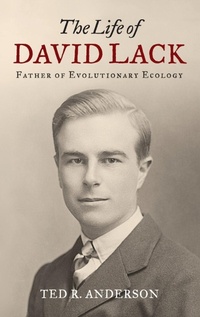
The Life of David Lack
Father of Evolutionary Ecology
Published on 18. July 2013
Book
Hardback
256 pages
978-0-19-992264-2 (ISBN)
Description
Most people who have taken a biology course in the past 50 years are familiar with the work of David Lack, but few remember his name. Almost all general biology texts produced during that period have a figure showing the beak size differences among the finches of the Galapagos Islands from Lack's 1947 classic, Darwin's Finches. Lack's pioneering conclusions in Darwin's Finches mark the beginning of a new scientific discipline, evolutionary ecology. Tim Birkhead, in his acclaimed book, The Wisdom of Birds, calls Lack the 'hero of modern ornithology.' Who was this influential, yet relatively unknown man? The Life of David Lack, Father of Evolutionary Ecology provides an answer to that question based on Ted Anderson's personal interviews with colleagues, family members and former students as well as material in the extensive Lack Archive at Oxford University.
Reviews / Votes
An excellent and fascinating account of the life and work of perhaps the most influential ornithologist and evolutionist of the 20th century * John F. Burton, British Trust for Orthinology * this book is readable and will be consistently interesting as history of science, as history of British academic culture and, to a lesser extent, as philosophy of science. Anderson has made a very helpful contribution and has opened a further research agenda for those willing to follow the lead. * Kenneth E. Hendrickson, British Journal for the History of Science * As Ted Anderson shows in his charming and very readable biography, Lack's argument, which developed slowly, was that differences in the way populations adapt to and compete for local resources (such as seeds, in the case of finches) is a key part of the process of speciation...Anderson gives us a vivid portrait of Lack and the personalities and careers of many people he interacted with. * Ben C. Sheldon, Nature * At its best, the book provides intimate glimpses into Lack's character and personality. ... Evolutionary ecologists may ... find this to be an accessible introduction to the diverse origins of their field, an area of increasing interest among historians and philosophers of the life sciences. * Quarterly Review of Biology * Overall, this is a most splendid addition to our understanding of an important 20th-century scientist and how his scientific work fundamentally shaped our understanding of ecology, evolution, and behavior in the second half of the 20th-century. It will prove useful to anyone interested in the history of 20th-century biology and especially to those of us wishing a fuller picture of the history of ecology and evolutionary biology as well as the origins of avian biology. * Ecology * Anderson has done an excellent job of collecting information on David Lack's life, and the short book is packed with interesting detail. The Life of David Lack is a welcome addition to the literature on the history of evolution, and it will be of interest to all of those who teach about evolution in their classes. * Reports of the National Center for Science Education * [A] sensitive and very readable appreciation of a great scientist. * Ibis * This book was a delight to read, and is warmly recommended to anyone interested in the life story of one of Britain's greatest ornithologists and his central role in the development of field ornithology in Britain during the middle of the twentieth century. * British Birds * [I]t was Lack's books that really made him so successful... This biolography is a particularly useful introduction to each of those books and is a treasure trove of information about the life of the man who wrote them. * Archives of Natural History * The book can be fully recommended not only for professionals working in the field of evolutionary ecology, but also to a general audience. * Acta Ornithologica *More details
Language
English
Place of publication
New York
United States
Target group
College/higher education
Professional and scholarly
Ornithologists, Population Ecologists, Behavioral Ecologists, members to the British Trust for Ornithology, members of the Royal Society for the Protection of Birds
Illustrations
19 black-and-white
Dimensions
Height: 240 mm
Width: 161 mm
Thickness: 20 mm
Weight
602 gr
ISBN-13
978-0-19-992264-2 (9780199922642)
Copyright in bibliographic data and cover images is held by Nielsen Book Services Limited or by the publishers or by their respective licensors: all rights reserved.
Schweitzer Classification
Other editions
Additional editions
E-Book
06/2013
1st Edition
OUP eBook
€67.49
Available for download
E-Book
06/2013
1st Edition
OUP eBook
€67.49
Available for download
Person
Ted R. Anderson is Emeritus Profess or Biology at McKendree University. Professor Anderson is the author of Biology of the Ubiquitous House Sparrow: From Genes to Populations (OUP 2006). He is retired and lives with his wife, Carol, in Kingston, Washington.
Content
Chapter I: The Birds of Cambridgeshire ; Chapter II: The Life of Robin ; Chapter III: Darwin's Finches ; Chapter IV: Robin Redbreast ; Chapter V: The Natural Regulation of Animal Numbers ; Chapter VI: Swifts in a Tower ; Chapter VII: Evolutionary Theory and Christian Belief ; Chapter VIII: Enjoying Ornithology ; Chapter IX: Population Studies of Birds ; Chapter X: Ecological Adaptations for Breeding in Birds ; Chapter XI: Ecological Isolation in Birds ; Chapter XII: Evolution Illustrated by Waterfowl ; Chapter XIII: Island Biology ; Notes