

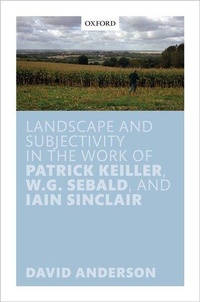
Landscape and Subjectivity in the Work of Patrick Keiller, W.G. Sebald, and Iain Sinclair
Published on 27. August 2020
Book
Hardback
312 pages
978-0-19-884719-9 (ISBN)
Description
This book situates the film-maker Patrick Keiller alongside the writers W.G. Sebald and Iain Sinclair as the three leading voices in 'English psychogeography', offering new insights to key works including London, The Rings of Saturn, and Lights Out for the Territory. Excavating social and political contexts while also providing plentiful close analysis, it examines the cultivation of a distinctive 'affective' mode or sensibility especially attuned to the cultural anxieties of the twentieth century's closing decades.
Landscape and Subjectivity explores motifs including essayism, the reconciliation of creativity with market forces, and the foregrounding of an often agonised or melancholic. It asks whether the work can, collectively, be seen to constitute a 'critical theory of contemporary space' and suggests that Keiller, Sebald, and Sinclair's contributions represent a highly significant moment in English culture's engagement with landscape, environment, and itself.
The book's analyses are fuelled by archival and topographical research and are responsive to various interdisciplinary contexts, including the tradition of the 'English Journey', the set of ideas associated with the 'spatial turn', critical theory, the so-called 'heritage debate', and more recent theorisation of the 'anthropocene'.
Landscape and Subjectivity explores motifs including essayism, the reconciliation of creativity with market forces, and the foregrounding of an often agonised or melancholic. It asks whether the work can, collectively, be seen to constitute a 'critical theory of contemporary space' and suggests that Keiller, Sebald, and Sinclair's contributions represent a highly significant moment in English culture's engagement with landscape, environment, and itself.
The book's analyses are fuelled by archival and topographical research and are responsive to various interdisciplinary contexts, including the tradition of the 'English Journey', the set of ideas associated with the 'spatial turn', critical theory, the so-called 'heritage debate', and more recent theorisation of the 'anthropocene'.
Reviews / Votes
my few paragraphs can never do justice to the 275 pages of David Anderson's remarkable book. I urge you to read it yourself. * Terry Pitt, Vertigo * To add something new in what seems like a firmly established discourse of millennial writer-walkers is no mean feat. That David Anderson manages to do so while discussing three artists with such differences of style and medium is hugely impressive. * Jamie Harris, Aberystwyth University, Modern Language Review * It has opened my eyes to how [Sebald's] books, though originally written in German and maintaining a decidedly European outlook, participate in a very English tradition of engagement with landscape. Most enjoyable, however, were not only the many insights I gained, but also the fact that it is written without the jargon that mars so many studies of Sebald. * Uwe Schuette, Aston University, What are you reading? * Anderson's study captures in great detail a powerful sense of the 1990s as a decade caught up in examining the ways that globalisation had problematised landscape both as an aesthetic category and as a space of imaginative renewal. * Niall Martin, University of Amsterdam, Review 31 * ...one will profit greatly from this carefully researched and impressively crafted study. * Richard Sheppard, Journal of European Studies * This is a convincing thesis...This breadth of reference is one of the strengths of Anderson's work on Keiller (and, for that matter, on Sebald and Sinclair too). Since all three are richly allusive and have densely elaborate frames of reference, writing about them presents its challenges, but this book rises to them well, and makes a particularly valuable addition to the literature on Keiller. * Julian Petley, Journal of British Cinema and Television *More details
Language
English
Place of publication
Oxford
United Kingdom
Target group
Professional and scholarly
Product notice
sewn/stitched
Cloth over boards
Illustrations
34 Illustrations
Dimensions
Height: 236 mm
Width: 155 mm
Thickness: 23 mm
Weight
676 gr
ISBN-13
978-0-19-884719-9 (9780198847199)
Copyright in bibliographic data and cover images is held by Nielsen Book Services Limited or by the publishers or by their respective licensors: all rights reserved.
Schweitzer Classification
Other editions
Additional editions
David Anderson
Landscape and Subjectivity in the Work of Patrick Keiller, W.G. Sebald, and Iain Sinclair
E-Book
08/2020
1st Edition
OUP eBook
€51.49
Available for download
David Anderson
Landscape and Subjectivity in the Work of Patrick Keiller, W.G. Sebald, and Iain Sinclair
E-Book
08/2020
1st Edition
OUP eBook
€51.49
Available for download
Person
David Anderson is Leverhulme Early Career Fellow in the Department of Comparative Literature at Queen Mary University of London. His research interests encompass Anglo-German cultural relations as well as representations of London in literature and film. He has recently been engaged as a Research Associate in UCL's Urban Laboratory, co-curating the symposium and screening series City, Essay, Film.
Content
Introduction
1: The Camera-I: Patrick Keiller's Early Short Films and Essays
2: A Vagrant Sensibility: Patrick Keiller's Robinson Films
3: W.G. Sebald's Early Writing: 'A European At The End of European Civilization'
4: An English Pilgrim: Sebald's The Rings of Saturn and Austerlitz
5: Iain Sinclair's Early Writing: The Arcane Scholarship of Place
6: Crosses, Circles, and Madness: Iain Sinclair's Lights Out for the Territory, London Orbital, and Edge of the Orison
Conclusion
1: The Camera-I: Patrick Keiller's Early Short Films and Essays
2: A Vagrant Sensibility: Patrick Keiller's Robinson Films
3: W.G. Sebald's Early Writing: 'A European At The End of European Civilization'
4: An English Pilgrim: Sebald's The Rings of Saturn and Austerlitz
5: Iain Sinclair's Early Writing: The Arcane Scholarship of Place
6: Crosses, Circles, and Madness: Iain Sinclair's Lights Out for the Territory, London Orbital, and Edge of the Orison
Conclusion