

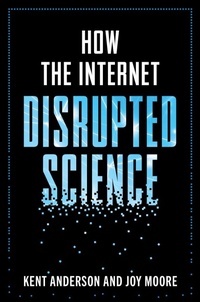
How the Internet Disrupted Science
Will be published approx. on 21. July 2026
Book
Hardback
360 pages
978-1-4930-9440-0 (ISBN)
Description
Scientific evidence affects policies, business, health outcomes, and economies worldwide. But is that scientific claim you just read reliable? Or nonsense? More and more often, it’s unreliable. The global system managing scientific claims has been hacked by bad ideas, big money, and bad incentives, and is being flooded by sketchy papers.
How the Internet Disrupted Science reveals the untold story of how science has been corrupted by digital information, academic and professional incentives, strange political ideologies, and big money interests. In this explosive expose, Kent Anderson and Joy Moore uncover how notions from the Big Tech world such as ‘move fast and break things’ and ‘information wants to be free’ have corrupted a scientific endeavor that once prided itself on truth-seeking, accountability, and transparency. Soon after that, scientific publishers were abdicating their responsibilities to practitioners and the public, while organized crime rings and conspiracy theorists took over.
In How the Internet Disrupted Science, two experts who witnessed this shift firsthand throughout their decades of experience in scientific publishing share a sprawling, endlessly fascinating tale decades in the making— one that is more relevant with each passing day, as we face new outbreaks, uncertainty around what information we can trust, a gutted scientific infrastructure, and concerns about centralized information in Large Language Models and AI systems. There is a way out of this mess, but only if we return to the self-correcting practices and core values that made science a reliable engine of progress for more than 500 years.
How the Internet Disrupted Science reveals the untold story of how science has been corrupted by digital information, academic and professional incentives, strange political ideologies, and big money interests. In this explosive expose, Kent Anderson and Joy Moore uncover how notions from the Big Tech world such as ‘move fast and break things’ and ‘information wants to be free’ have corrupted a scientific endeavor that once prided itself on truth-seeking, accountability, and transparency. Soon after that, scientific publishers were abdicating their responsibilities to practitioners and the public, while organized crime rings and conspiracy theorists took over.
In How the Internet Disrupted Science, two experts who witnessed this shift firsthand throughout their decades of experience in scientific publishing share a sprawling, endlessly fascinating tale decades in the making— one that is more relevant with each passing day, as we face new outbreaks, uncertainty around what information we can trust, a gutted scientific infrastructure, and concerns about centralized information in Large Language Models and AI systems. There is a way out of this mess, but only if we return to the self-correcting practices and core values that made science a reliable engine of progress for more than 500 years.
More details
Language
English
Product notice
sewn/stitched
Cloth over boards
With dust jacket
Dimensions
Height: 229 mm
Width: 152 mm
Thickness: 24 mm
Weight
558 gr
ISBN-13
978-1-4930-9440-0 (9781493094400)
Copyright in bibliographic data and cover images is held by Nielsen Book Services Limited or by the publishers or by their respective licensors: all rights reserved.
Schweitzer Classification
Persons
Joy Moore landed her first job out of college in a scientific journal editorial office in Chapel Hill, NC in 1995, in the days of fax, on the cusp of the internet. She quickly became a key player in the discovery and adoption of technology into the workflow to produce, disseminate, and monetize scholarly and medical products. She has worked for or with nearly every major global commercial publisher, scientific society, platform vendor, technology partner, and funding body in the space. Blackwell (later Wiley), Nature, Wolters Kluwer, McGraw-Hill, The American Medical Association, Silverchair, and EBSCO, to name a few. Her current home base is Williamsburg, Virginia.
Kent Anderson has worked in scholarly and scientific publishing for nearly thirty years, serving as Director of Journals at the American Academy of Pediatrics when the initial vaccine-autism link was forged in mass media; working as Publishing Director at the New England Journal of Medicine; serving as CEO of the Journal of Bone & Joint Surgery; and working as Publisher at AAAS/Science. He also founded two of the most influential blogs in scholarly publishing, the Webby-nominated Scholarly Kitchen and his current paid e-newsletter, the Geyser. Through these, he has kept a near-daily pulse on activities in the space since 2007. He lives and works as a consultant outside of Boston.
Kent Anderson has worked in scholarly and scientific publishing for nearly thirty years, serving as Director of Journals at the American Academy of Pediatrics when the initial vaccine-autism link was forged in mass media; working as Publishing Director at the New England Journal of Medicine; serving as CEO of the Journal of Bone & Joint Surgery; and working as Publisher at AAAS/Science. He also founded two of the most influential blogs in scholarly publishing, the Webby-nominated Scholarly Kitchen and his current paid e-newsletter, the Geyser. Through these, he has kept a near-daily pulse on activities in the space since 2007. He lives and works as a consultant outside of Boston.