


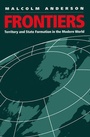
Frontiers
Territory and State Formation in the Modern World
Published on 8. March 1996
Book
Hardback
220 pages
978-0-7456-1652-0 (ISBN)
Description
Where frontiers are and what purposes they serve, affect all human societies in the contemporary world. This book argues that frontiers are not simply lines on maps - they are inseparable from the development of the states which they enclose. Understanding them is essential to the understanding of political life. Arguments used to justify frontier policies raise crucial, often dramatic, questions concerning citizenship, identity, political loyalty and the ends of the state. Contemporary international frontiers originated in the violent process of state formation in Western Europe. Certain international law doctrines of entitlement to territory were subsequently invented. But the legitimacy of frontiers has increasingly been based on the liberal concept of self-determination, an ambiguous doctrine which sometimes complicates European boundary disputes. European ideas and European imperial domination established African and Asian frontiers. The relative stability of these imposed frontiers is subject to a wide variety of challenges. But the international frontier in Europe is also subject to serious consideration for different reasons.
The development of the European Union and the growth of transfrontier links between local and regional authorities may undermine the international frontier as the basic political institution. But one element of the traditional sovereign control of frontiers - policing the movement of people across frontiers - remains at the centre of political debate. Perceptions of frontiers have been radically altered by technologies which have made use of uninhabited spaces - Antarctica, seas and oceans, airspace and outer space. International regimes regulate the new uses of these spaces. Taken together with regional integration, especially in Europe, these developments are changing the various meanings given to the international frontier.
The development of the European Union and the growth of transfrontier links between local and regional authorities may undermine the international frontier as the basic political institution. But one element of the traditional sovereign control of frontiers - policing the movement of people across frontiers - remains at the centre of political debate. Perceptions of frontiers have been radically altered by technologies which have made use of uninhabited spaces - Antarctica, seas and oceans, airspace and outer space. International regimes regulate the new uses of these spaces. Taken together with regional integration, especially in Europe, these developments are changing the various meanings given to the international frontier.
More details
Language
English
Place of publication
Oxford
United Kingdom
Target group
College/higher education
Illustrations
20 maps, bibliography, index
Dimensions
Height: 229 mm
Width: 152 mm
Weight
519 gr
ISBN-13
978-0-7456-1652-0 (9780745616520)
Copyright in bibliographic data is held by Nielsen Book Services Limited or its licensors: all rights reserved.
Schweitzer Classification
Other editions
Content
The international frontier in historical and theoretical perspective; self-determination and autonomy - European cases of boundary drawing; themes in African and Asian disputes; boundaries within states - size, democracy and service provision; frontiers and migrations; boundary-making in uninhabited zones; conclusion - the European Union and the future of frontiers.