

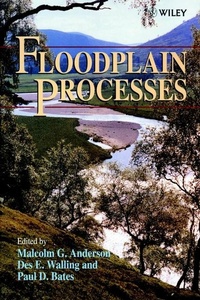
Floodplain Processes
1st Edition
Published on 10. October 1996
Book
Hardback
688 pages
978-0-471-96679-1 (ISBN)
Description
River floodplains represent a most important component of the environment. They play a critical role in the routing and storage of floodwaters and frequently represent unique and valuable habitats. Increasingly, such areas are under pressure form human activity in a wide variety of forms. This volume seeks to outline recent major research developments that have taken place in the study of floodplain processes. The chapters represent the results of recent engineering, geomorphological, hydrological, planning and other specialist developments. The book will contribute to research not only within the specialist research disciplines outlined, but also in the more interdisciplinary challenges facing river management.
More details
Language
English
Place of publication
New York
United States
Target group
Professional and scholarly
Product notice
sewn/stitched
Cloth over boards
Dimensions
Height: 250 mm
Width: 183 mm
Thickness: 45 mm
Weight
1332 gr
ISBN-13
978-0-471-96679-1 (9780471966791)
Copyright in bibliographic data and cover images is held by Nielsen Book Services Limited or by the publishers or by their respective licensors: all rights reserved.
Schweitzer Classification
Persons
Malcolm G. Anderson, is founder and Editor-in-Chief of Hydrological Processes, the international research journal published by Wiley. Professor Anderson has longstanding research interests in the fields of numerical hydrology and geotechnical model development for landslide prediction. He has held full year appointments as a Senior Research Hydrologist, for the U.S. Corps Engineers Waterways Experiment Station, USA and the Geotechnical Control Office, Hong Kong.
Des E. Walling is with the Department of Geography at the University of Exeter in the UK.
Des E. Walling is with the Department of Geography at the University of Exeter in the UK.
Content
List of Contributors.
The General Context for Floodplain Process Research (M. Anderson, et al).
Modelling Channel Evolution and Floodplain Morphology (A. Howard).
Analysis and Modelling of Overbank Deposits (S. Marriot).
Floodplain Palaeoenvironments (A. Brown).
River Channel and Floodplain Hydraulics (D. Knight and K. Shiono).
Recent Advances in Numerical Methods for Fluid Flows (J. Hervouet and L. Van Haren).
Analysis and Development of Hydraulic Models for Floodplain Flows (P. Bates, et al.).
Three-Dimensional Structures, Memory and Energy Dissipation in Meandering Compound Channel Flow (R. Sellin and B. Willets).
Progress in Turbulence Modelling for Open-Channel Flows (B. Younis).
Bayesian Calibration of Flood Inundation Models (R. Romanowicz, et al.).
Modelling Sediment Transport and Water Quality Processes on Tidal Floodplains (R. Falconer and Y. Chen).
Floodplains as Suspended Sediment Sinks (D. Wallig, et al.).
Fluxes and Storage of Sediment-Associated Heavy Metals in Floodplain Systems: Assessment and River Basin Management Issues at a Time of Rapid ENvironmental Change (M. Macklin).
Linking Hillslopes to Floodplains (T. Burt and N. Haycock).
Risks and Resources: Defining and Managing the Floodplain (E. Penning-Rowsell and S. Tunstall).
Sustaining the Ecological Integrity of Large Floodplain Rivers (G. Petts).
Floodplain Restoration and Rehabilitation (A. Brookes).
The Effects of River Management on the Hydrology and Hydroecology of Arid and Semi-Arid Floodplains (I. Jolly).
Integrated Field, Laboratory and Numerical Investigations of Hydrological Influences on the Establishment of Riparian Tree Species (K. Richard, et al.).
Author Index.
Subject Index.
The General Context for Floodplain Process Research (M. Anderson, et al).
Modelling Channel Evolution and Floodplain Morphology (A. Howard).
Analysis and Modelling of Overbank Deposits (S. Marriot).
Floodplain Palaeoenvironments (A. Brown).
River Channel and Floodplain Hydraulics (D. Knight and K. Shiono).
Recent Advances in Numerical Methods for Fluid Flows (J. Hervouet and L. Van Haren).
Analysis and Development of Hydraulic Models for Floodplain Flows (P. Bates, et al.).
Three-Dimensional Structures, Memory and Energy Dissipation in Meandering Compound Channel Flow (R. Sellin and B. Willets).
Progress in Turbulence Modelling for Open-Channel Flows (B. Younis).
Bayesian Calibration of Flood Inundation Models (R. Romanowicz, et al.).
Modelling Sediment Transport and Water Quality Processes on Tidal Floodplains (R. Falconer and Y. Chen).
Floodplains as Suspended Sediment Sinks (D. Wallig, et al.).
Fluxes and Storage of Sediment-Associated Heavy Metals in Floodplain Systems: Assessment and River Basin Management Issues at a Time of Rapid ENvironmental Change (M. Macklin).
Linking Hillslopes to Floodplains (T. Burt and N. Haycock).
Risks and Resources: Defining and Managing the Floodplain (E. Penning-Rowsell and S. Tunstall).
Sustaining the Ecological Integrity of Large Floodplain Rivers (G. Petts).
Floodplain Restoration and Rehabilitation (A. Brookes).
The Effects of River Management on the Hydrology and Hydroecology of Arid and Semi-Arid Floodplains (I. Jolly).
Integrated Field, Laboratory and Numerical Investigations of Hydrological Influences on the Establishment of Riparian Tree Species (K. Richard, et al.).
Author Index.
Subject Index.