

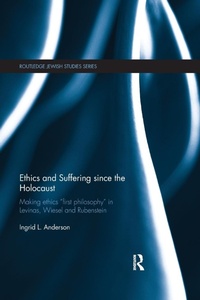
Ethics and Suffering since the Holocaust
Making Ethics "First Philosophy" in Levinas, Wiesel and Rubenstein
1st Edition
Published on 12. December 2019
Book
Paperback/Softback
186 pages
978-0-367-87634-0 (ISBN)
Description
For many, the Holocaust made thinking about ethics in traditional ways impossible. It called into question the predominance of speculative ontology in Western thought, and left many arguing that Western political, cultural and philosophical inattention to universal ethics were both a cause and an effect of European civilization's collapse in the twentieth century.
Emmanuel Levinas, Elie Wiesel and Richard Rubenstein respond to this problem by insisting that ethics must be Western thought's first concern. Unlike previous thinkers, they locate humanity's source of universal ethical obligation in the temporal world of experience, where human suffering, rather than metaphysics, provides the ground for ethical engagement. All three thinkers contend that Judaism's key lesson is that our fellow human is our responsibility, and use Judaism to develop a contemporary ethics that could operate with or without God. Ethics and Suffering since the Holocaust explores selected works of Levinas, Wiesel, and Rubenstein for practical applications of their ethics, analyzing the role of suffering and examining the use each thinker makes of Jewish sources and the advantages and disadvantages of this use. Finally, it suggests how the work of Jewish thinkers living in the wake of the Holocaust can be of unique value to those interested in the problem of ethics in the twentieth and twenty-first centuries.
Presenting a thorough investigation of the work of Levinas, Wiesel and Rubinstein, this book is of key interest to students and scholars of Jewish studies, as well as Jewish ethics and philosophy.
Emmanuel Levinas, Elie Wiesel and Richard Rubenstein respond to this problem by insisting that ethics must be Western thought's first concern. Unlike previous thinkers, they locate humanity's source of universal ethical obligation in the temporal world of experience, where human suffering, rather than metaphysics, provides the ground for ethical engagement. All three thinkers contend that Judaism's key lesson is that our fellow human is our responsibility, and use Judaism to develop a contemporary ethics that could operate with or without God. Ethics and Suffering since the Holocaust explores selected works of Levinas, Wiesel, and Rubenstein for practical applications of their ethics, analyzing the role of suffering and examining the use each thinker makes of Jewish sources and the advantages and disadvantages of this use. Finally, it suggests how the work of Jewish thinkers living in the wake of the Holocaust can be of unique value to those interested in the problem of ethics in the twentieth and twenty-first centuries.
Presenting a thorough investigation of the work of Levinas, Wiesel and Rubinstein, this book is of key interest to students and scholars of Jewish studies, as well as Jewish ethics and philosophy.
More details
Series
Language
English
Place of publication
London
United Kingdom
Publishing group
Taylor & Francis Ltd
Target group
College/higher education
Postgraduate and Undergraduate
Product notice
Paperback (trade)
Dimensions
Height: 234 mm
Width: 156 mm
Thickness: 11 mm
Weight
283 gr
ISBN-13
978-0-367-87634-0 (9780367876340)
Copyright in bibliographic data and cover images is held by Nielsen Book Services Limited or by the publishers or by their respective licensors: all rights reserved.
Schweitzer Classification
Other editions
Additional editions
Ingrid Anderson
Ethics and Suffering since the Holocaust
Making Ethics "First Philosophy" in Levinas, Wiesel and Rubenstein
E-Book
05/2016
Routledge
€59.49
Available for download
Ingrid Anderson
Ethics and Suffering since the Holocaust
Making Ethics "First Philosophy" in Levinas, Wiesel and Rubenstein
E-Book
05/2016
Routledge
€59.49
Available for download
Ingrid Anderson
Ethics and Suffering since the Holocaust
Making Ethics "First Philosophy" in Levinas, Wiesel and Rubenstein
Book
05/2016
1st Edition
Routledge
€220.50
Shipment within 10-20 days
Person
Ingrid L. Anderson is a doctor of Religious Studies. She is a full-time instructor in the College of Arts and Science Writing Program and an affiliate of the Elie Wiesel Center at Boston University. She currently teaches courses on post-Holocaust ethics, Judaism and gender, and modern Jewish thought. Her research interests include contemporary understandings of the relationship between ethical response and suffering and the construction of minority identities in the West. Her current research focuses on changes in the notions of Jewish mission and Jewish chosenness after 1945.
Content
1. Philosophical Ethics in Inter-War Europe: The 1929 Davos Disputation and Anti-(neo) Kantian Backlash
2. The Call of the Other: Levinasian Ethics
3. In Spite of Man: The Ethics of Elie Wiesel
4. "There is Nothing Final About the Death of God": Richard Rubenstein's Post-Holocaust Ethics
5. Toward an Ethics Grounded in Suffering
2. The Call of the Other: Levinasian Ethics
3. In Spite of Man: The Ethics of Elie Wiesel
4. "There is Nothing Final About the Death of God": Richard Rubenstein's Post-Holocaust Ethics
5. Toward an Ethics Grounded in Suffering