

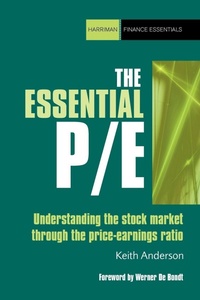
The Essential P/E
Understanding the stock market through the price-earnings ratio
Published on 4. June 2012
Book
Paperback/Softback
214 pages
978-0-85719-080-2 (ISBN)
Description
The price-earnings ratio, or P/E, is the most commonly quoted investment statistic, but have you ever considered what it actually means? For most people it's a shorthand way of deciding how highly the market regards a company, with investors prepared to overpay for earnings from a high-P/E 'glamour' stock as opposed to a low-P/E 'value' stock. However, academics have known since 1960 that the opposite is true: value stocks outperform glamour stocks consistently over decades.
A company with a low P/E may have been marked down for no readily apparent reason and thus could represent an attractive value investment for those with the patience to wait while the market re-values it. However, the P/E is a backward-looking measure and just because the company earned GBP1 per share last year it doesn't necessarily mean it will earn anything like that in the foreseeable future. Or, a low P/E can mean a company is deservedly cheap because it is in financial difficulty - in this case the company is likely to become cheaper yet or even go into administration.
This book is a practical guide to how you can adjust and improve the price-earnings ratio and use it, alongside other financial ratios, to run against the crowd and boost your stock returns.
A company with a low P/E may have been marked down for no readily apparent reason and thus could represent an attractive value investment for those with the patience to wait while the market re-values it. However, the P/E is a backward-looking measure and just because the company earned GBP1 per share last year it doesn't necessarily mean it will earn anything like that in the foreseeable future. Or, a low P/E can mean a company is deservedly cheap because it is in financial difficulty - in this case the company is likely to become cheaper yet or even go into administration.
This book is a practical guide to how you can adjust and improve the price-earnings ratio and use it, alongside other financial ratios, to run against the crowd and boost your stock returns.
Reviews / Votes
This book offers essential scientific reassurance, as well as practical tools, to triumph over misconceptions and behavioral errors that distort stock market prices. I recommend it to readers with great enthusiasm. -- Werner De Bondt, DePaul UniversityMore details
Language
English
Place of publication
Petersfield
United Kingdom
Target group
Professional and scholarly
Interest Age: From 18 years
Product notice
Paperback (UK-trade)
Illustrations
black & white illustrations
Dimensions
Height: 234 mm
Width: 156 mm
Thickness: 12 mm
Weight
336 gr
ISBN-13
978-0-85719-080-2 (9780857190802)
Copyright in bibliographic data and cover images is held by Nielsen Book Services Limited or by the publishers or by their respective licensors: all rights reserved.
Schweitzer Classification
Other editions
Additional editions
E-Book
06/2012
1st Edition
Harriman House Publishing
€17.49
Available for download
Person
After completing his BSc in Mathematical Statistics and Operational Research at Exeter, Keith Anderson worked for some years as a systems developer, most recently at Deutsche Bank in Frankfurt. He then did an MSc in Investment Analysis at Stirling, where he won the Morley Prize as the top academically in his year. For his PhD at the ICMA Centre, Reading University, Keith showed that different ways of calculating the Price-Earnings ratio could significantly improve investor returns. He worked as a lecturer at Durham University Business School for two years before moving to York in 2008. Keith has written a number of books, papers and articles.
Content
About the Author Foreword by Werner De Bondt Preface Introduction Part I: The P/E Calculation 1. History of the P/E 2. Earnings 3. The Price-Earnings Ratio (P/E) 4. Practical Calculation of EPS and the P/E from Company Accounts Part II: The Value Premium and the P/E 5. Value Investing 6. Efficient Markets and the CAPM 7. Accepting Reality: The Fama and French 3-Factor Model 8. Value Investors Fight Back Part III: Improving the P/E 9. Developing the P/E 10. The PEG Ratio 11. The Long-Term P/E 12. Decomposing the P/E 13. A Cautionary Tale: the Naked P/E 14. Have we Rescued the P/E? Part IV: Beyond the P/E 15. Ben Graham: The P/E and the Margin of Safety 16. Joel Greenblatt: The P/E and Return on Capital 17. Joseph Piotroski: The P/E and the Fscore Conclusion Appendices FTSE 100 EPSs and P/Es Glossary References Index