

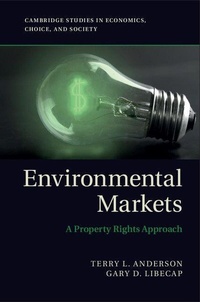
Environmental Markets
A Property Rights Approach
Published on 12. May 2014
Book
Hardback
244 pages
978-1-107-01022-2 (ISBN)
Description
Environmental Markets explains the prospects of using markets to improve environmental quality and resource conservation. No other book focuses on a property rights approach using environmental markets to solve environmental problems. This book compares standard approaches to these problems using governmental management, regulation, taxation, and subsidization with a market-based property rights approach. This approach is applied to land, water, wildlife, fisheries, and air and is compared to governmental solutions. The book concludes by discussing tougher environmental problems such as ocean fisheries and the global atmosphere, emphasizing that neither governmental nor market solutions are a panacea.
Reviews / Votes
'Two of the world's leading scholars on property rights and the environment offer a timely reminder that government is not always an effective steward of natural resources when markets fail at this task, and offer a rich review of the myriad creative ways in which market forces can be harnessed to improve environmental quality. The book's fresh perspective on the question of how best to solve problems ranging from climate change to overfishing reminds economists and their students to 'look before they leap', with regulation as a solution.' Sheila M. Olmstead, University of Texas, Austin 'Two of the economics profession's leading lights logically demolish the fallacy that only government action can protect the environment. In its place, they build a rock-solid, readily understandable case for a property-rights-market-based alternative approach. Their wealth of experience shines through in the case-study evidence used to reinforce their arguments.' Jeff Bennett, Australian National University 'Environmental Markets reminds us to identify the root causes of environmental problems before prescribing solutions. Often it is not failing markets but missing markets that are the problem. The authors' numerous examples are compelling. This book will serve as a guidepost for economists and other analysts proposing policy solutions to the difficult environmental problems we face today.' Margaret Walls, Research Director and Senior Fellow, Resources for the Future 'Provides an excellent introductory account of how environmental markets relate to environmental problems.' ChoiceMore details
Series
Language
English
Place of publication
Cambridge
United Kingdom
Target group
Professional and scholarly
Illustrations
6 Tables, unspecified; 6 Maps; 19 Halftones, unspecified; 11 Line drawings, unspecified
Dimensions
Height: 235 mm
Width: 157 mm
Thickness: 19 mm
Weight
552 gr
ISBN-13
978-1-107-01022-2 (9781107010222)
Copyright in bibliographic data and cover images is held by Nielsen Book Services Limited or by the publishers or by their respective licensors: all rights reserved.
Schweitzer Classification
Other editions
Additional editions
E-Book
05/2014
1st Edition
Cambridge University Press
€26.49
Available for download
Book
05/2014
Cambridge University Press
€44.10
Shipment within 15-20 days
E-Book
05/2014
Cambridge University Press
€23.49
Available for download
Persons
Terry L. Anderson is the President of the Property and Environment Research Center (PERC) and Senior Fellow at the Hoover Institution, Stanford University. His work helped launch the idea of 'free market environmentalism' with the publication of his book by that title, co-authored with Donald Leal. Dr Anderson's work emphasizes that private property rights encourage resource stewardship by harnessing the incentives of free enterprise to protect environmental quality. Anderson is the author or editor of 37 books including, most recently, Tapping Water Markets with Brandon Scarborough and Lawrence R. Watson. He has published widely in both professional journals and the popular press and has received many awards for his research and teaching. He received his PhD in economics from the University of Washington. Gary D. Libecap is Donald Bren Distinguished Professor of Corporate Environmental Management in the Donald Bren School of Environmental Science and Management and Professor of Economics at the University of California, Santa Barbara. He also is Research Associate at the National Bureau of Economic Research in Cambridge, MA; the Sherm and Marge Telleen Research Fellow at the Hoover Institution, Stanford University; and Senior Fellow at PERC, Bozeman, Montana. His research focuses on the role of property rights institutions in addressing the 'Tragedy of the Commons'. He received his PhD in economics from the University of Pennsylvania.
Content
1. Who owns the environment?; 2. Is government regulation the solution?; 3. Property rights for the common pool; 4. Local property rights to the commons; 5. The politics of property rights; 6. From property rights to markets; 7. Tackling the global commons; 8. Property rights, property rights, property rights.