

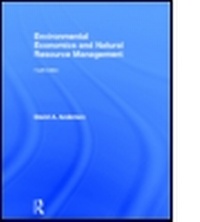
Environmental Economics and Natural Resource Management
4th Edition
Published on 16. September 2013
Book
Hardback
430 pages
978-0-415-64095-4 (ISBN)
Description
The tools of environmental economics guide policymakers as they weigh development against nature, present against future, and certain benefits against uncertain consequences. From reluctant-but-necessary calculations of the value of life, to quandaries over profits at the environment's expense, the policies and research findings explained in this textbook are relevant to decisions made daily by individuals, firms, and governments.
The fourth edition of Environmental Economics and Natural Resource Management pairs the user-friendly approaches of the previous editions with the latest developments in the field. A story-based narrative delivers clear, concise coverage of contemporary policy initiatives. To promote environmental and economic literacy, we have added even more visual aids, including color photographs and diagrams unmatched in other texts. Ancillaries include an Instructor's Guide with answers to all of the practice problems and downloadable slides of figures and tables from the book.
The economy is a subset of the environment, from which resources are obtained, workers and consumers receive sustenance, and life begins. Energy prices and environmental calamities constrain economic growth and the quality of life. The same can be said about overly restrictive environmental policies. It is with an appreciation for the weighty influence of this discipline, and the importance of conveying it to students, that this textbook is crafted.
The fourth edition of Environmental Economics and Natural Resource Management pairs the user-friendly approaches of the previous editions with the latest developments in the field. A story-based narrative delivers clear, concise coverage of contemporary policy initiatives. To promote environmental and economic literacy, we have added even more visual aids, including color photographs and diagrams unmatched in other texts. Ancillaries include an Instructor's Guide with answers to all of the practice problems and downloadable slides of figures and tables from the book.
The economy is a subset of the environment, from which resources are obtained, workers and consumers receive sustenance, and life begins. Energy prices and environmental calamities constrain economic growth and the quality of life. The same can be said about overly restrictive environmental policies. It is with an appreciation for the weighty influence of this discipline, and the importance of conveying it to students, that this textbook is crafted.
More details
Edition
4th New edition
Language
English
Place of publication
London
United Kingdom
Publishing group
Taylor & Francis Ltd
Target group
College/higher education
Edition type
New edition
Illustrations
148 farbige Abbildungen, 16 farbige Tabellen
16 Tables, color; 148 Illustrations, color
Dimensions
Height: 246 mm
Width: 189 mm
Weight
1134 gr
ISBN-13
978-0-415-64095-4 (9780415640954)
Copyright in bibliographic data and cover images is held by Nielsen Book Services Limited or by the publishers or by their respective licensors: all rights reserved.
Schweitzer Classification
Other editions
New editions
David A. Anderson
Environmental Economics and Natural Resource Management
Book
02/2019
5th Edition
Routledge
€230.27
Article exhausted; check for reprint
Additional editions

David A. Anderson
Environmental Economics and Natural Resource Management
Book
09/2013
4th Edition
Routledge
€95.51
Article exhausted; check for reprint
Person
David A. Anderson is Paul G. Blazer Professor of Economics at Centre College, Kentucky, USA. He is the author of Favorite Ways to Learn Economics and Economics by Example.
Content
1. The Big Picture 2. Efficiency and Choice 3. Market Failure 4. The Role of Government 5. Trade-Offs and the Economy 6. Environmental Quality 7. Energy 8. Sustainability 9. Population, Poverty and Economic Growth 10. Biodiversity and Valuation 11. International and Global Issues 12. Perspectives on Environmental Policy 13. Natural Resource Management: Renewable Resources 14. Natural Resource Management: Depletable and Replenishable Resources 15. Environmentral Dispute Resolution 16. Morals and Motivation