

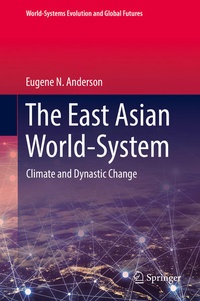
The East Asian World-System
Climate and Dynastic Change
Published on 14. June 2019
Book
Hardback
XII, 248 pages
978-3-030-16869-8 (ISBN)
Description
This book studies the East Asian world-system and its dynastic cycles as they were influenced by climate and demographic change, diseases, the expansion of trade, and the rise of science and technology. By studying the history of East Asia until the beginning of the 20th century and offering a comparative perspective on East Asian countries, including China, Japan and Korea, it describes the historical evolution of the East Asian world-system as being the result of good or poor management of the respective populations and environments. Lastly, the book discusses how the East Asian regions have become integrated into a single world-system by a combination of trade, commerce, and military action. Given its scope, the book will appeal to scholars of history, sociology, political science and environmental studies, and to anyone interested in learning about the effects of climate change on the dynamic development of societies.
More details
Series
Edition
2019 ed.
Language
English
Place of publication
Cham
Switzerland
Publishing group
Springer International Publishing
Target group
Professional and scholarly
Illustrations
6 s/w Abbildungen
XII, 248 p. 6 illus.
Dimensions
Height: 241 mm
Width: 160 mm
Thickness: 20 mm
Weight
559 gr
ISBN-13
978-3-030-16869-8 (9783030168698)
DOI
10.1007/978-3-030-16870-4
Schweitzer Classification
Other editions
Additional editions
Book
08/2020
Springer
€64.19
Shipment within 7-9 days
E-Book
06/2019
1st Edition
Springer
€64.19
Available for download
Person
E. N. Anderson is Professor of Anthropology, Emeritus, at the University of California, Riverside. He received his Ph.D. in anthropology from the University of California, Berkeley, in 1967. He has done research on ethnobiology, cultural ecology, political ecology, and medical anthropology, in several areas, especially Hong Kong, British Columbia, California, and the Yucatan Peninsula of Mexico. His books include The Food of China (Yale University Press. 1988), Ecologies of the Heart (Oxford University Press, 1996), The Pursuit of Ecotopia (Praeger, 2010), Caring for Place (2014), Everyone Eats (2014), Food and Environment in Early and Medieval China (2014), and, with Barbara A. Anderson, Warning Signs of Genocide (2012). He has five children and five grandchildren. He lives in Riverside, California, with his wife Barbara Anderson and three dogs.
Content
Theoretical Overview.- Cycles and Cycling.- Before Empire: State Formation in China and Proto-states Elsewhere.- The Creation of Stable Dynastic Empires in East and Southeast Asia.- High Empire: The Glory Days of Early Medieval Eastern Asia.- The Rise of Central Asia: Coastal Golden Ages Increasingly Threatened by Conquest Dynasties from the Deep Interior.- The Mongol Conquests of China and Korea and Invasion of Japan.- Long-lived Dynasties: Ming and Its Contemporaries.- The Early Modern Period in the East Asian World-System.- Lessons: Factors Driving the Rise and Fall of Dynasties.- Comparisons: Cycles and Empires in Agrarian Worlds.- What East Asia's Dynamics Teach Us about Climate, Society, and Change in the Modern and Future World.