

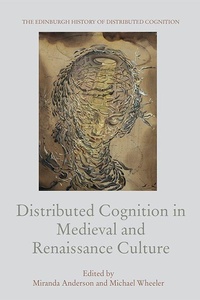
Distributed Cognition in Medieval and Renaissance Culture
Published on 16. June 2019
Book
Hardback
376 pages
978-1-4744-3813-1 (ISBN)
Description
This collection brings together 14 essays by international specialists in Medieval and Renaissance culture and provides a general and a period-specific introduction to distributed cognition and the cognitive humanities. The essays bring recent insights in cognitive science and philosophy of mind to bear on how cognition is seen as distributed across brain, body and world. The volume includes essays on law, history, drama, literature, art, music, philosophy, science and medicine, covering topics such as the mind, life and soul; the body and environment; the emotions; language and linguistic theories; theory of mind and interaction theory; the self and subjectivity; social, material and conceptual environments; the memory arts, orality and literacy; and literature and the arts.
Reviews / Votes
This original book should command the attention of scholars far beyond the set who subscribe to the 'distributed cognition' philosophy. It stimulates questions about analogous ideas of a dynamic mind-brain-body-world relation in the medieval and Renaissance periods - in philosophy, literature, drama, and medicine - and about ways in which thinking was constrained and enabled by tools. * David d'Avray, University College London * This volume is part of a larger and extraordinarily rich project that involves applying principles of distributed cognition to areas of the humanities. It's an excellent example of how one can use distributed cognition as a method to provide nuanced insights into issues that have remained obscure or dark from other perspectives. Can 21st-century science of the mind throw light on medieval and Renaissance minds? Can medieval and Renaissance texts, artworks, performances and practices contribute a deeper understanding of mind more generally as it manifests across material and epistemic environments, social relations and cultural institutions? This volume answers in the affirmative and in detail and it promises to push the arts and sciences of mind to new highs. * Shaun Gallagher, The University of Memphis *More details
Series
Language
English
Place of publication
Edinburgh
United Kingdom
Target group
Professional and scholarly
Product notice
sewn/stitched
Cloth over boards
Illustrations
9 black and white illustrations, 7 colour illustrations
Dimensions
Height: 246 mm
Width: 175 mm
Thickness: 28 mm
Weight
794 gr
ISBN-13
978-1-4744-3813-1 (9781474438131)
Copyright in bibliographic data and cover images is held by Nielsen Book Services Limited or by the publishers or by their respective licensors: all rights reserved.
Schweitzer Classification
Other editions
Additional editions
Miranda Anderson | Michael Wheeler
Distributed Cognition in Medieval and Renaissance Culture
E-Book
05/2019
1st Edition
Edinburgh University Press
€144.99
Available for download
Miranda Anderson | Michael Wheeler
Distributed Cognition in Medieval and Renaissance Culture
E-Book
05/2019
1st Edition
Edinburgh University Press
€0.00
Available for download
Persons
Miranda Anderson is an Anniversary Fellow at the University of Stirling and an Honorary Fellow at the University of Edinburgh. Her research focuses on cognitive approaches to literature and culture. She is the author of The Renaissance Extended Mind (Palgrave Macmillan, 2015). Michael Wheeler is Professor of Philosophy at the University of Stirling. He is the author of Reconstructing the Cognitive World: The Next Step (MIT, 2005). He is co-editor of Heidegger and Cognitive Science (Palgrave, 2012) and The Mechanical Mind in History (MIT, 2008).
Content
1. Series Introduction: Distributed Cognition and the HumanitiesMiranda Anderson, Michael Wheeler and Mark Sprevak
2. Introduction: Distributed Cognition in Medieval and Renaissance StudiesMiranda Anderson
3. Medieval Icelandic Legal Treatises as Tools for External Scaffolding of Legal Cognition Werner Schaefke
4. Horse-Riding Storytellers and Distributed Cognition in Chaucer's Canterbury Tales Guillemette Bolens
5. Cognitive Ecology and the Idea of Nation in Late-Medieval Scotland: The Flyting of William Dunbar and Walter KennedyElizabeth Elliott
6. The Mead of Poetry: Old Norse Poetry as a Mind-Altering SubstanceHannah Burrows
7. Enculturated, Embodied, Social: Medieval Drama and Cognitive IntegrationClare Wright
8. Ben Jonson and the Limits of Distributed CognitionRaphael Lyne
9. Masked Interaction: The Case for an Enactive View of Commedia dellArte (and the Italian Renaissance)Jan Soeffner
10. Thinking with the Hand: The Practice of Drawing in Renaissance ItalyCynthia Houng
11. The Medieval (Music) Book: A Multimodal Cognitive ArtefactKate Maxwell
12. Distributed Cognition, Improvisation and the Performing Arts in Early Modern EuropeEvelyn Tribble and Julie E. Cumming
13. Pierced with Passion: Brains, Bodies and Worlds in Early Modern TextsDaniel T. Lochman
14. Metaphors They Lived By: The Language of Early Modern IntersubjectivityHannah Chapelle Wojciehowski
15. Le Sigh: Enactive and Psychoanalytic Insights into Medieval and Renaissance Paralanguage L. O. Aranye Fradenburg
16. 'The Adding of Artificial Organs to the Natural': Extended and Distributed Cognition in Robert Hooke's MethodologyPieter Present
Notes on ContributorsBibliography
2. Introduction: Distributed Cognition in Medieval and Renaissance StudiesMiranda Anderson
3. Medieval Icelandic Legal Treatises as Tools for External Scaffolding of Legal Cognition Werner Schaefke
4. Horse-Riding Storytellers and Distributed Cognition in Chaucer's Canterbury Tales Guillemette Bolens
5. Cognitive Ecology and the Idea of Nation in Late-Medieval Scotland: The Flyting of William Dunbar and Walter KennedyElizabeth Elliott
6. The Mead of Poetry: Old Norse Poetry as a Mind-Altering SubstanceHannah Burrows
7. Enculturated, Embodied, Social: Medieval Drama and Cognitive IntegrationClare Wright
8. Ben Jonson and the Limits of Distributed CognitionRaphael Lyne
9. Masked Interaction: The Case for an Enactive View of Commedia dellArte (and the Italian Renaissance)Jan Soeffner
10. Thinking with the Hand: The Practice of Drawing in Renaissance ItalyCynthia Houng
11. The Medieval (Music) Book: A Multimodal Cognitive ArtefactKate Maxwell
12. Distributed Cognition, Improvisation and the Performing Arts in Early Modern EuropeEvelyn Tribble and Julie E. Cumming
13. Pierced with Passion: Brains, Bodies and Worlds in Early Modern TextsDaniel T. Lochman
14. Metaphors They Lived By: The Language of Early Modern IntersubjectivityHannah Chapelle Wojciehowski
15. Le Sigh: Enactive and Psychoanalytic Insights into Medieval and Renaissance Paralanguage L. O. Aranye Fradenburg
16. 'The Adding of Artificial Organs to the Natural': Extended and Distributed Cognition in Robert Hooke's MethodologyPieter Present
Notes on ContributorsBibliography