

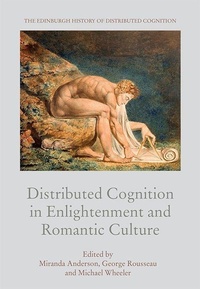
Distributed Cognition in Enlightenment and Romantic Culture
Published on 1. September 2019
Book
Hardback
296 pages
978-1-4744-4228-2 (ISBN)
Description
Revitalising our reading of 18th century works specifically in the fields of the history of the book, literary studies, material culture, art history, philosophy, technology, science and medicine, this volume brings recent insights in cognitive science and philosophy of mind to bear on the distributed nature of cognition. Collectively, the essays show how the particular range of sociocultural and technological contexts of the time fostered and reflected particular notions of distributed cognition.
Reviews / Votes
An innovative, thought-provoking approach to eighteenth-century culture. By applying new notions of the human mind as extended across brain, body, and environment, contributors open up refreshing perspectives on the most significant issues in Enlightenment and Romantic Studies. * Avi S. Lifschitz, Magdalen College, University of Oxford * A relatively recent, but pronounced, paradigm shift in cognitive science sees cognition as distributed across brain, body and world. This latest offering from the series, The Edinburgh History of Distributed Cognition, is a groundbreaking investigation of the implications of this distributed conception of cognition for our understanding of literature in the Enlightenment and Romantic periods. Anderson, Rousseau and Wheeler have assembled a set of consistently excellent contributions. The result is essential reading for anyone interested in the history of cognition and also provides a dramatically original way of reading works of the Enlightenment and Romantic periods. * Mark Rowlands, University of Miami *More details
Series
Language
English
Place of publication
Edinburgh
United Kingdom
Target group
Professional and scholarly
Product notice
sewn/stitched
Cloth over boards
Illustrations
5 colour illustrations, 3 black and white tables
Dimensions
Height: 244 mm
Width: 170 mm
Thickness: 20 mm
Weight
658 gr
ISBN-13
978-1-4744-4228-2 (9781474442282)
Copyright in bibliographic data and cover images is held by Nielsen Book Services Limited or by the publishers or by their respective licensors: all rights reserved.
Schweitzer Classification
Other editions
Additional editions
Miranda Anderson | George Rousseau | Michael Wheeler
Distributed Cognition in Enlightenment and Romantic Culture
E-Book
08/2019
1st Edition
Edinburgh University Press
€0.00
Available for download
Persons
Miranda Anderson is an Anniversary Fellow at the University of Stirling and an Honorary Fellow at the University of Edinburgh. Her research focuses on cognitive approaches to literature and culture. She is the author of The Renaissance Extended Mind (Palgrave Macmillan, 2015). George Rousseau is a Cultural Historian and a Fellow of the Royal Historical Society. He taught at Harvard for many years, was Professor at UCLA, Regius Professor at King's College Aberdeen and was Co-Director of the Centre for the History of Childhood at Oxford University until 2013. His books centre chronologically in the Enlightenment and usually include medicine, science and sex as primary to their concerns. Michael Wheeler is Professor of Philosophy at the University of Stirling. He is the author of Reconstructing the Cognitive World: The Next Step (MIT, 2005). He is co-editor of Heidegger and Cognitive Science (Palgrave, 2012) and The Mechanical Mind in History (MIT, 2008).
Content
List of illustrations
Series Preface
1. Series Introduction: Distributed Cognition and the Humanities
Miranda Anderson, Michael Wheeler and Mark Sprevak
2 Introduction I: Distributed Cognition in Enlightenment and Romantic Studies - An Overview
George Rousseau
Introduction II: Distributed Cognition in Enlightenment and Romantic Studies - Our Volume
Miranda Anderson
3. The Delicate Flux of World and Spirit: Barthold Heinrich Brockes and Distributed Cognition
Charlotte Lee
4. Wordsworth, Keats, and Cognitive Spaces of Empathy in Endymion
Renee Harris
5. The Body's Own Space: Embodied Cognition in Berkeley and Kant
Jennifer Mensch
6. Is Laurence Sterne's Protagonist Tristram Shandy Embodied, Enacted or Extended?
George Rousseau
7. Enacting the Absolute: Subject-Object Relations in Samuel Taylor Coleridge's Theory of Knowledge
Lisa Ann Robertson
8. Cognitive Scaffolding, Aids to Reflection
John Savarese
9. The Self in the History of Distributed Cognition: A View from the History of Reading
Elspeth Jajdelska
10. 'Thoroughly to unfold the labyrinths of the human mind': Distributed Cognition and Women (Novelist)'s Representation of Theatre in Eighteenth-Century England.
Ros Ballaster
11. The Literary Designer Environments of Eighteenth-Century Jesuit Poetics
Karin Kukkonen
12. Blake and the Mark of the Cognitive: Notes Towards the Appearance of the Skeptical Subject
Richard Sha
13. Eighteenth-Century Antiquity: Extended, Embodied, Enacted
Helen Slaney
Notes on contributors
Bibliography
Series Preface
1. Series Introduction: Distributed Cognition and the Humanities
Miranda Anderson, Michael Wheeler and Mark Sprevak
2 Introduction I: Distributed Cognition in Enlightenment and Romantic Studies - An Overview
George Rousseau
Introduction II: Distributed Cognition in Enlightenment and Romantic Studies - Our Volume
Miranda Anderson
3. The Delicate Flux of World and Spirit: Barthold Heinrich Brockes and Distributed Cognition
Charlotte Lee
4. Wordsworth, Keats, and Cognitive Spaces of Empathy in Endymion
Renee Harris
5. The Body's Own Space: Embodied Cognition in Berkeley and Kant
Jennifer Mensch
6. Is Laurence Sterne's Protagonist Tristram Shandy Embodied, Enacted or Extended?
George Rousseau
7. Enacting the Absolute: Subject-Object Relations in Samuel Taylor Coleridge's Theory of Knowledge
Lisa Ann Robertson
8. Cognitive Scaffolding, Aids to Reflection
John Savarese
9. The Self in the History of Distributed Cognition: A View from the History of Reading
Elspeth Jajdelska
10. 'Thoroughly to unfold the labyrinths of the human mind': Distributed Cognition and Women (Novelist)'s Representation of Theatre in Eighteenth-Century England.
Ros Ballaster
11. The Literary Designer Environments of Eighteenth-Century Jesuit Poetics
Karin Kukkonen
12. Blake and the Mark of the Cognitive: Notes Towards the Appearance of the Skeptical Subject
Richard Sha
13. Eighteenth-Century Antiquity: Extended, Embodied, Enacted
Helen Slaney
Notes on contributors
Bibliography