

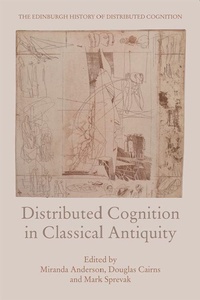
Distributed Cognition in Classical Antiquity
Will be published approx. on 6. November 2018
Book
Hardback
304 pages
978-1-4744-2974-0 (ISBN)
Description
12 essays by international experts look at how cognition is explicitly or implicitly conceived of as distributed across brain, body and world in Greek and Roman technology, science, medicine, material culture, philosophy and literary studies. A range of models emerge, which vary both in terms of whether cognition is just embodied or involves tools or objects in the world. As many of the texts and practices discussed have influenced Western European society and culture, this collection reveals the historical foundations of our theoretical and practical attempts to comprehend the distributed nature of human cognition.
Reviews / Votes
This is a fascinating volume that often reveals surprising analogies between contemporary accounts of distributed cognition and the views of several classical thinkers. It refreshingly goes beyond the contemporary focus on cognition as computation to consider the many ways in which body and world scaffold our psychic life, including its affective and conscious dimensions. * Giovanna Colombetti, University of Exeter * Once we look for it, distributed cognition is ubiquitous in classical antiquity. This book is a fascinating examination of the tools that made thinking easier and of the complex boundaries between the individual mind and the group. * Ruth Scodel, University of Michigan *More details
Series
Language
English
Place of publication
Edinburgh
United Kingdom
Target group
Professional and scholarly
Product notice
sewn/stitched
Cloth over boards
Illustrations
2 black and white illustrations, 4 colour illustrations
Dimensions
Height: 257 mm
Width: 185 mm
Thickness: 23 mm
Weight
703 gr
ISBN-13
978-1-4744-2974-0 (9781474429740)
Copyright in bibliographic data and cover images is held by Nielsen Book Services Limited or by the publishers or by their respective licensors: all rights reserved.
Schweitzer Classification
Other editions
Additional editions
Miranda Anderson | Douglas Cairns | Mark Sprevak
Distributed Cognition in Classical Antiquity
E-Book
10/2018
1st Edition
Edinburgh University Press
€144.99
Available for download
Miranda Anderson | Douglas Cairns | Mark Sprevak
Distributed Cognition in Classical Antiquity
E-Book
10/2018
1st Edition
Edinburgh University Press
€144.99
Available for download
Persons
Miranda Anderson is an Anniversary Fellow at the University of Stirling and an Honorary Fellow at the University of Edinburgh. Her research focuses on cognitive approaches to literature and culture. She is the author of The Renaissance Extended Mind (Palgrave Macmillan, 2015). Douglas Cairns (FRSE, FBA, MAE) is Professor of Classics in the University of Edinburgh. He is the author of Aidos: The Psychology and Ethics of Honour and Shame in Ancient Greek Literature (1993), Bacchylides: Five Epinician Odes (2010) and Sophocles: Antigone (2016). His most recent edited volumes include A Cultural History of the Emotions in Antiquity (2019), Emotions through Time: From Antiquity to Byzantium (with M. Hinterberger, A. Pizzone and M. Zaccarini, 2022), Contempt, Ancient and Modern (2023), and In the Mind, in the Body, in the World: Emotions in Early China and Ancient Greece (with C. Virag, 2024). Mark Sprevak is Senior Lecturer in Philosophy at the University of Edinburgh. He is the co-editor of The Routledge Handbook to the Computational Mind (Routledge, 2018), The Turing Guide: Life, Work, Legacy (OUP, 2017) and New Waves in Philosophy of Mind (Palgrave Macmillan, 2014).
Content
List of illustrations
Notes on contributors
Series Preface
1.Series Introduction: Distributed Cognition and the HumanitiesMiranda Anderson, Michael Wheeler and Mark Sprevak
2. Introduction: Distributed Cognition and the ClassicsDouglas Cairns
3. Physical Sciences: Ptolemy's Extended MindCourtney Roby
4. Distributed Cognition and the Diffusion of Information Technologies in the Roman WorldAndrew Riggsby
5. Mask as Mind Tool: A Methodology of Material EngagementPeter Meineck
6. Embodied, Extended and Distributed Cognition in Roman Technical PracticeWilliam Short
7. Roman-period Theatres as Distributed Cognitive Micro-ecologiesDiana Y. Ng
8. Cognition, Emotions and the Feeling Body in the Hippocratic CorpusGeorge Kazantidis
9. Enactivism and Embodied Cognition in Stoicism and Plato's TimaeusChristopher Gill
10. Enargeia, Enactivism and the Ancient Readerly ImaginationLuuk Huitink
11. Group Minds in Classical Athens? Chorus and Demos as Case Studies of Collective CognitionFelix Budelmann
12. One Soul in Two Bodies: Distributed Cognition and Ancient Greek FriendshipDavid Konstan
13. Distributed Cognition and Its Discontents: Three Episodes from the Classical TraditionThomas Habinek and Hector Reyes
Notes on contributors
Series Preface
1.Series Introduction: Distributed Cognition and the HumanitiesMiranda Anderson, Michael Wheeler and Mark Sprevak
2. Introduction: Distributed Cognition and the ClassicsDouglas Cairns
3. Physical Sciences: Ptolemy's Extended MindCourtney Roby
4. Distributed Cognition and the Diffusion of Information Technologies in the Roman WorldAndrew Riggsby
5. Mask as Mind Tool: A Methodology of Material EngagementPeter Meineck
6. Embodied, Extended and Distributed Cognition in Roman Technical PracticeWilliam Short
7. Roman-period Theatres as Distributed Cognitive Micro-ecologiesDiana Y. Ng
8. Cognition, Emotions and the Feeling Body in the Hippocratic CorpusGeorge Kazantidis
9. Enactivism and Embodied Cognition in Stoicism and Plato's TimaeusChristopher Gill
10. Enargeia, Enactivism and the Ancient Readerly ImaginationLuuk Huitink
11. Group Minds in Classical Athens? Chorus and Demos as Case Studies of Collective CognitionFelix Budelmann
12. One Soul in Two Bodies: Distributed Cognition and Ancient Greek FriendshipDavid Konstan
13. Distributed Cognition and Its Discontents: Three Episodes from the Classical TraditionThomas Habinek and Hector Reyes