

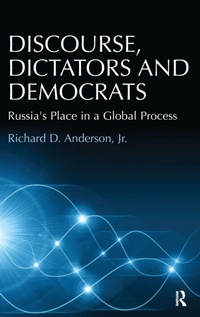
Discourse, Dictators and Democrats
Russia's Place in a Global Process
1st Edition
Published on 20. May 2014
Book
Hardback
240 pages
978-1-4094-6708-3 (ISBN)
Description
Voting hides a familiar puzzle. Many people take the trouble to vote even though each voter's prospect of deciding the election is nearly nil. Russians vote even when pervasive electoral fraud virtually eliminates even that slim chance. The right to vote has commonly been won by protesters who risked death or injury even though any one protester could have stayed home without lessening the protest's chance of success. Could people vote or protest because they stop considering their own chances and start to think about an identity shared with others? If what they hear or read affects political identity, a shift in political discourse might not just evoke protests and voting but also make the minority that has imposed the dictator's will suddenly lose heart. During the Soviet Union's final years the cues that set communist discourse apart from standard Russian sharply dwindled. A similar convergence of political discourse with local language has preceded expansion of the right to vote in many states around the globe. Richard D. Anderson, Jr., presents a groundbreaking theory of what language use does to politics.
Reviews / Votes
'This book certainly helps to fill in the niche of the complicated interdisciplinary study of the interrelation between political language and dictatorship. What is more, the author has succeeded in making it must-do reading for experts in political linguistics and equally understandable and enjoyable for all those interested in international politics, communication, and language. Through the rich content of the chapters and his globalized? approach, Anderson enriches us with a critical and scientific analysis of a subject that is highly topical but unfortunately seldom chosen by scholars.' Christ'l De Landtsheer, University of Antwerp, Belgium 'An imaginative and important advance in the study of political language. Using theory and case studies from around the world, Anderson shows how changes in political discourse strongly foreshadow advances in democracy.' Francis A. Beer, Professor Emeritus, University of Colorado, USA '... a valuable empirical contribution to the interdisciplinaty subject of political discourse. ... a very useful and stimulating resource for a better understanding of Russia's transition from Soviet rule and that countty's place within broader global patterns of shifts between repressive dictatorships and more inclusive democratic political systems and identities.' Russian ReviewMore details
Language
English
Place of publication
London
United Kingdom
Publishing group
Taylor & Francis Ltd
Target group
College/higher education
Dimensions
Height: 240 mm
Width: 161 mm
Thickness: 18 mm
Weight
529 gr
ISBN-13
978-1-4094-6708-3 (9781409467083)
Copyright in bibliographic data and cover images is held by Nielsen Book Services Limited or by the publishers or by their respective licensors: all rights reserved.
Schweitzer Classification
Other editions
Additional editions
Book
10/2016
1st Edition
Routledge
€83.50
Shipment within 10-20 days
E-Book
05/2016
Routledge
€77.49
Available for download
E-Book
05/2016
Routledge
€77.49
Available for download
Person
Richard D. Anderson, Jr., is a Professor of political science at the University of California, Los Angeles, where he has served on the faculty since 1989. Before earning the doctorate in political science from the University of California, Berkeley, he spent nine years in Washington, DC, as an intelligence analyst researching Soviet military capability and as a staff member of the House Permanent Select Committee on Intelligence and later of the Budget Committee assigned to the office of Rep. Les Aspin. He also holds a Master's in International Affairs from the Woodrow Wilson School at Princeton University and is a graduate of Davidson College.
Content
Introduction: A Protester's Tale; Part I Discursive Causality; Chapter 1 Voting and Repressing; Part II Russia Transformed; Chapter 2, 5. Material in this chapter first appeared in two journals. Some material derives from R. Anderson, Metaphors of dictatorship and democracy: Change in the Russian political lexicon and the transformation of Russian politics, Slavic Review 60, 2 (Summer 2001), 312-35. Slavic Review is published by the Association for Slavic, East European, and Eurasian Studies, and the material appears here with the permission of the publisher. Other material derives from R. Anderson,"Look at all those nouns in a row": Authoritarianism, democracy, and the iconicity of political Russian, Political Communication 13, 2 (April-June 1996), 145-64. It is used by permission of the publisher, Taylor & Francis.; Chapter 3 Spreading Political Identity in Russia 1 Material in this chapter has been previously published in R. Anderson, Speech and democracy in Russia: Responses to political texts in three Russian cities, British Journal of Political Science 27, 1 (January 1997), 23-45. It is used by permission of the publisher, Cambridge University Press.; Part III Discursive Consequences of the Colonial Encounter; Chapter 4 Colonialism and Enfranchisement in Europe; Chapter 5 British Settler Colonialism and Victory in 1945; Chapter 6 The Global South;