

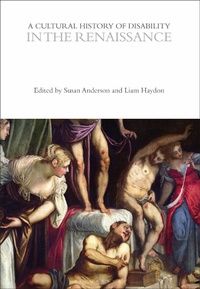
A Cultural History of Disability in the Renaissance
Published on 17. May 2023
Book
Hardback
208 pages
978-1-350-02887-6 (ISBN)
Description
In Renaissance humanism, difference was understood through a variety of paradigms that rendered particular kinds of bodies and minds disabled. A Cultural History of Disability in the Renaissance, covering the period from 1450 to 1650, explores evidence of the possibilities for disability that existed in the European Renaissance, observable in the literary and medicinal texts, and the family, corporate, and legal records discussed in the chapters of this volume. These chapters provide an interdisciplinary overview of the configurations of bodies, minds and collectives that have left evidence of some of the ways that normativity and its challengers interacted in the Renaissance.
An essential resource for researchers, scholars and students of history, literature, culture and education, A Cultural History of Disability in the Renaissance explores such themes and topics as: atypical bodies; mobility impairment; chronic pain and illness; blindness; deafness; speech; learning difficulties; and mental health.
An essential resource for researchers, scholars and students of history, literature, culture and education, A Cultural History of Disability in the Renaissance explores such themes and topics as: atypical bodies; mobility impairment; chronic pain and illness; blindness; deafness; speech; learning difficulties; and mental health.
More details
Series
Language
English
Place of publication
London
United Kingdom
Publishing group
Bloomsbury Publishing PLC
Target group
College/higher education
Product notice
sewn/stitched
Cloth over boards
With dust jacket
Dimensions
Height: 246 mm
Width: 168 mm
Thickness: 15 mm
Weight
658 gr
ISBN-13
978-1-350-02887-6 (9781350028876)
Copyright in bibliographic data and cover images is held by Nielsen Book Services Limited or by the publishers or by their respective licensors: all rights reserved.
Schweitzer Classification
Persons
Susan Anderson is Principal Lecturer and Deputy Head of English at Sheffield Hallam University, UK.
Liam Haydon is an International Development Policy Manager at United Kingdom Research and Innovation. Previously he was Lecturer in History at the University of Kent, UK.
Liam Haydon is an International Development Policy Manager at United Kingdom Research and Innovation. Previously he was Lecturer in History at the University of Kent, UK.
Content
List of Illustration
Notes of Contributors
Series Preface
Introduction, Susan Anderson, Sheffield Hallam University, UK and Liam Haydon, United Kingdom Research and Innovation, UK
Chapter 1: Atypical Bodies, by Simone Chess, Wayne State University, USA
Chapter 2: Mobility Impairment, by Liam Haydon and Edmond Smith, University of Manchester, UK
Chapter 3: Pain, by Adleen Crapo, University of Toronto, Canada
Chapter 4: Blindness, by Bianca Frohne, Keil University, Germany
Chapter 5: Deafness, by Jennifer Nelson, Gallaudet University, USA
Chapter 6: Speech, by Susan Anderson
Chapter 7: Learning Difficulties, by Emily Lathrop, The George Washington University, USA
Chapter 8: Mental Health, by Sonya Freeman Loftis, Morehouse College, USA
Notes
Bibliography
Index
Notes of Contributors
Series Preface
Introduction, Susan Anderson, Sheffield Hallam University, UK and Liam Haydon, United Kingdom Research and Innovation, UK
Chapter 1: Atypical Bodies, by Simone Chess, Wayne State University, USA
Chapter 2: Mobility Impairment, by Liam Haydon and Edmond Smith, University of Manchester, UK
Chapter 3: Pain, by Adleen Crapo, University of Toronto, Canada
Chapter 4: Blindness, by Bianca Frohne, Keil University, Germany
Chapter 5: Deafness, by Jennifer Nelson, Gallaudet University, USA
Chapter 6: Speech, by Susan Anderson
Chapter 7: Learning Difficulties, by Emily Lathrop, The George Washington University, USA
Chapter 8: Mental Health, by Sonya Freeman Loftis, Morehouse College, USA
Notes
Bibliography
Index