

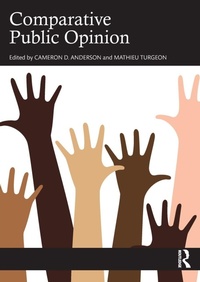
Comparative Public Opinion
1st Edition
Published on 22. July 2022
Book
Paperback/Softback
368 pages
978-0-367-64060-6 (ISBN)
Description
This book presents a comprehensive examination of public opinion in the democratic world.
Built around chapters that highlight key explanatory frameworks used in understanding public opinion, the book presents a coherent study of the subject in a comparative perspective, emphasizing and interrogating immigration as a key issue of high concern to most mass publics in the democratic world.
Key features of the book include:
Covers several theoretical issues and determinants of opinion such as the effects of personality, age and life cycle, ideology, social class, partisanship, gender, religion, ethnicity, language, and media, highlighting over time the effects of political, social, and economic contexts.
Each chapter explores the theoretical rationale, mechanisms of effect, and use in the scholarly literature on public opinion before applying these to the issue of immigration comparatively and in specific places or regions.
Widely comparative using a nine-country sample (Australia, Canada, France, Germany, Italy, Portugal, Switzerland, the United Kingdom, and the United States of America) in the analysis of individual-level determinants of public opinion about immigration and extending to other countries like Belgium, Brazil, and Japan when evaluating contextual factors.
This edited volume will be essential reading for students, scholars, and practitioners interested in public opinion, political behaviour, voting behaviour, politics of the media, immigration, political communication, and, more generally, democracy and comparative politics.
Built around chapters that highlight key explanatory frameworks used in understanding public opinion, the book presents a coherent study of the subject in a comparative perspective, emphasizing and interrogating immigration as a key issue of high concern to most mass publics in the democratic world.
Key features of the book include:
Covers several theoretical issues and determinants of opinion such as the effects of personality, age and life cycle, ideology, social class, partisanship, gender, religion, ethnicity, language, and media, highlighting over time the effects of political, social, and economic contexts.
Each chapter explores the theoretical rationale, mechanisms of effect, and use in the scholarly literature on public opinion before applying these to the issue of immigration comparatively and in specific places or regions.
Widely comparative using a nine-country sample (Australia, Canada, France, Germany, Italy, Portugal, Switzerland, the United Kingdom, and the United States of America) in the analysis of individual-level determinants of public opinion about immigration and extending to other countries like Belgium, Brazil, and Japan when evaluating contextual factors.
This edited volume will be essential reading for students, scholars, and practitioners interested in public opinion, political behaviour, voting behaviour, politics of the media, immigration, political communication, and, more generally, democracy and comparative politics.
Reviews / Votes
"Comparative Public Opinion provides a comprehensive and modern coverage of one of the major areas of political science research. It brings together leading authors in the field and takes a very broad and rigorous view of public opinion. The textbook provides a priceless insight into the field."Ignacio Lago, Universitat Pompeu Fabra, Barcelona, Spain.
More details
Language
English
Place of publication
London
United Kingdom
Publishing group
Taylor & Francis Ltd
Target group
College/higher education
Professional and scholarly
Postgraduate, Professional, Undergraduate Advanced, and Undergraduate Core
Illustrations
87 s/w Abbildungen, 87 s/w Zeichnungen, 27 s/w Tabellen
27 Tables, black and white; 87 Line drawings, black and white; 87 Illustrations, black and white
Dimensions
Height: 246 mm
Width: 174 mm
Thickness: 21 mm
Weight
689 gr
ISBN-13
978-0-367-64060-6 (9780367640606)
Copyright in bibliographic data and cover images is held by Nielsen Book Services Limited or by the publishers or by their respective licensors: all rights reserved.
Schweitzer Classification
Other editions
Additional editions
Cameron D. Anderson | Mathieu Turgeon
Comparative Public Opinion
Book
07/2022
1st Edition
Routledge
€207.40
Shipment within 15-20 days
Cameron D. Anderson | Mathieu Turgeon
Comparative Public Opinion
E-Book
07/2022
1st Edition
Routledge
€52.49
Available for download
Cameron D. Anderson | Mathieu Turgeon
Comparative Public Opinion
E-Book
07/2022
1st Edition
Routledge
€52.49
Available for download
Persons
Cameron D. Anderson is Associate Professor in the Department of Political Science at the University of Western Ontario, Canada.
Mathieu Turgeon is Associate Professor in the Department of Political Science at the University of Western Ontario, Canada.
Mathieu Turgeon is Associate Professor in the Department of Political Science at the University of Western Ontario, Canada.
Content
Part 1: Public opinion in a comparative perspective 1. Introduction 2. Defining and Measuring Public Opinion Part 2: The Individual-Level Determinants of Public Opinion 3. Public Opinion about Immigration and Immigrants 4. Age and Public Opinion 5. Gender and Public Opinion 6. Immigration Status and Public Opinion 7. Class and Public Opinion 8. Religion and Public Opinion 9. Personality and Public Opinion 10. Ideology and Public Opinion 11. Partisanship and Public Opinion Part 3: The contextual-level determinants of public opinion 12. Immigration and Public Opinion in Brazil: Taking Stock of New Waves of Migration and Polarization 13. The Inflow of Immigrants and Natives' Attitudes toward Immigration in Japan 14. The Impact of Labour Market Vulnerability: Explaining Attitudes toward Immigration in Europe 15. Linguistic Cleavages in Public Opinion 16. News Media Organizations and Public Opinion on Political Issues 17. Racial Attitudes and Opposition to Immigration 18. Conclusion