

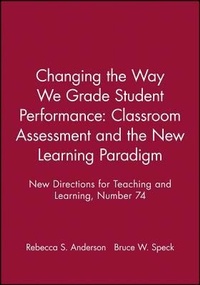
Changing the Way We Grade Student Performance: Classroom Assessment and the New Learning Paradigm
New Directions for Teaching and Learning, Number 74
Published on 14. August 1998
Book
Paperback/Softback
111 pages
978-0-7879-4278-6 (ISBN)
Description
Assigning grades to student work raises many dilemmas for college and university teachers. This volume helps teachers deal with these dilemmas by providing rubrics to be used as guides for scoring various kinds of student performance. The authors offer a range of alternative approaches to assessing student performance that are rooted in the belief that students should be active rather than passive learners.They draw on their own classroom experience to explain how to use each assessment measure presented--including developing criteria, integrating peer and self-assessment, and assigning grades--and discuss the advantages and disadvantages of each. This is the 74th issue of the quarterly journal New Directions for Teaching and Learning.
More details
Series
Language
English
Place of publication
New York
United States
Publishing group
John Wiley & Sons Inc
Target group
College/higher education
Professional and scholarly
Product notice
Paperback (trade)
Unsewn / adhesive bound
Dimensions
Height: 233 mm
Width: 148 mm
Thickness: 8 mm
Weight
172 gr
ISBN-13
978-0-7879-4278-6 (9780787942786)
Copyright in bibliographic data and cover images is held by Nielsen Book Services Limited or by the publishers or by their respective licensors: all rights reserved.
Schweitzer Classification
Persons
REBECCA S. ANDERSON is codirector of the Memphis Urban Writing Institute and assistant professor at the University of Memphis. BRUCE W. SPECK is professor of English and acting director of the Center for Academic Excellence at the University of Memphis.
Content
1. Why Talk About Different Ways to Grade? The Shift from Traditional Assessment to Alternative Assessment(Rebecca S. Anderson)
2. Unveiling Some of the Mystery of Professional Judgment in Classroom Assessment(Bruce W. Speck)
3. Grading Classroom Participation(John C. Bean, Dean Peterson)
4. Designing and Grading Oral Communication Assignments(Brooke L. Quigley)
5. Designing and Grading Written Assignments(Eric H. Hobson)
6. Grading Cooperative Projects(Karl A. Smith)
7. Evaluating Technology-Based Processes and Products(Gary R. Morrison, Steven M. Ross)
8. Portfolios: Purposeful Collections of Student Work(Joan A. Mullin)
9. Grading Inquiry Projects(Beverly Busching)
10. Grading Student Performance in Real-World Settings(Patricia A. Scanlon, Michael P. Ford)
2. Unveiling Some of the Mystery of Professional Judgment in Classroom Assessment(Bruce W. Speck)
3. Grading Classroom Participation(John C. Bean, Dean Peterson)
4. Designing and Grading Oral Communication Assignments(Brooke L. Quigley)
5. Designing and Grading Written Assignments(Eric H. Hobson)
6. Grading Cooperative Projects(Karl A. Smith)
7. Evaluating Technology-Based Processes and Products(Gary R. Morrison, Steven M. Ross)
8. Portfolios: Purposeful Collections of Student Work(Joan A. Mullin)
9. Grading Inquiry Projects(Beverly Busching)
10. Grading Student Performance in Real-World Settings(Patricia A. Scanlon, Michael P. Ford)