

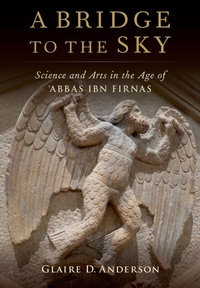
A Bridge to the Sky
The Arts of Science in the Age of 'Abbas Ibn Firnas
Published on 7. March 2024
Book
Hardback
248 pages
978-0-19-091324-3 (ISBN)
Description
In times of widespread Islamophobia, there is an understandable motivation for constructing scientific achievement as a counternarrative in popular discourse about Islam. Yet doing so has tended to impose an anachronistic conception of "science" onto pre-modern practices while also obscuring wider views of the intellectual, philosophical, and particularly the material context of medieval scientific achievement. An exemplary case study for this phenomenon is the figure of 'Abbas Ibn Firnas (d. 887), a celebrated early scientist, Cordoban courtier, and polymath. Ibn Firnas is best known today for conducting an early aeronautics experiment, which was commemorated by NASA. Some historians have called it the first successful human flight. The earliest and fullest account of Ibn Firnas' career in the Umayyad court includes the aeronautics experiment, and a great deal more on his achievements in the arts and design but has yet to receive sustained scholarly attention. That account, as preserved in a volume of the Muqtabas of Ibn Hayyan (d. 1076), the Cordoban court chronicle, presents Ibn Firnas as both the leading intellectual of early Islamic Iberia and as a pioneering figure in the design and construction of the court's first fine scientific instruments and space of scientific visualization.
A Bridge to the Sky reconstructs the account of Ibn Firnas' career to explore the exact sciences, design, and making as interconnected intellectual practices during the first flowering of the Islamic scientific revolution. Glaire D. Anderson deftly weaves analyses of the Arabic texts alongside the striking contemporaneous visual evidence, including some of the earliest surviving Islamic scientific instruments and illustrated treatises that are, as argued here, also works of art. A Bridge to the Sky thus offers both an intellectual biography of the intriguing figure of Ibn Firnas alongside an exploration of the culture of scientific learning in Umayyad al-Andalus. As a novel examination of the social significance of science, design and craftsmanship in medieval Iberia and the Islamic lands during the "classical" period of Islamic civilization, A Bridge to the Sky opens new avenues of study in the fields of medieval Islamic studies and art history, visual and material culture studies, and history of science.
A Bridge to the Sky reconstructs the account of Ibn Firnas' career to explore the exact sciences, design, and making as interconnected intellectual practices during the first flowering of the Islamic scientific revolution. Glaire D. Anderson deftly weaves analyses of the Arabic texts alongside the striking contemporaneous visual evidence, including some of the earliest surviving Islamic scientific instruments and illustrated treatises that are, as argued here, also works of art. A Bridge to the Sky thus offers both an intellectual biography of the intriguing figure of Ibn Firnas alongside an exploration of the culture of scientific learning in Umayyad al-Andalus. As a novel examination of the social significance of science, design and craftsmanship in medieval Iberia and the Islamic lands during the "classical" period of Islamic civilization, A Bridge to the Sky opens new avenues of study in the fields of medieval Islamic studies and art history, visual and material culture studies, and history of science.
Reviews / Votes
Glaire D. Anderson's book about 'Abbas Ibn Firnas is substantial and truly inventive. It describes the process and context in which he developed his work and the implications for all future investigations on this theme, exploring how medieval Islamic intellectuals likely informed the Italian Renaissance. A Caliphal Daedalus is an extraordinary contribution to its field. * Renata Holod, University of Pennsylvania * A fascinating exploration of the world of medieval Islamic science and art. Glaire D. Anderson, using the ninth century Andalusi polymath 'Abbas Ibn Firnas as her starting point, takes us on a journey through the connections between science and the visual arts, poetry and mechanical devices, engineering and design to traditional crafts, eventually revealing an intellectual milieu that was based on linking these endeavors in marvelous ways. This is a remarkably innovative and fresh look at medieval Islamic culture that should interest readers from many different fields and specializations. * Dwight Reynolds, University of California, Santa Barbara *More details
Language
English
Place of publication
New York
United States
Product notice
sewn/stitched
Cloth over boards
Illustrations
90, color
Dimensions
Height: 244 mm
Width: 185 mm
Thickness: 30 mm
Weight
703 gr
ISBN-13
978-0-19-091324-3 (9780190913243)
Copyright in bibliographic data and cover images is held by Nielsen Book Services Limited or by the publishers or by their respective licensors: all rights reserved.
Schweitzer Classification
Other editions
Additional editions
E-Book
01/2024
OUP eBook
€57.99
Available for download
Person
Glaire D. Anderson is an historian of Islamic arts and architecture during the age of the caliphs (650-1250), with a focus on Umayyad Cordoba and the arts of Islamic Iberia (Arabic al-Andalus). She is author of The Islamic Villa in Early Medieval Iberia: Aristocratic Estates and Court Culture in Umayyad Cordoba (2013), and co-editor of The Aghlabids and Their Neighbors (2018) and Revisiting al-Andalus: Perspectives on the Material Culture of Islamic Iberia and Beyond (2007).
Content
Acknowledgments A Note on Dates and Terms 'Abbas Inb Firnas & His Career: Selected Passages from Ibn Hayyan I. Overview Of 'Abbas's Character & Career II. On 'Abbas's Background & Skills III. On the Aeronautics Experiment IV. On the Meteorological Chamber V. On Two Precision Instruments Made for 'Abd Al- Rahman II & Muhammad I VI. His Poem on the munya (villa) al- Rusafa Introduction
1.The Sage of Al-Andalus
2. Mind and Hand
3. Visualizing Science at Home
4. Where Eagles and Vultures Dare
Epilogue: Echoes
Bibliography
1.The Sage of Al-Andalus
2. Mind and Hand
3. Visualizing Science at Home
4. Where Eagles and Vultures Dare
Epilogue: Echoes
Bibliography