

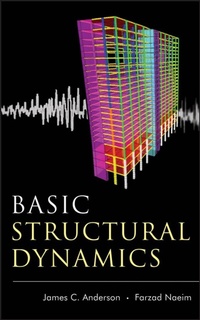
Basic Structural Dynamics
1st Edition
Published on 17. August 2012
Book
Hardback
288 pages
978-0-470-87939-9 (ISBN)
Description
A concise introduction to structural dynamics and earthquake engineering
Basic Structural Dynamics serves as a fundamental introduction to the topic of structural dynamics. Covering single and multiple-degree-of-freedom systems while providing an introduction to earthquake engineering, the book keeps the coverage succinct and on topic at a level that is appropriate for undergraduate and graduate students. Through dozens of worked examples based on actual structures, it also introduces readers to MATLAB, a powerful software for solving both simple and complex structural dynamics problems.
Conceptually composed of three parts, the book begins with the basic concepts and dynamic response of single-degree-of-freedom systems to various excitations. Next, it covers the linear and nonlinear response of multiple-degree-of-freedom systems to various excitations. Finally, it deals with linear and nonlinear response of structures subjected to earthquake ground motions and structural dynamics-related code provisions for assessing seismic response of structures. Chapter coverage includes:
Single-degree-of-freedom systems
Free vibration response of SDOF systems
Response to harmonic loading
Response to impulse loads
Response to arbitrary dynamic loading
Multiple-degree-of-freedom systems
Introduction to nonlinear response of structures
Seismic response of structures
If you're an undergraduate or graduate student or a practicing structural or mechanical engineer who requires some background on structural dynamics and the effects of earthquakes on structures, Basic Structural Dynamics will quickly get you up to speed on the subject without sacrificing important information.
Basic Structural Dynamics serves as a fundamental introduction to the topic of structural dynamics. Covering single and multiple-degree-of-freedom systems while providing an introduction to earthquake engineering, the book keeps the coverage succinct and on topic at a level that is appropriate for undergraduate and graduate students. Through dozens of worked examples based on actual structures, it also introduces readers to MATLAB, a powerful software for solving both simple and complex structural dynamics problems.
Conceptually composed of three parts, the book begins with the basic concepts and dynamic response of single-degree-of-freedom systems to various excitations. Next, it covers the linear and nonlinear response of multiple-degree-of-freedom systems to various excitations. Finally, it deals with linear and nonlinear response of structures subjected to earthquake ground motions and structural dynamics-related code provisions for assessing seismic response of structures. Chapter coverage includes:
Single-degree-of-freedom systems
Free vibration response of SDOF systems
Response to harmonic loading
Response to impulse loads
Response to arbitrary dynamic loading
Multiple-degree-of-freedom systems
Introduction to nonlinear response of structures
Seismic response of structures
If you're an undergraduate or graduate student or a practicing structural or mechanical engineer who requires some background on structural dynamics and the effects of earthquakes on structures, Basic Structural Dynamics will quickly get you up to speed on the subject without sacrificing important information.
More details
Language
English
Place of publication
New York
United States
Target group
Professional and scholarly
Product notice
Unsewn / adhesive bound
Paper over boards
Illustrations
Photos: 40 B&W, 0 Color; Drawings: 60 B&W, 0 Color
Dimensions
Height: 236 mm
Width: 155 mm
Thickness: 20 mm
Weight
499 gr
ISBN-13
978-0-470-87939-9 (9780470879399)
Copyright in bibliographic data and cover images is held by Nielsen Book Services Limited or by the publishers or by their respective licensors: all rights reserved.
Schweitzer Classification
Other editions
Additional editions
James C. Anderson | Farzad Naeim
Basic Structural Dynamics
E-Book
07/2012
Wiley
€107.99
Available for download
James C. Anderson | Farzad Naeim
Basic Structural Dynamics
E-Book
06/2012
Wiley
€105.99
Available for download
Persons
James C. Anderson is Professor of Civil Engineering at USC and is the author of, and contributor to, numerous book and journal articles.
Farzad Naeim is Vice President and General Counsel at John A. Martin & Associates, Inc., a consulting structural engineering firm headquartered in Los Angeles, California. He has received numerous awards for his contributions to earthquake engineering, including the 2007 Fazlur R. Khan Lifetime Achievement Medal by the Council on Tall Buildings and Urban Habitat.
Farzad Naeim is Vice President and General Counsel at John A. Martin & Associates, Inc., a consulting structural engineering firm headquartered in Los Angeles, California. He has received numerous awards for his contributions to earthquake engineering, including the 2007 Fazlur R. Khan Lifetime Achievement Medal by the Council on Tall Buildings and Urban Habitat.
Content
PREFACE xi
1 BASIC CONCEPTS OF STRUCTURAL DYNAMICS 1
1.1 The Dynamic Environment 1
1.2 Types of Dynamic Loading 2
1.3 Basic Principles 3
1.4 Dynamic Equilibrium 9
2 SINGLE-DEGREE-OF-FREEDOM SYSTEMS 13
2.1 Reduction of Degrees of Freedom 13
2.2 Time-Dependent Force 15
2.3 Gravitational Forces 17
2.4 Earthquake Ground Motion 18
2.5 Formulation of Equation of Motion 19
2.5.1 d'Alembert's Principle 19
2.5.2 Virtual Work (Virtual Displacements) 20
2.6 Generalized Coordinates 22
2.6.1 Discrete Parameters 23
2.6.2 Continuous Parameters 31
2.6.3 Transformation Factors 38
2.6.4 Axial Load Effect 42
2.6.5 Linear Approximation 44
3 FREE-VIBRATION RESPONSE OF SINGLE-DEGREE-OF-FREEDOM SYSTEMS 51
3.1 Undamped Free Vibration 51
3.1.1 Alternate Solution 53
3.1.2 Rayleigh's Method 58
3.1.3 Selection of Deflected Shape 60
3.2 Damped Free Vibration 61
3.2.1 Rotating Vector Form 63
3.2.2 Logarithmic Decrement 66
3.2.3 Radical Positive 67
4 RESPONSE TO HARMONIC LOADING 77
4.1 Undamped Dynamic System 77
4.2 Damped Dynamic System 84
4.3 Tripartite Logarithmic Plot 91
4.4 Evaluation of Damping 91
4.5 Seismic Accelerometers and Displacement Meters (Seismographs) 95
5 RESPONSE TO IMPULSE LOADS 101
5.1 Rectangular Pulse 104
5.2 Damped Rectangular Pulse 108
5.3 Triangular Pulse 109
5.4 Approximate Analysis for Short-Duration Impulse Load 112
6 RESPONSE TO ARBITRARY DYNAMIC LOADING 121
6.1 Duhamel Integral 121
6.2 Numerical Formulation of the Equation of Motion 123
6.3 Numerical Integration Methods 124
6.4 Newmark's Numerical Method 127
7 MULTIPLE-DEGREE-OF-FREEDOM SYSTEMS 137
7.1 Elastic Properties 137
7.1.1 Flexibility 137
7.1.2 Stiffness 138
7.1.3 Inertia 139
7.1.4 Viscous Damping 139
7.2 Undamped Free Vibration 141
7.3 Free Vibration 149
7.4 Betti's Law 153
7.5 Orthogonality Properties of Mode Shapes 155
7.6 Changing Coordinates (Inverse Transformation) 156
7.7 Holzer Method for Shear Buildings 159
7.8 Axial Load Effects (Linear Approximation) 162
7.9 Modal Equations for Undamped Time-Dependent Force Analysis 165
7.10 Modal Equations of Damped Forced Vibration 174
7.11 Modal Equations for Seismic Response Analysis 179
8 NONLINEAR RESPONSE OF MULTIPLE-DEGREE-OF-FREEDOM SYSTEMS 183
8.1 Static Nonlinear Analysis 184
8.2 Dynamic Nonlinear Analysis 185
8.3 Gauss Reduction 189
8.4 MATLAB Applications 190
9 SEISMIC RESPONSE OF STRUCTURES 201
9.1 Introduction 201
9.2 Linear Elastic Response Spectra 203
9.3 Elastic Design Response Spectrum 208
9.4 Earthquake Response of SDOF Systems 215
9.5 Earthquake Response Analysis of MDOF Systems 219
9.5.1 Time History Modal Analysis 221
9.5.2 Modal Combinations for Spectral Analyses 222
9.6 Structural Dynamics in the Building Code 232
9.6.1 Equivalent Lateral Force Procedure 234
9.6.2 Modal Response Spectrum Procedure 237
APPENDIX-HISTORICAL DEVELOPMENT OF BUILDING CODE SEISMIC PROVISIONS 249
SELECTED REFERENCES 263
INDEX 265
1 BASIC CONCEPTS OF STRUCTURAL DYNAMICS 1
1.1 The Dynamic Environment 1
1.2 Types of Dynamic Loading 2
1.3 Basic Principles 3
1.4 Dynamic Equilibrium 9
2 SINGLE-DEGREE-OF-FREEDOM SYSTEMS 13
2.1 Reduction of Degrees of Freedom 13
2.2 Time-Dependent Force 15
2.3 Gravitational Forces 17
2.4 Earthquake Ground Motion 18
2.5 Formulation of Equation of Motion 19
2.5.1 d'Alembert's Principle 19
2.5.2 Virtual Work (Virtual Displacements) 20
2.6 Generalized Coordinates 22
2.6.1 Discrete Parameters 23
2.6.2 Continuous Parameters 31
2.6.3 Transformation Factors 38
2.6.4 Axial Load Effect 42
2.6.5 Linear Approximation 44
3 FREE-VIBRATION RESPONSE OF SINGLE-DEGREE-OF-FREEDOM SYSTEMS 51
3.1 Undamped Free Vibration 51
3.1.1 Alternate Solution 53
3.1.2 Rayleigh's Method 58
3.1.3 Selection of Deflected Shape 60
3.2 Damped Free Vibration 61
3.2.1 Rotating Vector Form 63
3.2.2 Logarithmic Decrement 66
3.2.3 Radical Positive 67
4 RESPONSE TO HARMONIC LOADING 77
4.1 Undamped Dynamic System 77
4.2 Damped Dynamic System 84
4.3 Tripartite Logarithmic Plot 91
4.4 Evaluation of Damping 91
4.5 Seismic Accelerometers and Displacement Meters (Seismographs) 95
5 RESPONSE TO IMPULSE LOADS 101
5.1 Rectangular Pulse 104
5.2 Damped Rectangular Pulse 108
5.3 Triangular Pulse 109
5.4 Approximate Analysis for Short-Duration Impulse Load 112
6 RESPONSE TO ARBITRARY DYNAMIC LOADING 121
6.1 Duhamel Integral 121
6.2 Numerical Formulation of the Equation of Motion 123
6.3 Numerical Integration Methods 124
6.4 Newmark's Numerical Method 127
7 MULTIPLE-DEGREE-OF-FREEDOM SYSTEMS 137
7.1 Elastic Properties 137
7.1.1 Flexibility 137
7.1.2 Stiffness 138
7.1.3 Inertia 139
7.1.4 Viscous Damping 139
7.2 Undamped Free Vibration 141
7.3 Free Vibration 149
7.4 Betti's Law 153
7.5 Orthogonality Properties of Mode Shapes 155
7.6 Changing Coordinates (Inverse Transformation) 156
7.7 Holzer Method for Shear Buildings 159
7.8 Axial Load Effects (Linear Approximation) 162
7.9 Modal Equations for Undamped Time-Dependent Force Analysis 165
7.10 Modal Equations of Damped Forced Vibration 174
7.11 Modal Equations for Seismic Response Analysis 179
8 NONLINEAR RESPONSE OF MULTIPLE-DEGREE-OF-FREEDOM SYSTEMS 183
8.1 Static Nonlinear Analysis 184
8.2 Dynamic Nonlinear Analysis 185
8.3 Gauss Reduction 189
8.4 MATLAB Applications 190
9 SEISMIC RESPONSE OF STRUCTURES 201
9.1 Introduction 201
9.2 Linear Elastic Response Spectra 203
9.3 Elastic Design Response Spectrum 208
9.4 Earthquake Response of SDOF Systems 215
9.5 Earthquake Response Analysis of MDOF Systems 219
9.5.1 Time History Modal Analysis 221
9.5.2 Modal Combinations for Spectral Analyses 222
9.6 Structural Dynamics in the Building Code 232
9.6.1 Equivalent Lateral Force Procedure 234
9.6.2 Modal Response Spectrum Procedure 237
APPENDIX-HISTORICAL DEVELOPMENT OF BUILDING CODE SEISMIC PROVISIONS 249
SELECTED REFERENCES 263
INDEX 265