

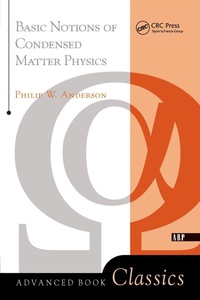
Basic Notions Of Condensed Matter Physics
1st Edition
Published on 1. January 1997
Book
Paperback/Softback
564 pages
978-0-201-32830-1 (ISBN)
Description
Basic Notions of Condensed Matter Physics is a clear introduction to some of the most significant concepts in the physics of condensed matter. The general principles of many-body physics and perturbation theory are emphasised, providing supportive mathematical structure. This is an expansion and restatement of the second half of Nobel Laureate Philip Anderson's classic Concepts in Solids.
More details
Language
English
Place of publication
Oxford
United States
Publishing group
Taylor & Francis Inc
Target group
College/higher education
Professional and scholarly
Dimensions
Height: 229 mm
Width: 152 mm
Thickness: 30 mm
Weight
806 gr
ISBN-13
978-0-201-32830-1 (9780201328301)
Copyright in bibliographic data and cover images is held by Nielsen Book Services Limited or by the publishers or by their respective licensors: all rights reserved.
Schweitzer Classification
Other editions
Additional editions
Philip W. Anderson
Basic Notions Of Condensed Matter Physics
Book
06/2019
1st Edition
CRC Press
€208.60
Shipment within 15-20 days
Philip W. Anderson
Basic Notions Of Condensed Matter Physics
E-Book
03/2018
1st Edition
CRC Press
€100.99
Available for download
Philip W. Anderson
Basic Notions Of Condensed Matter Physics
E-Book
03/2018
1st Edition
CRC Press
€100.99
Available for download
Person
Philip Anderson was born in 1923 in Indianapolis, Indiana. In 1949, he received his Ph.D. from Harvard University, where he studied under J.H. Van Yleck. He joined the technical staff of Bell Laboratories that same year. From 1967 to 1975 he held a part-time professor-ship at Cambridge University. He is currently Joseph Henry Professor of Physics emeritus at Princeton University. He has received numerous distinctions and honors, including the O.E. Buckley Prize, the John Bardeen Prize, the Dannie Heineman Prize, the National Medal of Science, and the 1977 Nobel Prize.
Content
Basic principles I - broken symmetry; basic principles II - adiabatic continuity and renormalization; solids, quantum and otherwise; uses of the idea of the renormalization group in many-body physics; broken symmetry; topology; Bose systems; quantum solids; renormalization group.