

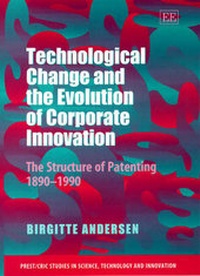
Technological Change and the Evolution of Corporate Innovation
The Structure of Patenting 1890-1990
Published on 23. February 2001
Book
Hardback
296 pages
978-1-84064-121-9 (ISBN)
Description
This book represents an original study of long term patterns in technological development and innovation in large corporations. The author is primarily concerned with understanding open-ended transformation processes in the evolution of industrialised societies. US patent data from 1890 to 1990 is employed within an evolutionary framework. The book offers an overview of an intellectual agenda associated with a highly important and pervasive set of phenomena and challenges several dogmas currently alive within economic reasoning including:
technological paradigms governing trajectories of opportunity
the S-shaped image of the technological growth cycle and technological dynamics
long waves
industrial dynamics
the variety of firms' technological profiles and corporate trajectories
corporate technological leadership
socio-economic transformation processes and underpinning 'rules'.
Technological Change and the Evolution of Corporate Innovation details historically how the innovative and competitive landscapes within industrialised societies have become increasingly complex. This book will appeal to industrial and business economists, technology historians, researchers, students, policymakers and business analysts.
technological paradigms governing trajectories of opportunity
the S-shaped image of the technological growth cycle and technological dynamics
long waves
industrial dynamics
the variety of firms' technological profiles and corporate trajectories
corporate technological leadership
socio-economic transformation processes and underpinning 'rules'.
Technological Change and the Evolution of Corporate Innovation details historically how the innovative and competitive landscapes within industrialised societies have become increasingly complex. This book will appeal to industrial and business economists, technology historians, researchers, students, policymakers and business analysts.
Reviews / Votes
'. . . this is an original contribution to the literature on innovation, especially as it takes a long-term, cross-industry perspective.' -- Gerben Bakker, Business History 'This book has a wealth of information regarding patents. Andersen has developed sophisticated analytical methods to analyze the patent statistics covering a century. Such a longitudinal analysis is indeed an important contribution to the literature on technology management. This book will be a welcome addition to anybody interested in the field of technology management.' -- Alok Chakrabarti, IEEE Transactions on Engineering Management 'Over the last quarter-century there has been a great deal of research and writing illuminating key aspects of the processes involved in technological advance, the nature of the firms and other organizations that have been the sources of new technology, and on how these variables differ by industry and by era. While in the eyes of those familiar with the broad scope of this research and writing, the overall picture is coherent, for the most part the different strands of research have been published in different places. In this book, Andersen proposes to bring the various pieces together. This she does quite well. The book provides a nice introduction to this diverse, but increasingly unified, body of theorizing about the coevolution of technologies and firm and industry structures . . . her work is a significant addition to a developing body of research that has involved a number of different scholars. In sum this is a good book. It both surveys effectively, and adds to, empirical research on several different aspects of technological advance, and on the nature of the firms that are leading the pack in various fields. It provides a good introduction to, and an example of excellent use of, patent statistics in the study of technological change.' -- Richard R. Nelson, Journal of Technology Transfer 'Birgitte Andersen revisits in a modern context the ideas of Kuznets on technological growth paths, but emphasises the structural variety in patenting where earlier authors focused on aggregate trends. This is an important contribution for scholars interested in the interface between the recent history of technology and evolutionary economics.' -- John Cantwell, Rutgers University, US 'This book represents the development of a major research project on patenting which is at last providing us with a solid quantitative base for examining these issues over a period spanning the twentieth century. Economics and history are skilfully woven into the data in order to interpret the processes of change. The results summarised in 21 'stylised facts', should frame all future studies of long-term industrial dynamics.' -- G.N. von Tunzelmann, SPRU - Science and Technology Policy Research, University of Sussex, UK 'This is a landmark book about evolving technologies and growth opportunities. It is unique in both the breadth: over 100 innovation cycles; and the scope; over the past century, of its coverage. Dr Andersen's presentation of a rich range of academic work and comprehensive original analysis will be of interest to entrepreneurs and venture capitalists as well as to researchers studying innovation and technological change.' -- James M. Utterback, Massachusetts Institute of Technology, USMore details
Series
Language
English
Place of publication
Cheltenham
United Kingdom
Target group
College/higher education
Dimensions
Height: 234 mm
Width: 156 mm
ISBN-13
978-1-84064-121-9 (9781840641219)
Copyright in bibliographic data and cover images is held by Nielsen Book Services Limited or by the publishers or by their respective licensors: all rights reserved.
Schweitzer Classification
Person
Birgitte Andersen, Professor of the Economics and Management of Innovation, School of Business, Economics and Informatics, Birkbeck College, University of London, UK
Content
Contents: Preface 1. Introduction 2. Indicators and Appropriate Use of Patent Data 3. Structural Changes in Trajectories of Technological Opportunities 4. The Hunt for S-Shaped Growth Paths in Trajectories of Technological Innovation 5. Clusters of Takeoffs in Innovation Trajectories: An Exploration of Wave-like Patterns 6. Technological System Dynamics: A Competence Bloc Approach 7. Types of Technological Competencies and Corporate Trajectories: The Variety of Firms and Path Dependency 8. Trajectories of Corporate Technological Leadership: Implications for Innovation Diffusion in the Course of Growth 9. Conclusion: Technological Change and the Evolution of Corporate Innovation References Index