

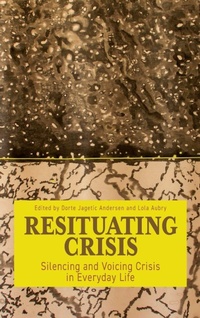
Resituating Crisis
Silencing and Voicing Crisis in Everyday Life
Published on 1. January 2025
Book
Hardback
298 pages
978-1-80539-825-7 (ISBN)
Description
The world is increasingly influenced by ongoing crises, or at least this is what mainstream media and politics wants us to believe. As is shown here, a crisis most often comes in the form of situations challenging a sense of normality, such as with violent conflicts, pandemics, or forced migration. However, crisis is not just a situation twisting normality but can become constitutive of normality itself. In exploring transformative and constructive elements to being in crisis, this volume resituates the view on crisis in everyday life to foster critical and nuanced examination of discourses on and experiences of it.
Reviews / Votes
"This is an excellent edited volume that is innovative, intriguing, and highly topical." * James W Scott, University of Eastern Finland"It has several fascinating and original chapters. It addresses crisis as an analytical term, bringing new perspectives on the term, its scale, and its analytical use." * Synnove Bendixsen, University of Bergen
More details
Language
English
Place of publication
Oxford
United Kingdom
Target group
Professional and scholarly
College/higher education
Product notice
Library binding
Illustrations
17 Illustrations
Dimensions
Height: 235 mm
Width: 157 mm
Thickness: 20 mm
Weight
568 gr
ISBN-13
978-1-80539-825-7 (9781805398257)
DOI
10.3167/9781805398257
Copyright in bibliographic data and cover images is held by Nielsen Book Services Limited or by the publishers or by their respective licensors: all rights reserved.
Schweitzer Classification
Other editions
Additional editions
E-Book
01/2025
1st Edition
Berghahn Books
€24.49
Available for download
E-Book
01/2025
1st Edition
Berghahn Books
€24.49
Available for download
Persons
Dorte Jagetic Andersen is Associate Professor at the Centre for Border Region Studies, Department of Political Science, University of Southern Denmark with a background in European ethnology, European continental philosophy and political science.
Content
List of Illustrations
Acknowledgments
Introduction: Silencing Crises / Making Crises Speak
Dorte Jagetic Andersen and Lola Aubry
Part I: (Re)Bordering the Crisis: Thinking Geopolitics from Everyday Life
Chapter 1. Everyday (Re)Bordering the Crisis
Georgie Wemyss
Chapter 2. Performing Crises/ Gatekeeping Crises: The Narrative Corridor in German Asylum and Court Hearings
Janina Schmidt
Chapter 3. Geopolitics and Biopolitics of Governing Cross-Border Mobilities in the Covid-19 Pandemic: Rationalities, Technologies and Subjectivities
Satu Kivelae and Eeva-Kaisa Prokkola
Chapter 4. Do I Cross a Border Now? An (Auto)Ethnographic Account of Borders and Bordering in Times of Crisis (and beyond)
Maria Fortuna and Dorte Jagetic Andersen
Part II: Revisiting the Critical Potential of Crisis
Chapter 5. Europe & the Crisis of Critical Thinking: Revisiting the Popular Movement Neues Forum
Marlene Paulin Kristensen
Chapter 6. 'It is All about Sexual Energy': Context-Specific Renditions of Homosexuality in Soviet Lithuania
Rasa Kamarauskaite
Chapter 7. Crisis Art: Artivism and Gender in Pandemic Times
Astrid M. Fellner
Chapter 8. Good Trouble: On Moral Crises and Ethical Experimentations
Lola Aubry
Part III: Crisis in, as and of Imperial and Colonial Legacies
Chapter 9. Crisis Apartheid: The Smokescreen of 'Geographical Proximity' as Rationalization to Legitimize a Welcome Politics for Ukrainian Refugees and Necropolitics for All the Others
Rodrigo Bueno Lacy and Henk Van Houtum
Chapter 10. Revisiting Ballybogoin - Lines, Traces, and Tidemarks in the Northern Irish Borderlands
Dorte Jagetic Andersen
Chapter 11. The Imposition of European Culture in the Indian Residential Schools of Canada and the Crisis of Colonial Narrative
Gaia Cardin and Kim Marcia Wittenburg
Chapter 12. Partition, Colonial Trauma and Temporalities of Stories: Writing and Performing Stories in Tandem to Situate Our Colonial Traumas in the Tensed Fields of Opacity and Heali
Kolar Aparna and Manju Sharma
Afterword: Spatializing Crisis
Olivier Kramsch
Index
Acknowledgments
Introduction: Silencing Crises / Making Crises Speak
Dorte Jagetic Andersen and Lola Aubry
Part I: (Re)Bordering the Crisis: Thinking Geopolitics from Everyday Life
Chapter 1. Everyday (Re)Bordering the Crisis
Georgie Wemyss
Chapter 2. Performing Crises/ Gatekeeping Crises: The Narrative Corridor in German Asylum and Court Hearings
Janina Schmidt
Chapter 3. Geopolitics and Biopolitics of Governing Cross-Border Mobilities in the Covid-19 Pandemic: Rationalities, Technologies and Subjectivities
Satu Kivelae and Eeva-Kaisa Prokkola
Chapter 4. Do I Cross a Border Now? An (Auto)Ethnographic Account of Borders and Bordering in Times of Crisis (and beyond)
Maria Fortuna and Dorte Jagetic Andersen
Part II: Revisiting the Critical Potential of Crisis
Chapter 5. Europe & the Crisis of Critical Thinking: Revisiting the Popular Movement Neues Forum
Marlene Paulin Kristensen
Chapter 6. 'It is All about Sexual Energy': Context-Specific Renditions of Homosexuality in Soviet Lithuania
Rasa Kamarauskaite
Chapter 7. Crisis Art: Artivism and Gender in Pandemic Times
Astrid M. Fellner
Chapter 8. Good Trouble: On Moral Crises and Ethical Experimentations
Lola Aubry
Part III: Crisis in, as and of Imperial and Colonial Legacies
Chapter 9. Crisis Apartheid: The Smokescreen of 'Geographical Proximity' as Rationalization to Legitimize a Welcome Politics for Ukrainian Refugees and Necropolitics for All the Others
Rodrigo Bueno Lacy and Henk Van Houtum
Chapter 10. Revisiting Ballybogoin - Lines, Traces, and Tidemarks in the Northern Irish Borderlands
Dorte Jagetic Andersen
Chapter 11. The Imposition of European Culture in the Indian Residential Schools of Canada and the Crisis of Colonial Narrative
Gaia Cardin and Kim Marcia Wittenburg
Chapter 12. Partition, Colonial Trauma and Temporalities of Stories: Writing and Performing Stories in Tandem to Situate Our Colonial Traumas in the Tensed Fields of Opacity and Heali
Kolar Aparna and Manju Sharma
Afterword: Spatializing Crisis
Olivier Kramsch
Index