

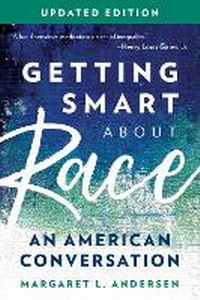
Getting Smart about Race
An American Conversation
Published on 15. July 2021
Book
Paperback/Softback
216 pages
978-1-5381-5635-3 (ISBN)
Description
Racial tension in America has become a recurring topic of conversation in politics, the media, and everyday life. There are numerous explanations as to why this has become a predominant subject in today's news and who is to blame. As Americans prepare once again to cast their Presidential ballots, it's more important than ever to have a smart and thoughtful conversation about race. In Getting Smart About Race, expert Margaret Andersen discusses why racial healing should be an integral element of our everyday discussions surrounding race and how to move the conversation in a positive direction. Getting Smart About Race is a clear, accessible introduction to understanding racial inequality and how we can and need to make a difference.
Reviews / Votes
In Getting Smart about Race, Margaret Andersen provides a lucid and sensitive meditation on racial inequality, analyzing both the origins of American racism as well our current social and political conflicts. Based on rigorous sociological research, this volume is written in an accessible narrative style and will provoke meaningful conversations about our nation's future. -- Henry Louis Gates Jr., Harvard University Like the cartoon fish who wonders what water is, white Americans are often oblivious to racism. This book is a necessary and timely corrective. Margaret Andersen has written an important examination of the "water" that continues to stubbornly define and divide us. I strongly recommend it. -- Mark Bowden, author of bestsellers <i>Black Hawk Down</i> and <i>The Last Stone</i>; journalist Margaret Andersen's clear, empathetic, evenhanded, and engaged writing can change the awareness of white readers who decide to face "all of this talk about race." Andersen makes their effort both worthwhile and rewarding. She lets readers know they matter and that what they think and do matters to the racial climate of this country--even the world. She shows us it is not too late to get smarter and outgrow what she calls the "commonsense racism" of our childhood environments and educations. The humane tone of this book is a gift to all who are making efforts toward social justice in the United States. -- Peggy McIntosh, Author of Privilege, Fraudulence, and Teaching As Learning and Founder of National SEED Project on Inclusive Curriculum (Seeking Educational Equity and Diversity) Getting Smart about Race promotes social understanding, drawing our attention to the peculiarly structural nature of systemic racism, while revealing some of its unlikely victims: white people. Gracefully written, accessible, and deeply illuminating - a reflexive work of singular importance that should be read and digested by everyone. -- Elijah Anderson, Sterling Professor of Sociology, Yale University, author of The Cosmopolitan Canopy: Race and Civility in Everyday Life and Code of the Street Dr. Andersen's approach to conversations around racism is accessible to people of all backgrounds, and provides a useful point of entry to discussions of race in a modern context. This book makes an important contribution to modern day efforts to dismantling racism across the country. -- Kristen Clarke, president and executive director, Lawyers' Committee for Civil Rights Under Law In a clear, elegant, and thorough way, Margaret Andersen makes us all 'smart about race'. She tells us what race, racism, and prejudice are, their effects in society, and what we can do to change the racial order of things. Getting Smart about Race will help advance our national dialogue about the continuing significance of race. -- Eduardo Bonilla-Silva, Duke University; author of Racism Without Racists Margaret Andersen's Getting Smart about Race is a roadmap for the substantive and constructive conversation about race we say we need to have. With the first sentence and one thoughtful question, she unsettles the racial landscape...But she doesn't just discuss the problem, she offers a way for us to discover the shared humanity which must be the foundation for racial healing in the United States of America. -- Jeffrey Blount, Emmy-award winning television director and author of The Emancipation of Evan WallsMore details
Edition
Revised edition
Language
English
Place of publication
United States
Publishing group
Bloomsbury Publishing Plc
Edition type
Revised edition
Illustrations
2 graphs
Dimensions
Height: 218 mm
Width: 142 mm
Thickness: 16 mm
Weight
286 gr
ISBN-13
978-1-5381-5635-3 (9781538156353)
Copyright in bibliographic data and cover images is held by Nielsen Book Services Limited or by the publishers or by their respective licensors: all rights reserved.
Schweitzer Classification
Other editions
Additional editions
E-Book
06/2021
Rowman & Littlefield Publishers
€20.49
Available for download
E-Book
06/2021
1st Edition
Rowman & Littlefield Publishers
€20.49
Available for download
Person
Margaret L. Andersen (Ph.D., M.A. University of Massachusetts, Amherst; B.A. Georgia State University) is the Edward F. and Elizabeth Goodman Rosenberg Professor Emerita at the University of Delaware. She is the author of several books, including her just published book: Race in Society: The Enduring American Dilemma, as well as Thinking about Women, soon to bepublished in its eleventh edition; the best-selling anthology, Race, Class and Gender (co-edited with Patricia Hill Collins; soon to be published in its 10th ed.), Race and Ethnicity in Society: The Changing Landscape (co-edited with Elizabeth Higginbotham; 4th edition), Sociology: The Essentials (co-authored, Howard F. Taylor, 10th ed.), Living Art: The Life of African American Art Collector Paul Jones; and, On Land and On Sea: A Century of Women in the Rosenfeld Collection.
She has received two teaching awards from the University of Delaware and two prestigious awards from her professional organizations: The Eastern Sociological Society Merit Award for career contributions and the American Sociological Association's Jessie Bernard Award, an award given for expanding the boundaries of sociology to include women. In 2017, she was granted an honorary doctorate from the University of Delaware in recognition of her scholarship, teaching, and service.
She has received two teaching awards from the University of Delaware and two prestigious awards from her professional organizations: The Eastern Sociological Society Merit Award for career contributions and the American Sociological Association's Jessie Bernard Award, an award given for expanding the boundaries of sociology to include women. In 2017, she was granted an honorary doctorate from the University of Delaware in recognition of her scholarship, teaching, and service.
Content
Acknowledgments
Introduction
Chapter 1: Race: A Thoroughly Social Idea
Chapter 2: Feeling Race in Everyday Life
Chapter 3: Who, Me? I'm Not a Racist, But . . .
Chapter 4: What Did You Say? Contesting
Commonsense Racism
Chapter 5: But That Was Then-I Didn't Have
Anything to Do with It
Chapter 6: Getting Smart about Race, Then Doing
Something about It
Appendix A: Finding Common Ground:
Questions for Conversation
Appendix B: Further Resources
Notes
Index
About the Author
Introduction
Chapter 1: Race: A Thoroughly Social Idea
Chapter 2: Feeling Race in Everyday Life
Chapter 3: Who, Me? I'm Not a Racist, But . . .
Chapter 4: What Did You Say? Contesting
Commonsense Racism
Chapter 5: But That Was Then-I Didn't Have
Anything to Do with It
Chapter 6: Getting Smart about Race, Then Doing
Something about It
Appendix A: Finding Common Ground:
Questions for Conversation
Appendix B: Further Resources
Notes
Index
About the Author