

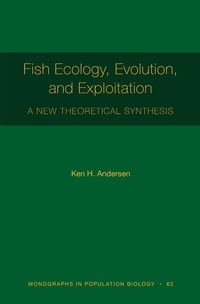
Fish Ecology, Evolution, and Exploitation
A New Theoretical Synthesis
Published on 16. July 2019
Book
Hardback
280 pages
978-0-691-17655-0 (ISBN)
Description
Fish are one of the most important global food sources, supplying a significant share of the world's protein consumption. From stocks of wild Alaskan salmon and North Sea cod to entire fish communities with myriad species, fisheries require careful management to ensure that stocks remain productive, and mathematical models are essential tools for doing so. Fish Ecology, Evolution, and Exploitation is an authoritative introduction to the modern size- and trait-based approach to fish populations and communities.
Ken Andersen covers the theoretical foundations, mathematical formulations, and real-world applications of this powerful new modeling method, which is grounded in the latest ecological theory and population biology. He begins with fundamental assumptions on the level of individuals and goes on to cover population demography and fisheries impact assessments. He shows how size- and trait-based models shed new light on familiar fisheries concepts such as maximum sustainable yield and fisheries selectivity-insights that classic age-based theory can't provide-and develops novel evolutionary impacts of fishing. Andersen extends the theory to entire fish communities and uses it to support the ecosystem approach to fisheries management, and forges critical links between trait-based methods and evolutionary ecology.
Accessible to ecologists with a basic quantitative background, this incisive book unifies the thinking in ecology and fisheries science and is an indispensable reference for anyone seeking to apply size- and trait-based models to fish demography, fisheries impact assessments, and fish evolutionary ecology.
Ken Andersen covers the theoretical foundations, mathematical formulations, and real-world applications of this powerful new modeling method, which is grounded in the latest ecological theory and population biology. He begins with fundamental assumptions on the level of individuals and goes on to cover population demography and fisheries impact assessments. He shows how size- and trait-based models shed new light on familiar fisheries concepts such as maximum sustainable yield and fisheries selectivity-insights that classic age-based theory can't provide-and develops novel evolutionary impacts of fishing. Andersen extends the theory to entire fish communities and uses it to support the ecosystem approach to fisheries management, and forges critical links between trait-based methods and evolutionary ecology.
Accessible to ecologists with a basic quantitative background, this incisive book unifies the thinking in ecology and fisheries science and is an indispensable reference for anyone seeking to apply size- and trait-based models to fish demography, fisheries impact assessments, and fish evolutionary ecology.
Reviews / Votes
"I believe that over time this book will come to be seen as redefining much of fisheries science and I recommend it wholeheartedly."---Robert Thorpe, Fish and Fisheries "Any scientist working on fish and with a basic background in numerical approach may find interest in this book."---Pierre Cresson, CybiumMore details
Series
Language
English
Place of publication
New Jersey
United States
Target group
College/higher education
Professional and scholarly
Product notice
Trade binding
Illustrations
71 b/w illus. 10 tables.
Dimensions
Height: 236 mm
Width: 160 mm
Thickness: 23 mm
Weight
612 gr
ISBN-13
978-0-691-17655-0 (9780691176550)
Copyright in bibliographic data and cover images is held by Nielsen Book Services Limited or by the publishers or by their respective licensors: all rights reserved.
Schweitzer Classification
Other editions
Additional editions
E-Book
06/2019
1st Edition
Princeton University Press
€45.99
Available for download
Person
Ken H. Andersen is professor of theoretical marine ecology and deputy director of the Centre for Ocean Life at the Technical University of Denmark's National Institute of Aquatic Resources.