

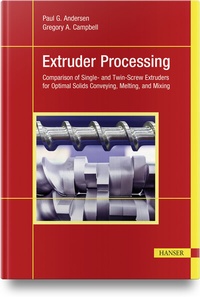
Extruder Processing
Comparison of Single- and Twin-Screw Extruders for Optimal Solids Conveying, Melting, and Mixing
1st Edition
Published on 30. September 2022
Book
Hardback
XIV, 220 pages
978-1-56990-863-1 (ISBN)
Description
Single-screw or twin-screw extruder? When the need to produce a homogeneous polymer melt occurs in the industrial environment, both product attributes and equipment cost must be evaluated. For many applications both the single and twin-screw extruder will produce the desired homogeneous melt needed to form the product through an extrusion die. Some applications such as dispersive mixing of solids in a polymer matrix are best accomplished in a twin-screw extruder. On the other hand, applications involving chemical reactions, color concentrate distributive mixing, and in line polymer-polymer distributive mixing can be accomplished with either device.
However, for the same production rate, twin-screw extruders are generally more expensive than single-screw extruders with a diameter less than 200 mm. Therefore, a thorough understanding is needed for the concepts of solids conveying, melting, and mixing for the two types of extruders to make appropriate process acquisition decisions. This book covers engineering and technology concepts that should aid the practitioner in comparing these two types of extrusion equipment relative to process requirements.
More details
Other editions
Additional editions
Paul G. Andersen | Gregory A. Campbell
Extruder Processing
Comparison of Single- and Twin-Screw Extruders for Optimal Solids Conveying, Melting, and Mixing
E-Book
09/2022
1st Edition
Hanser Publications
€99.99
Available for download
Persons
Author
Paul G. Andersen, Ph.D., is Process Technology Consultant at Coperion Corporation, Ramsey, NJ, USA. He was previously Director, Process Technology at Coperion, a position he held until 2016. In 2009/2010, he was President of the Society of Plastics Engineers (SPE).
ISNI:
ISNI:
Gregory A. Campbell, Ph.D., is Chief Technical Officer at Castle Associates, Jonesport, ME. He was previously professor and departmental chair of chemical engineeering at Clarkson University, NY. He formerly directed a research group at GM Research and managed polymer fabrication at Mobil Chemical Research. He is a Fellow and former Extrusion Board Member of the Society of Plastics Engineers (SPE).
ISNI:
ISNI:
Content
Part 1: Validation of Computerized Systems
Recent Changes in Regulations and Regulatory Guidance
Instrument Qualification, Computerized System Validation and Method Validation
Regulatory Requirements for Computerized System Validation
Computerized System Validation
Writing the User Requirements Specification (URS)
Auditing the System Supplier
Installation Qualification and Operational Qualification (IQ and OQ)
Performance Qualification (PQ) or End User Testing
Part 2: Method Validation
Measurement Errors and Uncertainty of Measurement
Validation of Analytical Procedures and Methods
Interlaboratory Studies in Thermal Analysis
Method Development Through to SOP
Practical Examples
Appendix 1: 21 CFR Part 11 and EU GMP Annex 11
Appendix 2: Basic Statistics
Appendix 3: Standard Test Methods for Thermal Analysis
Recent Changes in Regulations and Regulatory Guidance
Instrument Qualification, Computerized System Validation and Method Validation
Regulatory Requirements for Computerized System Validation
Computerized System Validation
Writing the User Requirements Specification (URS)
Auditing the System Supplier
Installation Qualification and Operational Qualification (IQ and OQ)
Performance Qualification (PQ) or End User Testing
Part 2: Method Validation
Measurement Errors and Uncertainty of Measurement
Validation of Analytical Procedures and Methods
Interlaboratory Studies in Thermal Analysis
Method Development Through to SOP
Practical Examples
Appendix 1: 21 CFR Part 11 and EU GMP Annex 11
Appendix 2: Basic Statistics
Appendix 3: Standard Test Methods for Thermal Analysis