

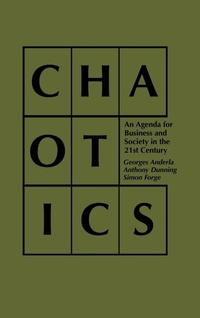
Chaotics
An Agenda for Business and Society in the 21st Century
Published on 25. June 1997
Book
Hardback
240 pages
978-0-275-95691-2 (ISBN)
Description
The new discipline of chaotics will alter our thinking about the real forces of change in our society. As presented here, chaotics emphasizes that the real world cannot be understood in terms of conventional deterministic philosophies or standard chaos theory, but that complexity in itself has a powerful but subtle role to play. How does this apply to business and society? To what degree are our lives governed by misguided notions-or do our businesses succeed by chance-because real societal and business forces and their effects are not really understood? Beginning with the foundations of the discipline, this book applies chaotics to business and wealth creation and to society. On the social side, it examines a sea-change in the philosophy of everyday living, be it the concept of employment or our relationship to the environment. The book examines personal identity and its loss in modern society, as well as the search for new contacts and gratification through technology. The authors look at the stunted growth of philosophy against science but emphasize what philosophy has to tell us in a chaotic world. A major new text which will be of interest to professionals and scholars in business, government, and society.
More details
Language
English
Place of publication
United States
Publishing group
Bloomsbury Publishing Plc
Target group
College/higher education
Professional and scholarly
Interest Age: From 7 to 17 years
Dimensions
Height: 235 mm
Width: 157 mm
Thickness: 19 mm
Weight
546 gr
ISBN-13
978-0-275-95691-2 (9780275956912)
Copyright in bibliographic data and cover images is held by Nielsen Book Services Limited or by the publishers or by their respective licensors: all rights reserved.
Schweitzer Classification
Persons
GEORGES ANDERLA, an economist by training, was head of the EC Information Technology Directorate, where he set up Euronet, an early European academic forerunner of the Internet. He is the coauthor, with Anthony Dunning, of Computer Strategies, 1990-1999 (1987).
ANTHONY DUNNING is Information Resources Manager in the office of the Directorate-General for Telecommunications, Information Market and Innovation of the European Commission.
SIMON FORGE is a director of the Cambridge Strategic Management Group, a telecommunications and information technology consultancy, and is on the board of Futures.
ANTHONY DUNNING is Information Resources Manager in the office of the Directorate-General for Telecommunications, Information Market and Innovation of the European Commission.
SIMON FORGE is a director of the Cambridge Strategic Management Group, a telecommunications and information technology consultancy, and is on the board of Futures.
Content
Illustrations Preface and Acknowledgments Foundations of Chaotics A Routemap to the Concepts and the Book An Overview of Chaos and Complexity Insights from Numbers and Visualizing Chaos Contrasts in Chaos Theory, Complex Systems Theory, and Greek Omelettes, in the Search for Chaotic Axioms Business Chaotics: Perspectives on Wealth Creation--a Positive Approach Production for Increasing Returns Economics, Intelligence and Turbulence Technology Forecasting, with a Safety Net Breakthrough and Soft Landing Social Chaotics: Principles for Designing and Building Society--a Sea-Change in the Philosophy of Living Earthly Space-Time Trade-Offs Employment, Unemployment and Its Antidotes The Coming Take-Off of the Third World An Environment in Search of Its Guardians A Recap Briefly, Thinking with Chaotics--And Our 21st Century Agenda Appendices: Computing under Chaotics--Slow Decay versus Self-Organization; Playing Simple Games with Numbers Bibliography Glossary of Terms Index