

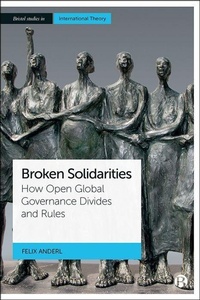
Broken Solidarities
How Open Global Governance Divides and Rules
1st Edition
Published on 28. July 2022
Book
Hardback
266 pages
978-1-5292-2021-6 (ISBN)
Description
Felix Anderl's book is a stimulating analysis of the decline of social movements against the World Bank and the rise of a new form of transnational rule.
Reflecting on the transnational mobilizations of the 1990s, the book examines activists' struggles to sustain their momentum. It shows how the opening up of world economic institutions contributed to complex rule in global governance, creating access for some while weakening their critique and fragmenting the overall movement.
The book bridges international relations and social movement studies to observe international organizations and social movements in their interaction, demonstrating how social movements are divided and ruled in the absence of a ruler.
Reflecting on the transnational mobilizations of the 1990s, the book examines activists' struggles to sustain their momentum. It shows how the opening up of world economic institutions contributed to complex rule in global governance, creating access for some while weakening their critique and fragmenting the overall movement.
The book bridges international relations and social movement studies to observe international organizations and social movements in their interaction, demonstrating how social movements are divided and ruled in the absence of a ruler.
Reviews / Votes
"A disheartened activist and brilliant scholar, Anderl rewrites the book on the dynamics of rule and resistance in global governance and the theorization of rule in international relations." Nicholas Onuf, Florida International University "This book is a major contribution to our understanding of both global social movements and global governance. Anderl's powerful analysis makes us see the relationship between social movements and international organizations in an entirely different light. A must-read for international-relations scholars of any stripe." Ayse Zarakol, University of Cambridge "Felix Anderl has produced a theoretically innovative and empirically rich book that re-frames debates about the role of advocacy groups in global governance. It is an impressive book that shows how openness and transparency also entail mechanisms of exclusion." Ole Jacob Sending, Norwegian Institute of International AffairsMore details
Series
Edition
First Edition
Language
English
Place of publication
Bristol
United Kingdom
Target group
Professional and scholarly
Edition type
Abridged edition
Illustrations
5 s/w Abbildungen, 6 s/w Tabellen
6 Tables, black and white; 5 Illustrations, black and white
Dimensions
Height: 237 mm
Width: 163 mm
Thickness: 22 mm
Weight
550 gr
ISBN-13
978-1-5292-2021-6 (9781529220216)
Copyright in bibliographic data and cover images is held by Nielsen Book Services Limited or by the publishers or by their respective licensors: all rights reserved.
Schweitzer Classification
Other editions
Additional editions
Book
01/2024
1st Edition
Bristol University Press
€43.50
Shipment within 3-4 weeks
E-Book
07/2022
1st Edition
Bristol University Press
€42.49
Available for download
Person
Felix Anderl is Professor for Conflict Studies at the Center for Conflict Studies at Philipps Universitaet Marburg.
Content
Introduction
1 Social Movements and International Relations
2. Transnational Rule and Resistance
3. Complex Rule in Global Governance
4. Mechanisms of Fragmentation
5. A History of Interaction: The World Bank Group and Its Early Critics
6. When a Contentious Process Opens Up: Extractive Industries Review
7. Fragmentation in Contestation: The Movement during the EIR Process
8. Uncontentious Politics? The Civil Society Policy Forum
9. Fragmentation in Cooperation: Observing the Changing Practices of Critique
Conclusion
1 Social Movements and International Relations
2. Transnational Rule and Resistance
3. Complex Rule in Global Governance
4. Mechanisms of Fragmentation
5. A History of Interaction: The World Bank Group and Its Early Critics
6. When a Contentious Process Opens Up: Extractive Industries Review
7. Fragmentation in Contestation: The Movement during the EIR Process
8. Uncontentious Politics? The Civil Society Policy Forum
9. Fragmentation in Cooperation: Observing the Changing Practices of Critique
Conclusion