

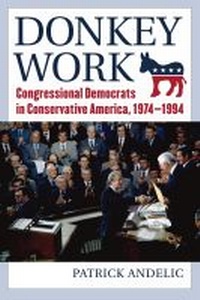
Donkey Work
Congressional Democrats in Conservative America, 1974-1994
Will be published approx. on 30. May 2019
Book
Hardback
304 pages
978-0-7006-2803-2 (ISBN)
Description
What happened to the Democratic Party after the 1960s? In many political histories, the McGovern defeat of 1972 announced the party's decline-and the conservative movement's ascent. What the conventional narrative neglects, Patrick Andelic submits, is the role of Congress in the party's, and the nation's, political fortunes. In Donkey Work, Andelic looks at Congress from 1974 to 1994 as the Democratic Party's stronghold and explores how this twenty-year tenure boosted and undermined the party's response to the conservative challenge.
If post-1960s America belongs to the conservative movement, Andelic asks, how do we account for the failure of so much of the conservative agenda-especially the shrinking of the federal government? Examining the Democratic Party's unusual durability in Congress after 1974, Donkey Work disrupts the narrative of inexorable liberal decline since the 1970s and reveals the ways in which liberalism and conservatism actually developed in tandem. The book traces the evolution of ideologies within the Democratic Party, particularly the emergence of "neoliberalism," suggesting that this political philosophy was as much an anticipation of America's "right turn" as a reaction to it; as factions vied for control of the party, Congress itself both strengthened and weakened liberal resistance to the conservative movement.
By putting the focus on Congress and legislative politics, in contrast to the "presidential synthesis" that dominates US political history, Andelic's book offers a new, deeply informed perspective on two turbulent decades of American politics-a perspective that alters and expands our understanding of how we arrived at our present political moment.
If post-1960s America belongs to the conservative movement, Andelic asks, how do we account for the failure of so much of the conservative agenda-especially the shrinking of the federal government? Examining the Democratic Party's unusual durability in Congress after 1974, Donkey Work disrupts the narrative of inexorable liberal decline since the 1970s and reveals the ways in which liberalism and conservatism actually developed in tandem. The book traces the evolution of ideologies within the Democratic Party, particularly the emergence of "neoliberalism," suggesting that this political philosophy was as much an anticipation of America's "right turn" as a reaction to it; as factions vied for control of the party, Congress itself both strengthened and weakened liberal resistance to the conservative movement.
By putting the focus on Congress and legislative politics, in contrast to the "presidential synthesis" that dominates US political history, Andelic's book offers a new, deeply informed perspective on two turbulent decades of American politics-a perspective that alters and expands our understanding of how we arrived at our present political moment.
Reviews / Votes
A powerful and necessary corrective to the idea that US liberalism simply sputtered out with the elections of Nixon and Reagan. Engaging and smart, Andelic shows the persistent power of congressional liberalism in the 1970s, '80s, and beyond."" - Jennifer A. Delton, author of Making Minnesota Liberal: Civil Rights and the Transformation of the Democratic PartyMore details
Language
English
Place of publication
Kansas
United States
Target group
Professional and scholarly
Dimensions
Height: 229 mm
Width: 152 mm
Thickness: 25 mm
Weight
615 gr
ISBN-13
978-0-7006-2803-2 (9780700628032)
Copyright in bibliographic data and cover images is held by Nielsen Book Services Limited or by the publishers or by their respective licensors: all rights reserved.
Schweitzer Classification
Other editions
Additional editions
E-Book
06/2019
1st Edition
University Press of Kansas
from
€102.99
Available for download
Person
Patrick Andelic is lecturer in American history at Northumbria University at Newcastle upon Tyne, United Kingdom. His work has appeared in the Journal of Policy History and The Historical Journal.