

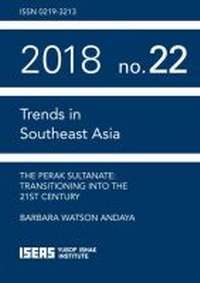
The Perak Sultanate
Transitioning Into the 21st Century
Published on 28. February 2019
Book
Paperback/Softback
56 pages
978-981-4843-34-8 (ISBN)
Description
Although Dr Mahathir Mohamad's earlier government (1981-2003) limited the powers and privileges of Malaysia's nine hereditary rulers, the political influence that they could exercise was still evident in the "Perak Crisis" of 2009, which also generated public debate about royal rights.
In recent years, public wariness in Malaysia about politicians has helped the rulers present themselves as alternative sources of authority. "Monarchical activism" has been especially evident in the state of Perak, dating from 1984 when Sultan Azlan Muhibbuddin Shah, who was until then Malaysia's Lord President, was installed as the thirty-fourth ruler. In 2014, he was succeeded by his eldest son, Sultan Nazrin Muizzuddin Shah.
Sultan Nazrin Shah has presented himself as a modern, educated and approachable ruler who consistently endorses the rule of law and is aware that public support for the monarch is highly dependent on meeting expectations in regard to ethical conduct and good governance.
This paper argues that although Sultan Azlan Shah and Sultan Nazrin Shah have embraced the idea of a "new" Malaysian monarchy that actively responds to changing political and social contexts, two issues with especial relevance to the situation today can be tracked through the history of Perak's royal line since its inception in the sixteenth century. The first, arguably now of lesser importance, concerns royal succession. The second issue, still highly important, involves the ruler's relationships with non-royal officials and with elected representatives and the public at large.
In recent years, public wariness in Malaysia about politicians has helped the rulers present themselves as alternative sources of authority. "Monarchical activism" has been especially evident in the state of Perak, dating from 1984 when Sultan Azlan Muhibbuddin Shah, who was until then Malaysia's Lord President, was installed as the thirty-fourth ruler. In 2014, he was succeeded by his eldest son, Sultan Nazrin Muizzuddin Shah.
Sultan Nazrin Shah has presented himself as a modern, educated and approachable ruler who consistently endorses the rule of law and is aware that public support for the monarch is highly dependent on meeting expectations in regard to ethical conduct and good governance.
This paper argues that although Sultan Azlan Shah and Sultan Nazrin Shah have embraced the idea of a "new" Malaysian monarchy that actively responds to changing political and social contexts, two issues with especial relevance to the situation today can be tracked through the history of Perak's royal line since its inception in the sixteenth century. The first, arguably now of lesser importance, concerns royal succession. The second issue, still highly important, involves the ruler's relationships with non-royal officials and with elected representatives and the public at large.
More details
Series
Language
English
Place of publication
Pasir Panjang
Singapore
Target group
Professional and scholarly
Dimensions
Height: 229 mm
Width: 152 mm
Weight
333 gr
ISBN-13
978-981-4843-34-8 (9789814843348)
Copyright in bibliographic data and cover images is held by Nielsen Book Services Limited or by the publishers or by their respective licensors: all rights reserved.
Schweitzer Classification
Person
Barbara Watson Andaya is Professor of Asian Studies at the University of Hawai'i at Manoa and former Visiting Senior Fellow at the ISEAS - Yusof Ishak Institute, Singapore.