

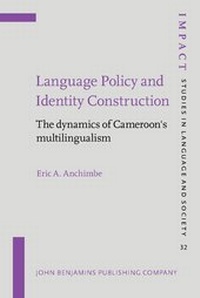
Language Policy and Identity Construction
The dynamics of Cameroon's multilingualism
Published on 7. January 2013
Book
Hardback
250 pages
978-90-272-1873-5 (ISBN)
Description
The (dis)empowerment of languages through language policy in multilingual postcolonial communities often shapes speakers' identification with these languages, their attitude towards other languages in the community, and their choices in interpersonal and intergroup communication. Focusing on the dynamics of Cameroon's multilingualism, this book contributes to current debates on the impact of politic language policy on daily language use in sociocultural and interpersonal interactions, multiple identity construction, indigenous language teaching and empowerment, the use of Cameroon Pidgin English in certain formal institutional domains initially dominated by the official languages, and linguistic patterns of social interaction for politeness, respect, and in-group bonding. Due to the multiple perspectives adopted, the book will be of interest to sociolinguists, applied linguists, pragmaticians, Afrikanists, and scholars of postcolonial linguistics.
More details
Series
Language
English
Place of publication
Amsterdam
Netherlands
Target group
Professional and scholarly
Dimensions
Height: 245 mm
Width: 164 mm
Weight
645 gr
ISBN-13
978-90-272-1873-5 (9789027218735)
Copyright in bibliographic data and cover images is held by Nielsen Book Services Limited or by the publishers or by their respective licensors: all rights reserved.
Schweitzer Classification
Other editions
Additional editions
Eric A. Anchimbe
Language Policy and Identity Construction
The dynamics of Cameroon's multilingualism
E-Book
01/2013
1st Edition
John Benjamins Publishing Company
€123.99
Available for download
Person
Content
1. Introduction: Language policy and identity construction in multilingual Cameroon; 2. Chapter 1. Functional marginalisation and the future of indigenous languages: More official functions for indigenous languages; 3. Chapter 2. Language policy towards indigenous languages: Many decrees and laws but less practice; 4. Chapter 3. Constraints to indigenous language empowerment: On language relevance, views from below; 5. Chapter 4. Crossing the survival line: Factors that protect indigenous languages from extinction; 6. Chapter 5. Towards a regional multilingualism model: Empowering indigenous languages through policy and functional utility; 7. Chapter 6. Slippery pathways in French-English bilingualism: Cameroon is bilingual but Cameroonians are not; 8. Chapter 7. Anglophonism and francophonism: Tendencies in official language identity; 9. Chapter 8. Hybrid linguistic identities and identity opportunism: Switching identity together with language; 10. Chapter 9. Cameroon Pidgin English: Expanding functions and increasing users; 11. Chapter 10. Come greet Uncle Eric: Politeness and respect through kinship terms; 12. Chapter 11. Youthspeak: Lexical markers of youth group communication; 13. On language policy, linguistic identity, and social interaction: General implications and further research; 14. Appendices; 15. References; 16. Index