

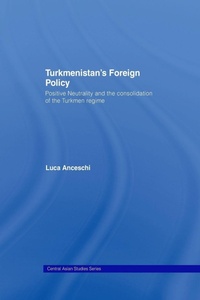
Turkmenistan's Foreign Policy
Positive Neutrality and the consolidation of the Turkmen Regime
1st Edition
Published on 21. December 2015
Book
Paperback/Softback
240 pages
978-1-138-99391-4 (ISBN)
Description
Turkmenistan, an independent nation since 1991, is a strategically important Central Asian state. This book covers the most significant period of the establishment of the Turkmen political regime. At the core of this book is the Doctrine of Positive Neutrality, which, from 1995 onwards, constituted the theoretical backbone for the foreign policy of post-Soviet Turkmenistan. The author analyses the reason and aim of the concept, its significance for and impact on the country's domestic and foreign relations, its practical implementation and its transformation into a tool of strengthening of absolute personal authority. Furthermore, he establishes whether Positive Neutrality has to be seen as a 'domestic-oriented' foreign policy, which has been used by the Turkmen regime to reinforce its internal position. .
This is the first book-length and thorough analysis of Turkmenistan's foreign policy. It furthers our understanding of Turkmenistan, and provides an informed background for the study of its foreign policy. It fills a void in the current literature, and it will constitute an essential reference for most scholars and researcher focusing on contemporary Central Asia, Russian foreign policy, Foreign Policy, International Relations and Comparative Politics.
This is the first book-length and thorough analysis of Turkmenistan's foreign policy. It furthers our understanding of Turkmenistan, and provides an informed background for the study of its foreign policy. It fills a void in the current literature, and it will constitute an essential reference for most scholars and researcher focusing on contemporary Central Asia, Russian foreign policy, Foreign Policy, International Relations and Comparative Politics.
Reviews / Votes
'In Turkmenistan's Foreign Policy, Luca Anceschi provides welcome insights into the development of this fascinating country. He draws a comprehensive picture of the evolution of the Turkmen regime from the emergence and consolidation of Saparmurat Niyazov's personal dictatorship to the post-Niyazov era of President Gurbanguly Berdymukhammedov, who, as Anceschi effectively points out, has so far provided more continuity than change in Turkmenistan's domestic and foreign-policy approaches despite his early promise to open up Turkmenistan's political system' - Survivial, December 2008'Anceschi's book presents a great opportunity to fill the scholarly vacuum that continues to exist with respect to Turkmen studies. The book provides an in-depth analysis of post-Soviet Turkmen foreign policy...]' - Grigol Ubiria, The Australian National University, Asian Politics and Policy 1(3) 2009
'Luca Anceschi's book makes itself immediately valuable as a study that, without ignoring Niyazov's cult of personality, looks beyond that regime's eccentricities to provide an overview of Turkmenistan's policy of positive neutrality' - VICTORIA CLEMENT, Europe-Asia Studies, Volume 61, 2009
"As a whole, the book is a revealing read...It is based on an admirably broad selection of first-hand sources...The chapter on economic foreign policy, in particular, is detailed and impressive". - Michael Pye, Asian Affairs, July 2010
"Luca Anceschi provides a unique, scholarly analysis of the evolution of Turkmenistan's foreign policy in the post-Soviet era, as the country struggled to establish itself as an independent state in a turbulent neighbourhood... a well-written, thorough analysis of Turkmenistan's foreign policy, which provides a fascinating insight into the evolution of a unique international stance." - Tracey German, King's College London, UK; International Affairs 86:6, 2010 "Luca Anceschi provides a unique, scholarly analysis of the evolution of Turkmenistan's foreign policy in the post-Soviet era...[This] is a well-written, thorough analysis of Turkmenistan's foreign policy, which provides a fascinating insight into the evolution of a unique international stance." - Tracey German, International Affairs, 86:6, 2010
More details
Series
Language
English
Place of publication
London
United Kingdom
Publishing group
Taylor & Francis Ltd
Target group
College/higher education
Illustrations
11 s/w Tabellen, 4 s/w Abbildungen, 4 s/w Zeichnungen
11 Tables, black and white; 4 Line drawings, black and white; 4 Illustrations, black and white
Dimensions
Height: 234 mm
Width: 156 mm
Thickness: 13 mm
Weight
371 gr
ISBN-13
978-1-138-99391-4 (9781138993914)
Copyright in bibliographic data and cover images is held by Nielsen Book Services Limited or by the publishers or by their respective licensors: all rights reserved.
Schweitzer Classification
Other editions
Additional editions
Luca Anceschi
Turkmenistan's Foreign Policy
Positive Neutrality and the consolidation of the Turkmen Regime
E-Book
07/2008
Routledge
€67.49
Available for download
Luca Anceschi
Turkmenistan's Foreign Policy
Positive Neutrality and the consolidation of the Turkmen Regime
E-Book
07/2008
Routledge
€67.49
Available for download
Luca Anceschi
Turkmenistan's Foreign Policy
Positive Neutrality and the consolidation of the Turkmen Regime
Book
07/2008
1st Edition
Routledge
€262.10
Shipment within 15-20 days
Person
Luca Anceschi is Research Associate at the Centre for Dialogue, La Trobe University, Australia. He is a graduate of the University of Naples 'L'Orientale' and of La Trobe University. His main research interests include the international politics of post-Soviet Central Asia and the Caucasus.
Content
Introduction Part 1: Contextualising Turkmenistan's Foreign Policy 1. Establishing a conceptual framework for the policy of Positive Neutrality 2. Turkmen authoritarianism in the post-Soviet era 3. The Doctrine of Positive Neutrality as a key element in nation-building Part 2: The Operational Dimension of Turkmen Foreign Policy 4. The Economic Foreign Policy of Neutral Turkmenistan 5. Neutrality as equidistance from sources of dependency: Russo-Turkmen relations in the post-Soviet Era 6. Neutrality as a policy of insulation: The international community and human rights violations in Turkmenistan 7. Turkmenistan's foreign policy in the post-Niyazov era Conclusion: Continuity and change in Turkmen foreign policy-making