

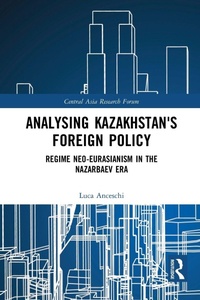
Analysing Kazakhstan's Foreign Policy
Regime neo-Eurasianism in the Nazarbaev era
1st Edition
Published on 29. August 2022
Book
Paperback/Softback
208 pages
978-1-032-40028-0 (ISBN)
Description
This book investigates the roles that ideas and constructs associated with Eurasia have played in the making of Kazakhstan's foreign policy during the Nazarbaev era.
This book delves into the specific Eurasia-centric narratives through which the regime, headed by Nursultan Nazarbaev, imagined the role of post-Soviet Kazakhstan in the wider Eurasian geopolitical space. Based on substantive fieldwork and sustained engagement with primary sources, the book unveils the power implications of Kazakhstani neo-Eurasianism, arguing that the strengthening of the regime's domestic power ranked highly in the list of objectives pursued by Kazakhstani foreign policy between the collapse of the Soviet Union and Nazarbaev's apparent withdrawal from the Kazakhstani political scene (19 March 2019). This book, ultimately, is a study of inter-state integration, which makes use of a rigorous methodological approach to assess different incarnations of post-Soviet multilateralism, from the Commonwealth of Independent States to the more recent, and highly controversial, Eurasian Economic Union.
This book offers a ground-breaking analysis of Kazakhstani foreign policy in the Nazarbaev era. It will be of interest to students and scholars of Central Asian Politics, International Relations and Security Studies.
This book delves into the specific Eurasia-centric narratives through which the regime, headed by Nursultan Nazarbaev, imagined the role of post-Soviet Kazakhstan in the wider Eurasian geopolitical space. Based on substantive fieldwork and sustained engagement with primary sources, the book unveils the power implications of Kazakhstani neo-Eurasianism, arguing that the strengthening of the regime's domestic power ranked highly in the list of objectives pursued by Kazakhstani foreign policy between the collapse of the Soviet Union and Nazarbaev's apparent withdrawal from the Kazakhstani political scene (19 March 2019). This book, ultimately, is a study of inter-state integration, which makes use of a rigorous methodological approach to assess different incarnations of post-Soviet multilateralism, from the Commonwealth of Independent States to the more recent, and highly controversial, Eurasian Economic Union.
This book offers a ground-breaking analysis of Kazakhstani foreign policy in the Nazarbaev era. It will be of interest to students and scholars of Central Asian Politics, International Relations and Security Studies.
Reviews / Votes
Luca Anceschi needs little introduction as a well-published scholar of Central Asian affairs. [...] Analyzing Kazakhstan's Foreign Policy provides a masterful account of the driving themes and issues with Kazakhstan's foreign policy since its independence. - Li-Chen Sim, Khalifa University, United Arab Emirates, Journal of Asian Security and International Affairs 8(2)More details
Series
Language
English
Place of publication
London
United Kingdom
Publishing group
Taylor & Francis Ltd
Target group
College/higher education
Postgraduate
Dimensions
Height: 234 mm
Width: 156 mm
Thickness: 12 mm
Weight
327 gr
ISBN-13
978-1-032-40028-0 (9781032400280)
Copyright in bibliographic data and cover images is held by Nielsen Book Services Limited or by the publishers or by their respective licensors: all rights reserved.
Schweitzer Classification
Other editions
Additional editions
Book
04/2020
1st Edition
Routledge
€206.20
Shipment within 15-20 days
E-Book
03/2020
1st Edition
Routledge
€59.49
Available for download
E-Book
03/2020
1st Edition
Routledge
€59.49
Available for download
Person
Luca Anceschi is Senior Lecturer in Central Asian Studies at the University of Glasgow, UK. He is the Editor of the journal Europe-Asia Studies and the author of Turkmenistan's Foreign Policy-Positive Neutrality and the Consolidation of the Turkmen Regime, also published by Routledge (2009).
Content
Introduction 1. Kazakhstani Foreign Policy in the Pre-Eurasianist Era (December 1991-November 1993) 2. From Ideya to Initsiativa? Neo-Eurasianist Rhetoric in Post-Soviet Kazakhstan 3. Regime Neo-Eurasianism and the Failure of Central Asian Regionalism 4. Civilised Divorce, Marriage of Convenience: Revisiting Two Decades of Post-Soviet Re-INTEGRATSIYA (1994-2010) 5. Eurasia without Eurasianism. Kazakhstan and the Eurasian Economic Union Conclusion: Foreign Policy, Power and Identity in the Nazarbaev Era