

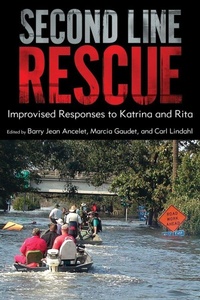
Second Line Rescue
Improvised Responses to Katrina and Rita
Published on 30. May 2013
Book
Hardback
228 pages
978-1-61703-796-2 (ISBN)
Description
Second Line Rescue: Improvised Responses to Katrina and Rita chronicles the brave and creative acts through which Gulf Coast people rescued their neighbors during the chaotic aftermath of Hurricanes Katrina and Rita. Ordinary citizens joined in with whatever resources they had. Unlike many of the official responders, vernacular rescuers found ways around paralysis produced by a breakdown in communications and infrastructure. They were able to dispel unfounded fears produced by erroneous or questionable reporting. The essays, personal narratives, media reports, and field studies presented here all have to do with effective and often ingenious answers that emerged from the people themselves. Their solutions are remarkably different from the hamstrung government response, and their perspectives are a tonic to sensationalized media coverage.
The first part of the collection deals with Gulf Coast rescuers from outside stricken communities: those who, safe in their own homes and neighborhoods, marshaled their resources to help their fellow citizens. It includes some analysis and scholarly approaches, but it also includes direct responses and first-hand field reports. The second part features the words of hurricane survivors displaced from New Orleans and other Gulf Coast communities to Houston, Texas. In many cases, the ""victims"" themselves were the first responders, rescuing family, friends, and strangers. All of the stories, whether from the ""outside"" or ""inside"" responders, reveal a shared history of close-knit community bonds and survival skills sharpened by hard times. This book is about what went right in the aftermath of Katrina and Rita--in spite of all that went so wrong.
The first part of the collection deals with Gulf Coast rescuers from outside stricken communities: those who, safe in their own homes and neighborhoods, marshaled their resources to help their fellow citizens. It includes some analysis and scholarly approaches, but it also includes direct responses and first-hand field reports. The second part features the words of hurricane survivors displaced from New Orleans and other Gulf Coast communities to Houston, Texas. In many cases, the ""victims"" themselves were the first responders, rescuing family, friends, and strangers. All of the stories, whether from the ""outside"" or ""inside"" responders, reveal a shared history of close-knit community bonds and survival skills sharpened by hard times. This book is about what went right in the aftermath of Katrina and Rita--in spite of all that went so wrong.
More details
Language
English
Place of publication
Jackson
United States
Target group
Professional and scholarly
Product notice
sewn/stitched
Cloth over boards
With dust jacket
Illustrations
40 - 40 black & white illustrations
Dimensions
Height: 236 mm
Width: 156 mm
Thickness: 30 mm
Weight
614 gr
ISBN-13
978-1-61703-796-2 (9781617037962)
Copyright in bibliographic data and cover images is held by Nielsen Book Services Limited or by the publishers or by their respective licensors: all rights reserved.
Schweitzer Classification
Persons
Barry Jean Ancelet, Scott, Louisiana, holds the Willis Granger and Tom Debaillon/BORSF Professorship in Francophone Studies and is a Research Fellow at the Center for Louisiana Studies, University of Louisiana at Lafayette. He is the author of numerous books, including Cajun and Creole Music Makers and Cajun Country (University Press of Mississippi).|Marcia Gaudet, Duson, Louisiana, is professor emerita in English at University of Louisiana at Lafayette and author of Carville: Remembering Leprosy in America (University Press of Mississippi).|Carl Lindahl, Houston, Texas, is a professor of English and folklore at the University of Houston and author of Cajun Mardi Gras Masks and Swapping Stories: Folktales from Louisiana (University Press of Mississippi).