

Invasive Computing
Published on 22. August 2022
Book
Paperback/Softback
IX, 431 pages
978-3-96147-570-4 (ISBN)
Description
Invasive computing is a paradigm for designing and programming
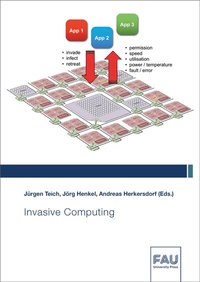
future parallel computing systems. For systems with 1,000 or more cores on a chip, resource-aware programming is of utmost importance to obtain high utilisation as well as computational, energy and power efficiency. Invasive computing provides a programmer explicit handles to specify and argue about resource requirements desired or required in different phases of execution: In an invade phase, an application asks the operating system to allocate a set of processor, memory and communication resources to be claimed. In a subsequent infect phase, the parallel workload is spread and executed on the obtained claim of resources. Finally, if the degree of parallelism should be lower again, a retreat operation frees the claim again, and the application resumes a sequential execution. To support this idea of self-adaptive and resource-aware programming, not only new programming concepts, languages, compilers, and operating systems were needed to be developed, but also revolutionary architectural changes in the design of MPSoCs (multiprocessor systems-on-a-chip) to efficiently support invasion, infection, and retreat operations. This book gives a comprehensive overview of all aspects of invasive computing.