

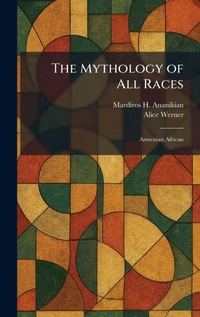
The Mythology of All Races
Description
"The Mythology of All Races: Armenian African" is a profound scholarly exploration into the rich tapestry of folklore and belief systems spanning two distinct and diverse cultural landscapes. This volume, divided into two comprehensive sections, offers an in-depth analysis of the myths, legends, and spiritual traditions of Armenia and the various regions of Africa.
In the first section, Mardiros H. Ananikian meticulously details the pre-Christian Armenian pantheon, examining the evolution of ancient deities, the lore of spirits and supernatural beings, and the enduring legacy of heroic legends. This study provides crucial insight into the religious and cultural history of the Armenian people. The second section, authored by Alice Werner, transitions to the vast African continent, documenting an extensive array of oral traditions, creation myths, and animal fables from numerous ethnic groups. Werner explores the central roles of ancestral spirits and the natural world within African cosmologies.
As part of a larger encyclopedic effort to document the myths of humanity, "The Mythology of All Races: Armenian African" remains a foundational text for students of anthropology, comparative religion, and cultural history. Its detailed accounts and cross-cultural perspective make it an essential resource for understanding the fundamental narratives that have shaped these societies.
This work has been selected by scholars as being culturally important, and is part of the knowledge base of civilization as we know it. This work was reproduced from the original artifact, and remains as true to the original work as possible. Therefore, you may see the original copyright references, library stamps (as most of these works have been housed in our most important libraries around the world), and other notations in the work.
This work is in the public domain in the United States of America, and possibly other nations. Within the United States, you may freely copy and distribute this work, as no entity (individual or corporate) has a copyright on the body of the work.
As a reproduction of a historical artifact, this work may contain missing or blurred pages, poor pictures, errant marks, etc. Scholars believe, and we concur, that this work is important enough to be preserved, reproduced, and made generally available to the public. We appreciate your support of the preservation process, and thank you for being an important part of keeping this knowledge alive and relevant.