

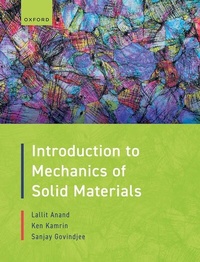
Introduction to Mechanics of Solid Materials
Published on 13. December 2022
Book
Hardback
592 pages
978-0-19-286607-3 (ISBN)
Description
Introduction to Mechanics of Solid Materials is concerned with the deformation, flow, and fracture of solid materials. This textbook offers a unified presentation of the major concepts in Solid Mechanics for junior/senior-level undergraduate students in the many branches of engineering - mechanical, materials, civil, and aeronautical engineering among others.
The book begins by covering the basics of kinematics and strain, and stress and equilibrium, followed by a coverage of the small deformation theories for different types of material response: (i) Elasticity; (ii) Plasticity and Creep; (iii) Fracture and Fatigue; and (iv) Viscoelasticity. The book has additional chapters covering the important material classes of: (v) Rubber Elasticity, and (vi) Continuous-fiber laminated composites. The text includes numerous examples to aid the student. A substantial companion volume with example problems is available free of charge on the book's companion website.
The book begins by covering the basics of kinematics and strain, and stress and equilibrium, followed by a coverage of the small deformation theories for different types of material response: (i) Elasticity; (ii) Plasticity and Creep; (iii) Fracture and Fatigue; and (iv) Viscoelasticity. The book has additional chapters covering the important material classes of: (v) Rubber Elasticity, and (vi) Continuous-fiber laminated composites. The text includes numerous examples to aid the student. A substantial companion volume with example problems is available free of charge on the book's companion website.
Reviews / Votes
The book is well-crafted and organized logically. It fills a void in need for a book that is lucid and accessible to undergraduates taking a course in advanced mechanics of materials. The material covered spans a whole range of topics relevant to modern applications of solid mechanics, including fracture and fatigue, rubber elasticity, viscoelasticity, plasticity, and fiber-reinforced composites. This is an excellent book authored by leading authorities in the field who have taught this course at their respective universities. The companion book on example problems is a welcome addition. * Ravi Ravichandran, Caltech * This book is of the highest technical quality and maintains clarity for understanding. It covers a wide range of relevant topics for the undergraduate student in mechanics of solid materials and with a well thought out level of depth per topic. A notable feature of this book is that the authors are able to summarize the main ideas in easy to digest modules that give the student a sense of the topic... This book does a great job at bringing a fresh set of ideas into the undergraduate curriculum and therefore will find a wide audience with upper level undergraduates all over the world. * Shawn A. Chester, New Jersey Institute of Technology * This book covers at the right level of detail most of the important topics in solid mechanics including fracture, fatigue, viscoelasticity, composites, rubbers, etc., that are important in modern applications. * Prashant K. Purohit, University of Pennsylvania * The text is written with the required rigor to address the topics therein, while ensuring that the mathematics and surrounding prose is appealing to the intended target audience. * Dr Brian Mercer, University of Illinois at Urbana-Champaign *More details
Language
English
Place of publication
Oxford
United Kingdom
Target group
College/higher education
Product notice
sewn/stitched
Cloth over boards
Illustrations
228 line drawings and colour halftones
Dimensions
Height: 254 mm
Width: 200 mm
Thickness: 32 mm
Weight
1407 gr
ISBN-13
978-0-19-286607-3 (9780192866073)
Copyright in bibliographic data and cover images is held by Nielsen Book Services Limited or by the publishers or by their respective licensors: all rights reserved.
Schweitzer Classification
Other editions
Additional editions
Lallit Anand | Ken Kamrin | Sanjay Govindjee
Introduction to Mechanics of Solid Materials
Book
12/2022
Oxford University Press
€71.80
Shipment within 15-20 days
Lallit Anand | Ken Kamrin | Sanjay Govindjee
Introduction to Mechanics of Solid Materials
E-Book
11/2022
1st Edition
OUP eBook
€45.99
Available for download
Persons
Lallit Anand joined the MIT faculty in 1982, where he is currently the Rohsenow Professor of Mechanical Engineering. The honors he has received include: ICES Eric Reissner Medal, 1992; ASME Fellow, 2003; Khan International Plasticity Medal, 2007; IIT Kharagpur Distinguished Alumnus Award, 2011; ASME Drucker Medal, 2014; MIT Den Hartog Distinguished Educator Award, 2017; Brown University Engineering Alumni Medal, 2018; and SES Prager Medal, 2018. He was elected to the U.S. National Academy of Engineering in 2018.
Ken Kamrin joined the Mechanical Engineering faculty at MIT in 2011, receiving the Class of 1956 Career Development Chair. Notable awards include the 2010 Nicholas Metropolis Award from the American Physical Society, the National Science Foundation CAREER Award, the Eshelby Mechanics Award for Young Faculty, the Ruth and Joel Spira Teaching Award from the MIT School of Engineering, and the ASME Journal of Applied Mechanics Award. Kamrin currently sits on the Board of Directors of the Society of Engineering Science.
Sanjay Govindjee currently is the Horace, Dorothy, and Katherine Johnson Endowed Professor in Engineering, University of California, Berkeley. He serves as a consultant to several governmental agencies and private corporations and is also a registered Professional Mechanical Engineer in the state of California. Noteworthy honors include a National Science Foundation Career Award, the inaugural 1998 Zienkiewicz Prize and Medal, an Alexander von Humboldt Foundation Fellowship 1999, a Berkeley Chancellor's Professorship 2006-2011, and a Humboldt-Forschungspreis (Humboldt Research Award) in 2018.
Ken Kamrin joined the Mechanical Engineering faculty at MIT in 2011, receiving the Class of 1956 Career Development Chair. Notable awards include the 2010 Nicholas Metropolis Award from the American Physical Society, the National Science Foundation CAREER Award, the Eshelby Mechanics Award for Young Faculty, the Ruth and Joel Spira Teaching Award from the MIT School of Engineering, and the ASME Journal of Applied Mechanics Award. Kamrin currently sits on the Board of Directors of the Society of Engineering Science.
Sanjay Govindjee currently is the Horace, Dorothy, and Katherine Johnson Endowed Professor in Engineering, University of California, Berkeley. He serves as a consultant to several governmental agencies and private corporations and is also a registered Professional Mechanical Engineer in the state of California. Noteworthy honors include a National Science Foundation Career Award, the inaugural 1998 Zienkiewicz Prize and Medal, an Alexander von Humboldt Foundation Fellowship 1999, a Berkeley Chancellor's Professorship 2006-2011, and a Humboldt-Forschungspreis (Humboldt Research Award) in 2018.
Author
Warren and Towneley Rohsenow Professor of Mechanical EngineeringWarren and Towneley Rohsenow Professor of Mechanical Engineering, Massachusetts Institute of Technology
Professor of Mechanical EngineeringProfessor of Mechanical Engineering, Massachusetts Institute of Technology
Horace, Dorothy, and Katherine Johnson Endowed Professor in EngineeringHorace, Dorothy, and Katherine Johnson Endowed Professor in Engineering, University of California, Berkeley
Content
1: Kinematics and strain 2: Stress and equilibrium 3: Balance laws of forces and moments for small deformations 4: Stress and strain are symmetric second-order tensors 5: Isotropic linear elasticity 6: Elastic deformation of thick-walled cylinders 7: Stress concentration 8: Wave propagation in isotropic elastic bodies 9: Limits to elastic response 10: One-dimensional plasticity 11: Physical basis of metal plasticity 12: Three-dimensional rate-independent plasticity 13: Three-dimensional rate-dependent plasticity 14: Introduction to fracture mechanics 15: Linear elastic fracture mechanics 16: Energy-based approach to fracture 17: Fatigue 18: Linear viscoelasticity 19: Linear viscoelasticity under oscillatory strain and stress 20: Temperature dependence of linear viscoelastic response 21: Three-dimensional linear viscoelasticity 22: Rubber elasticity 23: Continuous-fiber polymer-matrix composites Appendices A: Thin-walled pressure vessels B: Elastic bending of beams C: Elastic buckling of columns D: Torsion of circular elastic shafts E: Castigliano's theorems F: Elasticity in different coordinate systems G: Hardness of a material H: Stress intensity factors for some crack configurations I: MATLAB codes