

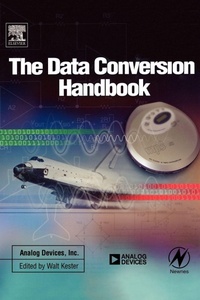
Data Conversion Handbook
Published on 18. December 2004
Book
Hardback
976 pages
978-0-7506-7841-4 (ISBN)
Description
This comprehensive handbook is a one-stop engineering reference. Covering data converter fundamentals, techniques, applications, and beginning with the basic theoretical elements necessary for a complete understanding of data converters, this reference covers all the latest advances in the field. This text describes in depth the theory behind and the practical design of data conversion circuits as well as describing the different architectures used in A/D and D/A converters. Details are provided on the design of high-speed ADCs, high accuracy DACs and ADCs, and sample-and-hold amplifiers. Also, this reference covers voltage sources and current reference, noise-shaping coding, and sigma-delta converters, and much more. The book's 900-plus pages are packed with design information and application circuits, including guidelines on selecting the most suitable converters for particular applications. You'll find the very latest information on:? Data converter fundamentals, such as key specifications, noise, sampling, and testing? Architectures and processes, including SAR, flash, pipelined, folding, and more? Practical hardware design techniques for mixed-signal systems, such as driving ADCs, buffering DAC outputs, sampling clocks, layout, interfacing, support circuits, and tools.? Data converter applications dealing with precision measurement, data acquisition, audio, display, DDS, software radio and many more. The accompanying CD-ROM provides software tools for testing and analyzing data converters as well as a searchable pdf version of the text.
Reviews / Votes
"Listed as noteworthy book by Bill Schweber from EDN Magazine" - EDN Feb 2005More details
Language
English
Place of publication
Oxford
United Kingdom
Publishing group
Elsevier Science & Technology
Target group
Professional and scholarly
Electronics design engineers and technicians working in a large array of application areas- medical, communications, embedded, military, aerospace/ aviation, automotive, construction, etc.;
Instrumentation engineers; test and control engineers
Electrical/software engineering students, inhouse training departments of electronics manufacturers
Product notice
Laminated cover
Illustrations
1, black & white illustrations
Dimensions
Height: 267 mm
Width: 187 mm
Thickness: 63 mm
Weight
1875 gr
ISBN-13
978-0-7506-7841-4 (9780750678414)
Copyright in bibliographic data and cover images is held by Nielsen Book Services Limited or by the publishers or by their respective licensors: all rights reserved.
Schweitzer Classification
Other editions
Additional editions
Analog Devices Inc Engineering Analog Devices Inc | Engineeri Analog Devices Inc | Analog Devices Inc Engineeri
Data Conversion Handbook
E-Book
05/2014
Newnes
€73.95
Available for download
Person
An S&P 500 company with annual revenues over $2 billion, headquartered in Norwood, MA, an industry leader in analog, digital, and mixed signal processing technology.
Content
1. Fundamentals of Sampled Data Systems Coding and Quantizing DAC/ADC Ideal Static Transfer Functions Sampling Theory Data Converter AC errors and specifications2. DAC Architectures and Origins Kelvin Divider String DACs R/2R DACs Segmented DACs Capacitor DACs Multiplying DACs Interpolating DACs Deglitching DAC outputs PWM DACs Sigma-Delta DACs Video DACs with lookup tables Digital potentiometers MicroDACs LogDACs3. ADC Architectures and origins Low speed High speed Sigma-Delta4. Data Converter Process Technology 5. Testing Data Converters6. Interfacing to ADCs and DACs7. Data Conversion Support Circuits Sample-and-hold circuits Voltage references Analog switches and multiplexers 8. Applications Precision measurement and sensor conditioning Data acquisition subsystems Multichannel systems and multiplexing Data distribution systems using multiple DACs Digital pot applications Display electronics Audio Video Software radio and IF sampling Higher levels of integration DDS9. Hardware Design Techniques for Mixed-Signal Systems Passive components Printed circuit board design issues Layout "Smart" Partitioning Grounding mixed signal devices Digital isolation techniques Filtering switching supply outputs Data converter overvoltage protection Thermal considerations EMI/RFI considerations Logic considerations Simulation and IBIS models Prototyping Evaluation BoardsAppendixIndex