

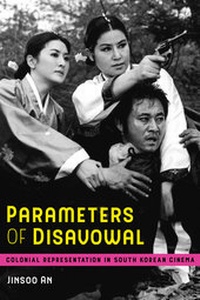
Parameters of Disavowal
Colonial Representation in South Korean Cinema
1st Edition
Published on 8. June 2018
Book
Paperback/Softback
204 pages
978-0-520-29530-8 (ISBN)
Description
At publication date, a free ebook version of this title will be available through Luminos, University of California Press's Open Access publishing program. Visit www.luminosoa.org to learn more. The colonial experience of the twentieth century (1910-1945) decidedly shaped the culture and identity of Korea, yet the precise manner as to how South Korean postcolonial cinema depicts this troubling past has not received sufficient scholarly attention. Parameters of Disavowal seeks to break this hiatus. It approaches the subject of the colonial past in South Korean cinema as a particular kind of postcolonial knowledge-production that responds to the repercussions of Cold War geopolitics while also subscribing to the precept of anticolonial nationalism. It also advances beyond manifest readings of anticolonial messages by examining how postcolonial cinema not only posits, but also constructs Korean national history through disavowals and elisions of the very past they wish to represent.
In particular, this book focuses on how South Korean films have created ways of seeing and imagining the colonial past by privileging certain Korean sites as spaces generating unique meanings and values contrary to the assumed total domination of the colonial power. These films thereby inscribe colonial power within parameters of disavowal, ultimately rendering it delimited, incomplete, and flawed. This unique cinematic mode of visualization, the author argues, has shaped historical thinking about Korea's colonial past and demands further investigation of the relationship between politics and aesthetics in cinema.
In particular, this book focuses on how South Korean films have created ways of seeing and imagining the colonial past by privileging certain Korean sites as spaces generating unique meanings and values contrary to the assumed total domination of the colonial power. These films thereby inscribe colonial power within parameters of disavowal, ultimately rendering it delimited, incomplete, and flawed. This unique cinematic mode of visualization, the author argues, has shaped historical thinking about Korea's colonial past and demands further investigation of the relationship between politics and aesthetics in cinema.
Reviews / Votes
"An's study is complex as he deals with people and culture at different times-colonial days, the days of producing the films, and contemporary audiences and critics. His painstaking work of sorting and collecting relevant films and analyzing such a huge data set indeed represents a tremendous effort and achievement. The memory of colonial days should not be forgotten; Koreans have to embrace, cherish, and be able to confidently live with this enduring han." * Cross-Currents *More details
Series
Edition
First Edition
Language
English
Place of publication
Berkerley
United States
Target group
Professional and scholarly
Product notice
Paperback (trade)
Illustrations
12 b-w
Dimensions
Height: 229 mm
Width: 152 mm
Thickness: 13 mm
Weight
318 gr
ISBN-13
978-0-520-29530-8 (9780520295308)
Copyright in bibliographic data and cover images is held by Nielsen Book Services Limited or by the publishers or by their respective licensors: all rights reserved.
Schweitzer Classification
Other editions
Additional editions
E-Book
06/2018
1st Edition
Naval Institute Press
€12.49
Available for download
Person
Jinsoo An is Assistant Professor of Korean Studies at Department of East Asian Languages and Cultures of University of California, Berkeley.
Content
List of Illustrations
Acknowledgments
Introduction
1. Under the Banner of Nationalism: The Changing Imagery of Anticolonial Leadership
2. Film and the Waesaek ("Japanese Color") Controversies of the 1960s
3. The Manchurian Action Film: A New Anticolonial Imaginary in the Cold War Context
4. In the Colonial Zone of Contact: Kisaeng and Gangster Films
5. Horror and Revenge: Return of the Repressed Colonial Violence
Coda: After 2000
Notes
Bibliography
Index
Acknowledgments
Introduction
1. Under the Banner of Nationalism: The Changing Imagery of Anticolonial Leadership
2. Film and the Waesaek ("Japanese Color") Controversies of the 1960s
3. The Manchurian Action Film: A New Anticolonial Imaginary in the Cold War Context
4. In the Colonial Zone of Contact: Kisaeng and Gangster Films
5. Horror and Revenge: Return of the Repressed Colonial Violence
Coda: After 2000
Notes
Bibliography
Index