

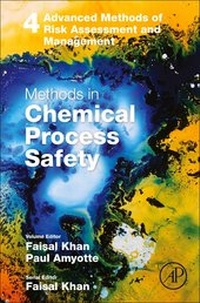
Methods in Chemical Process Safety: Volume 4
Published on 26. June 2020
Book
Hardback
454 pages
978-0-12-821824-2 (ISBN)
Description
Methods in Chemical Process Safety, Volume Four focuses on the process of learning from experience, including elements of process safety management, human factors in the chemical process industries, and the regulation of chemical process safety, including current approaches. Users will find this book to be an informative tool and user manual for process safety for a variety of professionals with this new release focusing on Advanced Methods of Risk Assessment and Management, Logic Based Methods for Dynamic Risk Assessment, Bayesian Methods for Dynamic Risk Assessment, Data Driven Methods, Rare Event Risk Assessment, Risk Management and Multi Criteria, and much more.
More details
Series
Language
English
Place of publication
San Diego
United States
Publishing group
Elsevier Science Publishing Co Inc
Target group
Professional and scholarly
The audience of this series is engineering practitioners as well researchers
Dimensions
Height: 229 mm
Width: 152 mm
Weight
840 gr
ISBN-13
978-0-12-821824-2 (9780128218242)
Copyright in bibliographic data and cover images is held by Nielsen Book Services Limited or by the publishers or by their respective licensors: all rights reserved.
Schweitzer Classification
Other editions
Additional editions
Persons
Paul Amyotte is a Distinguished Research Professor and Professor of Chemical Engineering at Dalhousie University (Halifax, Canada). He is a chemical engineering graduate of the Royal Military College of Canada (Bachelor's), Queen's University (Master's), the Technical University of Nova Scotia (PhD) and a registered professional engineer in Nova Scotia. Dr. Amyotte is a member and past president of Canadian Society of Chemical Engineering, a member of American Institute of Chemical Engineers, a Fellow of Chemical Institute of Canada, the Engineering Institute of Canada, Canadian Academy of Engineering, Engineers Canada, and the Canadian Academy of Engineering. Dr. Amyotte has an extensive record of authorship, with six books, several book chapters, and over 350 papers published in peer-reviewed journals or presented at national and international conferences. He has presented invited plenary lectures at symposia in Canada, France, Italy, Malaysia, Netherlands, Norway, Poland, Qatar, Taiwan, and the United States. He is the current editor of the Journal of Loss Prevention in the Process Industries, and a past president of the Canadian Society for Chemical Engineering, Engineers Nova Scotia, and Engineers Canada. He has also served as chair of the Canadian Engineering Qualifications Board, member of the Canadian Engineering Accreditation Board, and co-chair of the Materials and Chemical Engineering Evaluation Group of the Natural Sciences and Engineering Research Council of Canada. Dr. Amyotte has consulted on numerous industrial projects involving hazard analysis, incident investigation, and material explosibility. Dr. Amyotte is a recipient of distinct awards including Cybulski Medal from the Polish Academy of Sciences, the Trevor Kletz Merit Award from the Mary Kay O'Connor Process Safety Center, and the Process Safety Management Award from the Canadian Society for Chemical Engineering. Faisal I. Khan is a Chemical Engineering Professor and Director of the Mary Kay O'Connor Process Safety Center and the Ocean Energy Safety Institute (OESI), Texas A&M University. He is the founder of the Centre for Risk Integrity and Safety Engineering (C-RISE), a Fellow of the Canadian Academy of Engineering, the Engineering Institute of Canada, and the Canadian Society of Chemical Engineering. His areas of research interest include offshore safety and risk engineering, inherent safety, risk management, and risk-based integrity assessment and management. Dr. Khan is actively involved with multinational oil and gas industries in addressing safety and asset integrity issues. He also served as the Safety and Risk Advisor to the Government of Newfoundland and Labrador, Canada. He continues to serve as a subject matter expert to many organizations, including Lloyd's Register EMEA, SBM Modco, Intecsea, Technip, and Qatar Gas. He served as a Visiting Professor of Offshore and Marine Engineering at the Australian Maritime College (AMC), University of Tasmania, Australia, where he led the development of the offshore safety and risk engineering group and initiated global engagements with numerous international institutions.
Dr. Khan is the recipient of the President's Outstanding Research Award of 2012-13 at Memorial University, the President's Outstanding Research Supervision Award of 2013-14 at Memorial University, the CSChE National Award on Process Safety Management of 2014, and the Society of Petroleum Engineers award for his contribution to Health, Safety, and Risk Engineering. He has authored over 500 research articles in peer-reviewed journals and conferences on safety, risk, and reliability engineering. He has authored five books on the subject area. He is the Editor of the Journal of Process Safety and Environmental Protection, Safety in Extreme Environment, and ASME Part A (Risk and Uncertainty Analysis). He regularly offers training programs/workshops on safety and risk engineering in various locations, including St. John's, Chennai, Dubai, Beijing, Aberdeen, Cape Town, Doha, and Kuala Lumpur.
Dr. Khan is the recipient of the President's Outstanding Research Award of 2012-13 at Memorial University, the President's Outstanding Research Supervision Award of 2013-14 at Memorial University, the CSChE National Award on Process Safety Management of 2014, and the Society of Petroleum Engineers award for his contribution to Health, Safety, and Risk Engineering. He has authored over 500 research articles in peer-reviewed journals and conferences on safety, risk, and reliability engineering. He has authored five books on the subject area. He is the Editor of the Journal of Process Safety and Environmental Protection, Safety in Extreme Environment, and ASME Part A (Risk and Uncertainty Analysis). He regularly offers training programs/workshops on safety and risk engineering in various locations, including St. John's, Chennai, Dubai, Beijing, Aberdeen, Cape Town, Doha, and Kuala Lumpur.
Content
1. Advanced Methods of Risk Assessment and Management - An Overview
Faisal Khan and Paul Amyotte
2. Dynamic Risk - Fundamentals
Nicola Paltrinieri
3. Logic Based Methods for Dynamic Risk Assessment
Hans Pasman
4. Bayesian Methods for Dynamic Risk Assessment
Nima Khakzad
5. Data Driven Methods
Jinsong Zhao
6. Rare Event Risk Assessment
Terje Aven
7. Risk Management - Multi Criteria
Rehan Sadiq
8. Human Factors Risk Assessment
Norafneeza Binti Norazahar
9. Acceptable Risk - Regulatory Aspects
Howard Pike
10. Advanced Methods for Environmental Risk Management
Rouzbeh Abbassi
11. Methods for Process Economic Risk Management
Genserik Reniers
12. Methods for Domino Effect Risk Assessment
Valerio Cozzani
13. Inherently Safer Design Principles in Risk Management
Paul Amyotte
Faisal Khan and Paul Amyotte
2. Dynamic Risk - Fundamentals
Nicola Paltrinieri
3. Logic Based Methods for Dynamic Risk Assessment
Hans Pasman
4. Bayesian Methods for Dynamic Risk Assessment
Nima Khakzad
5. Data Driven Methods
Jinsong Zhao
6. Rare Event Risk Assessment
Terje Aven
7. Risk Management - Multi Criteria
Rehan Sadiq
8. Human Factors Risk Assessment
Norafneeza Binti Norazahar
9. Acceptable Risk - Regulatory Aspects
Howard Pike
10. Advanced Methods for Environmental Risk Management
Rouzbeh Abbassi
11. Methods for Process Economic Risk Management
Genserik Reniers
12. Methods for Domino Effect Risk Assessment
Valerio Cozzani
13. Inherently Safer Design Principles in Risk Management
Paul Amyotte